
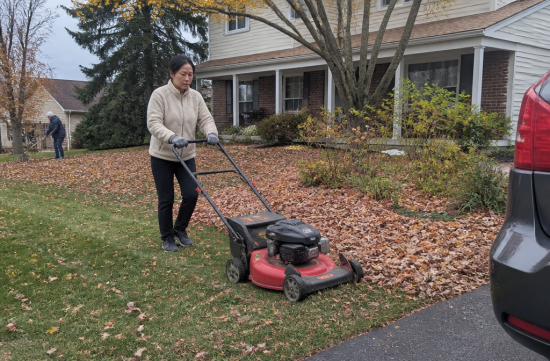
Last weekend, I looked out at my front yard and saw that leaves were already covering the ground. The fall colors are beautiful, but I sighed at the thought of how to clean them all up.
Last year, I ended up calling a service. They cleaned it up in half a day, but I was a bit shocked when I saw the invoice. It was quite hefty for just a few piles of leaves.
Curious, I looked it up and found that according to Angi's 2026 data, the average cost for leaf removal is $379. Most people pay between $191 and $592.
HomeAdvisor's data is almost the same. The average is $377, with a range of about $190 to $591.
There can also be additional fees for bag disposal. Angi suggests a disposal fee of about $5 to $10 per bag.
But leaves don't just fall once during the fall. If they fall two or three times, that can easily add up to several hundred dollars. Honestly, that's a lot to spend just for the fall season.
So this year, I changed my approach. Instead of raking and disposing of the leaves, I'm using my lawn mower to chop them up and leave them on the grass. This is called leaf mulching.
It's great because it eliminates most of the raking and bagging.
At first, I was skeptical too. I had heard that leaving leaves on the grass would suffocate it.
That's true. If thick layers of leaves cover the grass, sunlight can be blocked, which can damage the grass.
The key is to chop them "finely." Pieces of leaves broken down to the size of a coin can fall between the grass blades and decompose on the soil.
This has been confirmed by university research. A team from Michigan State University observed lawns where leaves were mulched for years and found that the grass was unharmed.
In fact, there were benefits. The title of a related research paper is "Mulched Maple and Oak Leaves are Associated with Reduced Dandelion Presence."
The principle is simple. Finely chopped leaves cover the gaps between the grass, reducing the space for weed seeds to germinate.
According to MSU data, you can mulch leaves piled up to 6 inches deep in one go. Of course, it depends on the performance of your lawn mower, so don't push it.
Virginia Tech Extension provides a more realistic guideline. If about half of the grass is visible after mulching, that's okay; if less is visible, they suggest raking up the excess leaves for composting.
Now let's talk about fertilizer. This is actually the part I was most excited about.
According to research from Penn State Extension, grass clippings from Kentucky bluegrass contained 46-59% of the nitrogen provided by fertilizer. This was measured over three years.
So, by not throwing away the clippings and returning them to the lawn, you're essentially reusing the fertilizer you paid for. This means you can reduce the number of times you need to fertilize, according to Penn State.
Leaves don't have as much nitrogen as clippings. However, they do add organic matter to the soil, which helps improve soil structure.
MSU researchers also observed that after a few years, the grass turned green in the spring with less fertilizer. It's hard to quantify exactly how many dollars you save, but the trend is clear. At the very least, it's worth reconsidering that spring fertilizer application.
You don't need fancy equipment. A lawn mower with a mulching blade is ideal, but a regular mower can work too if you block the discharge and make a few passes. Changing directions while mowing helps break the leaves up more evenly.
It's much easier to mulch on dry days. Wet leaves after a rain tend to clump together and remain in piles.
If you still have leftover leaves, send them to your flower beds. Spreading the mulched leaves under trees or in flower beds will act as mulch, covering the soil during winter.
This is a way to use what you have instead of buying bagged mulch from the garden center, which can save you some money. It also reduces the need to buy mulch when tidying up the flower beds in spring.
However, if you have a certain amount you need to dispose of, check your local collection rules first. In our borough, they only take biodegradable paper leaf bags and do not accept plastic bags at all.
Collection weeks are also set by area, so checking the schedule posted on the borough website each year is the most accurate way to know.
I believe this method is not just about saving money. It seems wasteful to have a truck come and take the leaves away, only to spread chemical fertilizers back in their place.
We're returning what the trees have given us back to the earth. It's a win-win for both my wallet and the local environment.
This fall, consider using your lawn mower instead of a rake. I would definitely try this method at least once before calling a service.
 Chase60Plates




 kuku 100 |
 novent |
 Silent Sea |
 Pointy |
 Idaho's Sumi's House |
  Then you must be spring |
 Pleasant K |
 ansdal |
 Northeastern |
 refresh |
  American Blog Forge |
  MMORPG Games |
  Spicy Immigration Life |
  zenvor16 |
  The 2000 |
  toclick |
  wexlin84 |
  Hairy Poppins |
  daisypat |
  Taco Bell Candy Note Blog |
  MintO |
  My Town My Way Blog |
  New Mexico Friends MAX |
  Hajiwon Blog Hair Salon |
  Wicked - Fireyo |
  Seattle - Emerald City |
  new noah |
  xylora |
  Anjollinya Blog |