
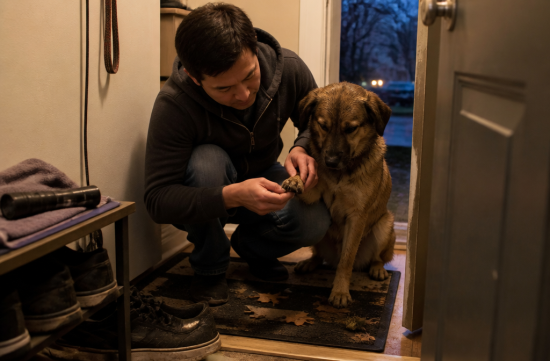
After our evening walk yesterday, I sat on the couch and noticed my dog licking one of his front paws for quite a while. At first, I thought it was just grooming.
But when he didn't stop after 10 minutes, I flipped his paw over. I found a needle-like seed half stuck in the fur between his toes.
Honestly, it gave me chills. From the outside, his paw looked fine, but it was in a spot that could only be seen by parting the fur.
So today, I want to explain why it's essential to check between your dog's toes after a fall walk. It may seem trivial, but once you know, you can't ignore it.
The first culprit is a seed called foxtail. It's a seed that falls from a grass-like plant, and it has a sharp end with tiny barbs pointing in one direction.
This structure means that once it gets stuck, it only burrows in further. It's a very stubborn little thing that doesn't back out.
According to veterinary sources, one of the most common places for foxtails to get stuck is right between the thin skin of the webbing between the toes. If it continues to burrow under the skin, it can cause swelling and painful lumps.
Foxtails are typically seen from late spring through summer and into early fall. During this time, areas with dry grass or the edges of walking paths are essentially seed dispensers.
The second concern is ticks. Many people think that ticks are done in the fall, but it's quite the opposite.
Research from New Jersey indicates that adult blacklegged ticks, also known as deer ticks, have their peak activity in October and November. As the weather cools, they actually become more active.
Moreover, on warm winter days that don't drop below freezing, adults can still be active. In New Jersey, there's even a saying that there's no month without tick worries.
The CDC specifically highlights checking between the toes as a key area for pet tick checks. They also recommend checking under the collar, around the ears, near the tail, between the back legs, under the front legs, and around the eyelids.
Additionally, they advise checking daily after being outside. The method is to gently press the fur with your fingers to feel for any small bumps.
For reference, ticks don't just bite dogs. Ticks that attach to your dog can come into your home and move to your couch or bed, so developing a habit of checking at the entrance is beneficial for humans too.
The third concern is what's hidden under fallen leaves. Autumn walking paths are often covered with wet leaves, making it hard for people to know what's underneath.
Pieces of acorn shells, clusters of spiky seeds, and broken glass can easily hide under leaves and get stuck between your dog's pads or toes. Debris stuck in wet fur is much harder to shake off than in dry fur.
So what happens if you leave it? Irritation from foreign objects can lead to inflammatory lumps between the toes, known as interdigital cysts.
According to VCA Animal Hospitals, these lumps can be painful, cause limping, and lead to excessive licking or chewing. Licking causes more irritation, which leads to a vicious cycle of licking.
So, the signals I look for are three things: whether he's obsessively licking one paw, if he's limping slightly while walking, and if there's swelling or discharge between his toes.
Checking is not difficult. As soon as I come in the door, I lift each paw, gently spread the toes, and run my fingertips through the fur.
If I have a set order, I won't miss anything. Left front paw, right front paw, left back paw, right back paw, and finally checking under the collar.
If you have a long-haired breed, keeping the fur on the pads trimmed short makes it much easier. It reduces the places for debris to hide.
On wet days, it's good to rinse with lukewarm water and thoroughly dry between the toes. Leaving them damp can easily lead to skin irritation.
If you see a seed, carefully remove it only if it's just resting on the surface. If it's already embedded in the skin or the end isn't visible, it's best not to force it out and to visit the vet instead.
The same goes for ticks. If you try to twist and pull them out with your bare hands, you might leave the head behind, so if it's your first time, I recommend asking your vet how to remove them properly.
And I want to emphasize this: the choice of tick prevention and assessments of your dog's condition can vary based on age, weight, and health status, so be sure to consult with your veterinarian.
Since this incident, I've hung a towel and a small flashlight by the entrance. A friend who came over joked that it looked like an airport security checkpoint.
But this checkpoint only takes about 30 seconds. After a few times, my dog learned to present his paws.
Autumn walks are truly a wonderful seasonal bonus. Just remember that small hitchhikers can tag along with that bonus.
If it were me, I would check between my dog's toes just once after tonight's walk. If nothing is there, that's great, and if something does come out, that 30 seconds could save on vet bills.
 BurgerMan



 sun walker |
 Let's Be Like a Salt-like City Person |
 Springs Korea |
 US Legal Consultation on Trials |
 Study Abroad Life Know-How Tips |
 Jersey City |
 quiet river |
 Living in New Jersey blog |
 coffeee |
 Hajiwon Blog Hair Salon |
  hoosierdaddy |
  saffronroute |
  korvex93 |
  Mini Mee |
  Darnignac |
  vanilla |
  selvon |
  brownie |
  Star Blog |
  The Day the Sun Rises |
  sweetpop |
  California Kangaroo |
  zanero |
  station |
  Static |
  Star Way |
  American Blog Forge |
  MMORPG Games |
  Then you must be spring |