
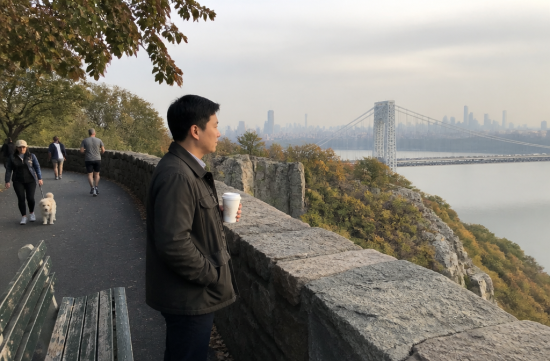
On Monday morning, traffic was at a standstill on the George Washington Bridge entrance ramp. I found myself staring blankly at the brake lights of the car in front of me when I suddenly thought about how this neighborhood was originally the capital of American cinema. I wondered how many of the commuters knew that.
To be honest, I didn't know until recently. When I thought of Fort Lee, I only pictured Korean markets, tofu houses, and the commute to Manhattan across the bridge.
But upon researching, I found that Fort Lee came before Hollywood. And there are quite solid records to back that up.
It all started in 1907. The Thomas Edison Company filmed a movie at the Palisades Cliffs, titled "Rescued from an Eagle's Nest."
The story involves an eagle stealing a baby and the father rescuing it. The lead actor in this film later became a renowned director, D.W. Griffith.
That same year, the Kalem Company also began using Fort Lee as a filming location, and other production companies quickly followed suit. The reason was surprisingly practical.
It was just a ferry ride from Manhattan, but the land was much cheaper than in New York. With cliffs, forests, rivers, and country roads, it was also a fitting backdrop for westerns.
The first permanent studio was built by the Champion Film Company in Coitsville, north of Fort Lee. It's interesting that they deliberately chose a remote location.
At the time, the patent trust led by Edison was pressuring independent production companies with patents on film equipment. They filmed in hiding to avoid the detectives from that trust.
It's like going off-site to avoid the corporate audit team nowadays. As an employee, I found that oddly relatable.
The person who bought this Champion Studio was Carl Laemmle. In 1909, he filmed "Hiawatha" in Fort Lee and returned in 1912 to acquire the studio, which became Universal's first home.
After that, it was almost a rush. In 1914, Fox set up shop, and in 1916, Goldwyn and Selznick established themselves in Fort Lee. Names like Metro, World, and Pathé also appear in Fort Lee's filming records during this period.
By 1918, there were as many as 11 studios producing silent films in this small town. Considering the size of downtown now, that's honestly a surprising number.
My favorite story is about the origin of the term "cliffhanger." In the 1914 serial film "The Perils of Pauline," Pearl White often hung from the edge of the Palisades Cliffs.
Originally planned as 13 episodes, it was extended to 20 due to its popularity. The technique of leaving viewers eager for the next episode originated from our town's cliffs.
So why did everyone leave? Several factors coincided.
California had cheap land and sunny weather year-round. In an era of weak lighting, the sun was essentially the equipment, making a big difference.
Additionally, a coal shortage during World War I and an unprecedented cold snap forced studios to cut back on filming. The 1918 flu pandemic is recorded as the final blow.
Meanwhile, in Hollywood, on October 10, 1911, the Nestor Company rented an old tavern building at the corner of Sunset and Gower to open the first studio. Interestingly, the Housley brothers who founded this company were originally filmmakers from Bayonne, New Jersey.
Many of those who helped shape early Hollywood had learned their craft near the Hudson River. I feel like I want to argue that they didn't leave their hometown; they just moved.
What's disappointing is that there are almost no traces of that history left in Fort Lee today. Most of the studio buildings have disappeared, replaced by apartments and commercial spaces.
However, in October 2022, the borough opened the Barrymore Film Center, named after Drew Barrymore's grandfather. It operates as both a cinema and a film museum.
Construction began in 2018 and took four years to complete, making it quite a significant project for the community.
The screening programs are more diverse than expected. Regular film festivals like the Italian Film Festival and the Alice Guy Blaché Women's Film Festival are held.
Alice Guy Blaché was a female director who established the Solax studio in Fort Lee. Knowing her name made me see the town a little differently.
On my way home, I once turned my car toward the Palisades and looked down at the cliffs. I thought about how someone a hundred years ago must have hung there by a thread to capture the audience for the next week.
I find myself hanging on the edge of quitting every Monday. At least Pearl White got paid for her performances.
So I've decided on one thing. This weekend, I plan to watch a movie at the Barrymore Film Center and grab a vanilla latte while walking through the park by the cliffs on my way out.
I admit Hollywood is glamorous. But knowing that the first chapter of that story was written right next to this bridge, which is always congested, makes my daily commute feel just a little less frustrating.
 ToastSkiJump

 Anjollinya Blog |
 Anova US Beauty Information |
 anchor |
 Korea Tiger News |
 Alpha and Omega World |
 La Bean |
 sweetvan |
 The Yellow |

 Darnignac |
  vanilla |
  selvon |
  brownie |
  Star Blog |
  The Day the Sun Rises |
  sweetpop |
  California Kangaroo |
  zanero |
  station |
  Static |
  Star Way |
  American Blog Forge |
  MMORPG Games |
  Then you must be spring |
  Spicy Immigration Life |
  zenvor16 |
  The 2000 |
  toclick |
  wexlin84 |