
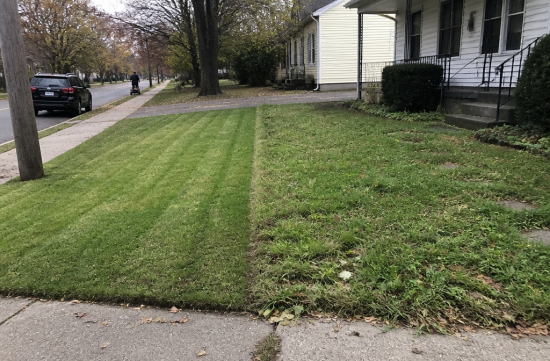
When I had just moved in, the neighbor lent me a lawnmower and said, "Here, the front yard is your business card."
At the time, I thought it was just a joke.
But after a few months, I understood. Just driving slowly through the neighborhood gives you a rough idea of the property values.
The secret lies not in the color of the grass but in the edges. Some homes have a line where the sidewalk meets the grass that looks like it was cut with a knife.
Creating that line takes equipment and time. Or it costs money to hire someone to do it for you.
I was curious why it was specifically about grass, so I did some research.
It all started in 1868 in Riverside, Illinois. It was the first planned suburban community in the U.S., designed by Frederick Law Olmsted and Calvert Vaux, the creators of Central Park.
Here, homes had to be set back at least 30 feet from the street, fences were prohibited, and trees had to be planted in the front yard.
I paused at the part about not allowing fences. It means that even though it's private property, the view is meant to be shared.
So, the front yard has been a stage from the moment it was born. It's my land, but it's the only area judged by others.
The scale is larger than you might think. In 2005, NASA researcher Christina Milici estimated that the area of grass in the U.S. was about 128,000 square kilometers.
In terms of irrigated area, grass is the largest crop in America. It uses three times the water of cornfields.
It's amusing to see that the number one crop is grass, which is neither eaten nor sold.
The key to its function as a class signal is ultimately time. If grass is not maintained, it shows within two weeks.
If you often work late or have a side job on weekends, you can't keep up with that two-week timeline. Then, the yard speaks first.
Research supports this as well. A 2019 study published in PLOS ONE surveyed over 7,000 households in six major U.S. metropolitan areas by phone.
Households with higher incomes were found to be 16 to 23 percent more likely to maintain their lawns.
What's even more interesting is the neighbor aspect. The more neighbors you know by name, the 9 percent more likely you are to water and fertilize your lawn.
This suggests that not just money, but social awareness is nurturing the grass.
In many places, this awareness has become a norm. According to a 2025 report from the Community Association Research Foundation, there are 373,000 homeowners' associations in the U.S., with a resident population of 78.1 million.
This accounts for 35.2 percent of the total housing stock. Preferences become regulations, and regulations become fines.
To be honest, I find this aspect a bit uncomfortable. The burden of aesthetic standards often falls first on the homes with the least time.
Of course, many believe that common standards help maintain property values, and that calculation isn't wrong.
However, the meaning of grass is already diverging by region. In Nevada, a law passed in 2021 prohibits the use of Colorado River water for decorative grass starting in 2027.
While this does not apply to front and back yards of single-family homes, in water-scarce areas, having a large green lawn is slowly becoming less of a bragging point.
The situation is different in the rain-rich Northeast. Here, grass is still more like a test of diligence than a water issue.
I see my yard not as flat land but as a forest. A layer of tall trees, a layer of shrubs, and a layer of clover and moss on the ground.
By stacking layers like that, the area to mow decreases, and instead, bees and birds come in.
Perfectly uniform grass feels to me like factory-sliced cheese. It has no flaws but also no stories.
The cheese I like has a bumpy rind and holes of various sizes. I prefer my yard to be like that too.
Ultimately, dogs don't care about the edges at all. They dive into the clover-mixed areas and ponder for a while.
On their grading scale, there are countless types of smells. I think that standard is quite reasonable.
I'm not saying we should tear out all the grass. A lawn where kids run and dogs roll is definitely useful.
However, I wonder if we can start to put aside the habit of reading a person's character based on their half-mowed front yard.


 lavender |
 logger |
 Conflite Teacher |
 Unknown Dog Walk blog |
 Khan Film Blog Production |
 US Regional Information Blog |
 DO Main TODAY |
 cookiefox |

 mapsina |
  Softy |
  cheesepup |
  Mr. Largo |
  breezem |
  Omelet Rice for Strength |
  Vermont Capt |
  waltz |
  Shoot Me |
  Michigan Enthusiast |
  festive |
  Supplemental Security Income (SSI) Information |
  Sams Market |
  ansdal |
  VVV 80 |
  BIODOCTOR NEWS |
  Gold Bar |
  Tamfa Fan |
  Jenny's Mom blog |
  Karina's Blog |