
On a chilly autumn night, I looked up for a long time at the moon peeking through the clouds. There's a place that always comes to mind around this time of year.
It's the Antietam National Battlefield in Sharpsburg, just a short drive away. During the day, it looks like a peaceful cornfield and hills, but once you know the story of that day, the landscape appears completely different.
On September 17, 1862, the Battle of Antietam took place here during the Civil War. It is recorded as the day with the most bloodshed in a single day in American military history.
According to the National Park Service (NPS), over 22,000 soldiers from both the Union and Confederate armies were killed, wounded, or missing that day. When I first saw that number, I was speechless for a while.
So many people fell in the fields and woods around the creek between sunrise and sunset. It felt less like a battle and more like an entire city had vanished.
To provide some background, General Robert E. Lee led the Confederate Army of Northern Virginia as they pushed into northern territory in Maryland for the first time.
To stop them, General George McClellan's Union Army of the Potomac confronted them near Antietam Creek. The battle moved from the north to the center to the south throughout the day, from dawn until dusk.
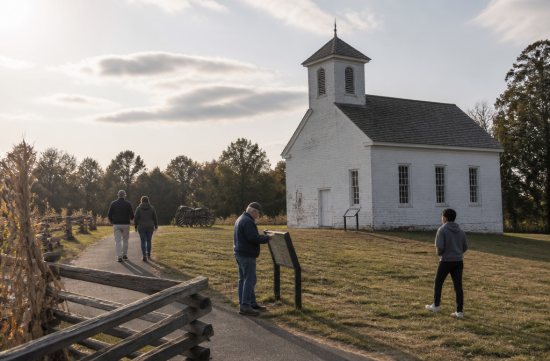
The morning fight took place in the cornfields of Miller's Farm, West Woods, and in front of the small white Dunker Church. It's said that the ownership of the cornfield changed hands several times over the course of a few hours.
At midday, fierce fighting erupted in the low sunken road in the center. As bodies piled up on both sides for hours, this road became known as Bloody Lane.
In the afternoon, at the southern end of the stone bridge, General Ambrose Burnside's troops struggled to cross. It's now called Burnside Bridge, and in photos, it looks like a small, pretty bridge, which makes it even more chilling.
From a tactical standpoint, the battle did not yield a clear victory. Nevertheless, General Lee eventually retreated back to Virginia, and the Confederate invasion of the North was halted there.
This outcome took on greater significance five days later. President Lincoln announced the preliminary Emancipation Proclamation on September 22, 1862.
Lincoln was concerned that announcing it immediately after a defeat would make it seem like a desperate move by a cornered government, so he waited until the Union had achieved some success. Antietam became that turning point.
I believe it marked a moment when the nature of the war changed. The focus shifted from merely preserving the Union to ending slavery.
Meanwhile, General McClellan faced criticism for not pursuing the retreating Confederates aggressively. Ultimately, Lincoln removed him from command in November of that year.
One story from this battle that has stayed with me is that of Clara Barton.
Barton arrived with several wagons of medical supplies from Washington around noon on the day of the battle, reaching the northern part of the battlefield. NPS records indicate that the army surgeons were wrapping wounds with corn husks due to a lack of bandages.
She delivered supplies and helped carry water and food to the wounded, supporting their heads. A surgeon who witnessed her efforts called her the "Angel of the Battlefield."
Almost twenty years later, in 1881, Barton founded the American Red Cross. It's oddly comforting to think that such a seed was planted in the midst of that bloody day.
The story of photography cannot be overlooked either. Alexander Gardner and his assistant James Gibson arrived two days after the battle, on September 19, to take photographs.
Those photos were exhibited in October of that year at Matthew Brady's gallery on Broadway in New York. They are considered the first images of dead bodies on the battlefield to be shown to the public.
People from New York, who had only encountered the war through newspaper articles, flocked to the gallery to see the photographs. It was the first time they saw that the war was not just tales of heroes from a distant land.
When you visit the battlefield today, it's so quiet that it almost feels deafening. The only sounds are the rustling of corn leaves in the wind and the distant chirping of birds.
As an immigrant, I often viewed American history as a story from another country. But walking on this land makes that distance quickly disappear.
Rather than taking sides between North and South, the countless nameless young men who fell that day resonate more deeply. You can truly feel the cost of what it took for this country to become what it is today.
If you plan to visit, I recommend starting at the visitor center to get an overview, then following the order of the battle from the cornfield to Bloody Lane and Burnside Bridge. It makes understanding the events much easier.
If it were me, I would choose the time just before sunset. Seeing the white walls of Dunker Church in the low light stays with me for a long time.
The sky I looked up at tonight, peeking through the clouds, must have been spread out over the battlefield that night as well. Thinking of that makes me quietly bow my head.
 Poppin


 Anjollinya Blog |
 Anova US Beauty Information |
 anchor |
 Korea Tiger News |
 Alpha and Omega World |
 romeo JU |
 maryland park |
 Annapolis NSA |
 mygoddess blog |
  The Day the Sun Rises |
  sweetpop |
  California Kangaroo |
  zanero |
  station |
  Static |
  Star Way |
  American Blog Forge |
  MMORPG Games |
  Then you must be spring |
  Spicy Immigration Life |
  zenvor16 |
  The 2000 |
  toclick |
  wexlin84 |
  Hairy Poppins |
  daisypat |
  Taco Bell Candy Note Blog |
  MintO |
  My Town My Way Blog |