
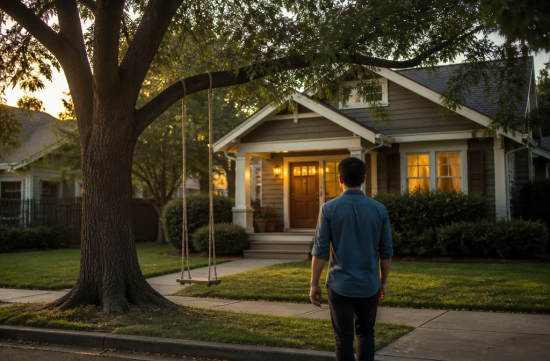
One weekend, I went to check out a neighborhood open house and witnessed an interesting scene.
A Korean family looking at the house was meticulously considering room sizes, school districts, and resale values, while right next to them, an American elderly couple stood for a long time admiring a single tree in the backyard.
"If we hang a swing here, the grandkids will love it," was all they said.
It was fascinating to see that even while looking at the same property, the two groups were communicating in completely different languages.
Living in America for a long time, I often notice this temperature difference.
While many people do see their homes as a means of asset appreciation, there are those who particularly emphasize the word "home."
For them, fluctuations in home prices are merely secondary news.
What truly matters is the doorframe where their child marked their height and the string of lights under the eaves that they light up every Christmas.
I've seen neighbors shake their heads at the suggestion of moving, saying it's because they raised their kids here, which might be frustrating from a real estate agent's perspective, but is a perfectly rational choice for them.
A grandfather I met at a neighborhood block party mentioned that he has lived in the same house for forty years, acknowledging that selling it would yield a large sum, but asking where he would move with that money.
That question lingered in my mind for a long time.
Thinking back, I was one of those who checked school districts and resale values when I first moved to this neighborhood.
However, after living here for a few years, I found myself noticing how much the trees I planted in the yard had grown instead of calculating numbers.
I've pondered why such differences arise.
One reason seems to relate to the history of migration.
For immigrants, a home is proof of having settled in this land and a stepping stone for the next generation.
Thus, it makes sense that they calculate in numbers, considering how much values have risen and when it would be advantageous to sell.
On the other hand, for those who have deep roots in a community for generations, a home is already a proven entity, so there's no need to verify it with numbers again.
Another reason could be practical matters like taxes or inheritance structures.
Seeing neighbors who endure increasing property tax burdens yet remain in the same neighborhood makes me think that for them, a home is not an asset to sell for profit, but rather a story they have paid off over a lifetime.
I have no intention of taking a political side, but it seems that everyone can subtly relate to this aspect regardless of their inclinations.
Once home prices are viewed solely as numbers in a portfolio, the affection for the neighborhood and neighbors may also fade.
Conversely, neighbors who see their homes as a place to stay long-term tend to greet each other over the fence and come out to clear the snow from the sidewalk when it snows.
Because they think of it as a place to stay rather than an investment, they naturally care for those who keep that space.
Even within the Korean community, a similar trend is emerging these days.
As the next generation takes over, families are increasingly asking where they want to continue living rather than focusing on buying and selling homes.
The emphasis is shifting from immediate resale considerations to how many holidays they will spend here.
Of course, I also feel happy when I receive the annual property assessment that comes in the mail.
However, I increasingly realize that the sounds of children playing in the yard and a friendly greeting from the neighbor make this neighborhood feel like my true home, more than any number.
Sometimes, I suddenly think that I want to become an adult who maintains this kind of presence in my neighborhood.
Ultimately, whether one views their home as an asset or a home is not a question with a right answer; it reflects where each person chooses to root their life.
Today, with a refreshed mind, I think I'll take a walk around my neighborhood.


 lavender |
 logger |
 Conflite Teacher |
 Unknown Dog Walk blog |
 Khan Film Blog Production |
 eatontown blog |
 silverleaf |


 Mr. Largo |
  breezem |
  Omelet Rice for Strength |
  Vermont Capt |
  Softy |
  solid90 |
  waltz |
  Ohio Ohayoung Hello |
  parlon |
  Shoot Me |
  Michigan Enthusiast |
  festive |
  You Turn Me On |
  Supplemental Security Income (SSI) Information |
  Sams Market |
  ansdal |
  VVV 80 |
  BIODOCTOR NEWS |
  Gold Bar |
  Tamfa Fan |