
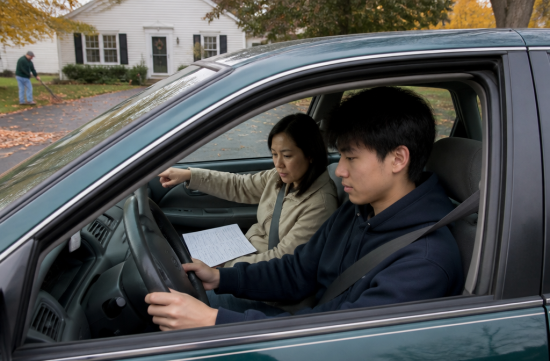
I went to a friend's house with brownies, only to hear a sigh when I got there. They were shocked by the insurance renewal notice after their high school son got his license.
That sweet brownie felt a bit bitter that day. So, I calmly looked into it when I got home.
According to a report citing Bankrate data, the average annual full coverage insurance premium for a 16-year-old added to a parent's policy was $5,740. This is nearly a $700 increase compared to 2023.
That means about $270 more per month. The moment I saw those numbers, I couldn't help but put my teacup down.
The reason insurance companies charge this is simple. Teens have no driving record, so they have to base their rates on accident statistics for their age group.
Those statistics show that teens tend to have more accidents, and the severity of those accidents is often higher. As a parent, it's frustrating, but it's something we have to accept.
However, that doesn't mean we should just sit back and do nothing. The first thing to consider is the Good Student Discount.
Typically, students with a B average or higher qualify. You just need to submit a report card or school certificate to the insurance company, but some companies require verification each semester.
The discount amount and age limit vary by insurer. One insurance company in Massachusetts states that they apply the discount for students up to 21 years old with a B average, so be sure to ask your insurance provider about their criteria.
Letting your child know that their grades can lower insurance costs is also a good lesson. It gives them one more reason to study.
The second step is to keep a record of any completed driver education courses. In Massachusetts, to get a license before age 18, students must complete a state-approved driver education program.
This includes a minimum of 30 hours of classroom instruction, 12 hours of actual driving, and 6 hours of observing other students driving. There's also a 2-hour class for parents.
Additionally, they must complete 40 hours of practice driving with a parent or guardian. If you inform the insurance company that this requirement has been met, they may offer a discount, so be sure to ask.
The third tip is to avoid getting a separate insurance policy for your child and instead add them to the parent's policy. Generally, adding them to the parent's policy is much cheaper than a separate policy, according to industry standards.
The fourth consideration is what car they will be driving. Designating a used sedan with good safety ratings and lower repair costs as the primary vehicle can lead to lower insurance premiums compared to a new, expensive car.
The fifth point is about college. If your child attends a school far from home and doesn't take a car, some companies offer discounts for distant students.
Massachusetts also has some unique regulations. State law prohibits insurance companies from using credit scores or gender when determining auto insurance rates.
So, whether it's a son or daughter, the rates won't differ based on that, and ultimately, driving records become the most significant factor. Under the state's Safe Driver Insurance Plan (SDIP), drivers with less than six years of experience are classified as inexperienced drivers.
This means that having an accident or violation in the first few years can significantly impact insurance rates. Ultimately, the best discount is to avoid accidents altogether.
Therefore, it's wise to strictly adhere to junior license regulations at home. For the first six months after obtaining a license, they cannot have passengers under 18 who are not family members.
From 12:30 AM to 5 AM, they cannot drive without a parent or guardian in the car. Using a cell phone while driving is also prohibited.
If their license is suspended due to a violation, that record will directly affect their insurance rates. I recommend clearly explaining this connection to your child.
Finally, compare quotes from multiple companies each time you renew. Even with the same family conditions, there can be significant differences in quotes between companies.
It's also good to ask about bundling discounts with home insurance and apps that measure driving habits. However, be cautious with app programs, as frequent hard braking could negatively impact rates, so read the terms carefully.
Insurance conditions and discount options vary widely based on family situations and insurance companies. The safest approach is to check with your agent for the exact amounts based on your household.
If I were a parent, I would keep the report card and driver education completion certificate in one envelope before the driving test. And for the first year, I would choose the oldest car as the primary vehicle.
Insurance costs can be seen as tuition for the process of your child becoming an adult. Still, it's essential to save wherever possible. Each discount may seem small, but when combined, they can make a significant difference in your annual budget.
Tonight, I plan to bake brownies again and take them to that friend's house. I hope to share the Good Student Discount information, which might sweeten their sigh a little.
 SeaSquirt


 Vacation on Hawaii |
 morvex37 |
 Ari Songhan American Immigration Life |
 Bearded Strawberry Smoothie |
 Heart Ticker |
 Masa Masa |

 neapolis |


 brownie |
  Star Blog |
  The Day the Sun Rises |
  sweetpop |
  California Kangaroo |
  zanero |
  station |
  Static |
  Star Way |
  American Blog Forge |
  MMORPG Games |
  Then you must be spring |
  Spicy Immigration Life |
  zenvor16 |
  The 2000 |
  toclick |
  wexlin84 |
  Hairy Poppins |
  daisypat |
  Taco Bell Candy Note Blog |