
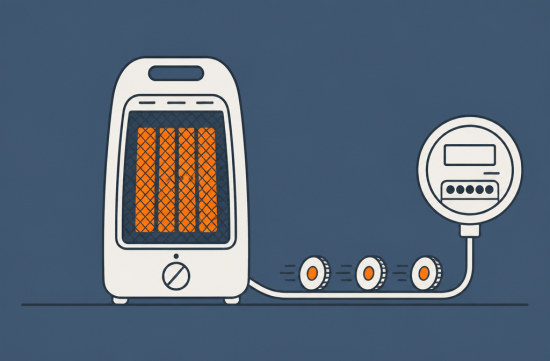
In October, the morning air has changed dramatically. As soon as I opened the garage door, the cold wind hit my face, and I thought, ah, another long winter is beginning this year. I need to prepare before the snow news comes from the lake.
I was considering whether to place an electric heater in my basement workspace when I suddenly became curious. Would it be cheaper than turning on the boiler for the whole house, or would it lead to a shocking bill? If I run this for 8 hours a day, how much will the electric bill actually be?
I realized I couldn't just guess, so I dug into the numbers. Winter preparations need to start with a solid plan.
First, let's set a baseline. Most electric heaters sold in stores have a maximum output of 1500 watts.
If you run 1500 watts for 1 hour, it uses 1.5 kilowatt-hours. If you run it for 8 hours a day, that amounts to 12 kilowatt-hours. This is about how long it would be on from dinner time until bedtime after work.
Over a month of 30 days, that totals 360 kilowatt-hours. Just looking at the numbers doesn't give a clear picture, but when you multiply by the rates, it changes the story.
According to a report from the Empire Center, based on data from the U.S. Energy Information Administration (EIA), the average residential electric rate in New York State in June 2026 was 29.49 cents per kilowatt-hour. The national average for the same month was 18.34 cents.
This means New York State was 60.8 percent more expensive than the national average. Seeing this number honestly made me sigh.
Now, let's do the math. Multiplying 360 kilowatt-hours by 29.49 cents gives a monthly cost of $106.16.
If we calculate the same usage at the national average rate, it comes to $66.02. That's over a $40 difference for the same usage.
Spending $100 a month on one heater is almost like paying for two cable bills. At first, I thought I had made a mistake in my calculations and checked the calculator three times.
However, there are several reasons why you shouldn't take this number at face value. Let's go through them one by one.
First, the state average is a blended value that includes New York City. Upstate tends to have lower supply costs than downstate, so the actual rate may be lower than this.
Utility companies like National Grid in upstate New York change their supply rates every month. Therefore, the most accurate way to know your rate is to check your bill directly.
The method is simple. Divide the total amount on your bill by the kilowatt-hours used that month to find the actual rate, which includes delivery charges, supply charges, and various fees.
For example, if the actual rate is 22 cents, then under the same conditions, the monthly cost would be $79.20. Still, that's not a small amount. Using it for just three or four months a year could lead to electric bills several times the cost of the heater itself.
Second, the heater won't run at maximum output for the entire 8 hours. If it has a temperature control feature, it will turn off when it reaches the set temperature and then turn back on again.
If the room is small and well-insulated, the actual usage will be significantly lower than the calculations. Conversely, if the room is drafty, it will likely run at full capacity.
So, using these calculations is best for worst-case scenarios. Knowing the upper limit helps you be less surprised when the bill arrives.
Third, using a lower power mode changes the situation significantly. Many heaters support a 750-watt low setting, which would use 180 kilowatt-hours over 8 hours.
Calculating at the state average rate would result in $53.08. Since the output is exactly half, the cost is also exactly half. If the room isn't large, the low setting can be sufficient.
My conclusion is this: an electric heater should not be used to heat the entire house but rather as a tool to warm the space where you are. You should lower the overall temperature of the house and use the heater to supplement only the rooms where people are present. Leaving the heater on in an empty room is like setting money on fire.
Products with timers are even better. If you set it to turn off 1-2 hours after you fall asleep, the wasted time is significantly reduced. A draft stopper at the door can also be surprisingly effective.
And more important than money is safety. The National Fire Protection Association (NFPA) recommends keeping flammable items at least 3 feet away from heaters.
This includes curtains, blankets, sofas, and laundry baskets. Another basic rule is to plug directly into a wall outlet rather than using an extension cord or power strip.
According to NFPA data, many heating-related fire fatalities started when combustible materials near heaters caught fire. This is a part that should never be taken lightly.
In the end, I decided to buy a heater. However, I will make sure to check for three features: temperature control, low power mode, and an automatic shut-off feature if it tips over.
The battle with electric bills this winter has already begun. Take a look at your bill and calculate your actual rate; that's the first line of defense.
 FamilyBladder


 kuku 100 |
 novent |
 Silent Sea |
 Pointy |
 Idaho's Sumi's House |
 chicpo |
 Delicious Food Finder |

 Banana |
 See It |
 Holy Cow |
  korvex93 |
  Mini Mee |
  Darnignac |
  vanilla |
  selvon |
  brownie |
  Star Blog |
  The Day the Sun Rises |
  sweetpop |
  California Kangaroo |
  zanero |
  station |
  Static |
  Star Way |
  American Blog Forge |
  MMORPG Games |
  Then you must be spring |
  Spicy Immigration Life |
  zenvor16 |
  The 2000 |