

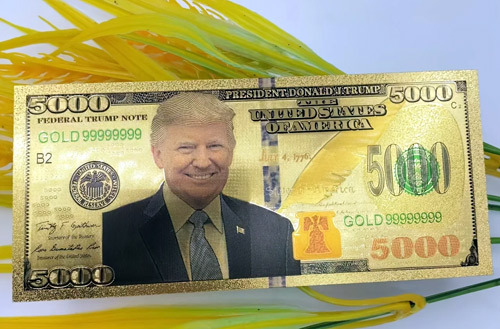
Looking at the current state of American politics, I can't tell if I'm watching the news or a home shopping channel, haha.
This time, President Trump made a shocking statement at the Republican National Convention for the midterm elections held in Dallas on September 9, 2026.
If the Republicans maintain control of both the House and Senate in the November midterms, he promised to give $5,000 to each adult American citizen.
They even have a name for it: 'Trump Dividend.'
On the surface, it sounds simple. "If the Republicans win, you win with us. We will give you $5,000."
Sure, I understand that if you live in Alaska, you get a dividend once a year (but I wouldn't dare live in such a tough area), but what is this? Haha.
First of all, giving $5,000 to all adult Americans would require over a trillion dollars.
This isn't money that the president is just pulling out of his checkbook. Ultimately, it's federal government money, and to actually distribute it, they would have to navigate the mountains of legislative and budgetary processes in Congress.
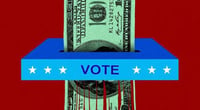
What's even more peculiar is the blatant connection between elections and cash.
U.S. federal law prohibits offering money or economic benefits as a quid pro quo for someone's vote.
However, we can't immediately label this statement as illegal vote buying.
It's not a case of saying, "If you prove you voted for the Republicans, we'll give you $5,000," but rather a promise that if the Republicans win, they will implement a government policy to distribute the funds.
Still, from the listener's perspective, it's quite clever.
There is a significant legal difference between saying, "If you vote for us, you get $5,000" and "If we win, we will implement a $5,000 policy."
However, it's hard to say that there are no issues in the American electoral system where common sense applies.
Similar controversies have occurred in South Korea as well. After the launch of the Lee Jae-myung administration, consumer recovery coupons were distributed.
While there were policy objectives of economic stimulus and support for livelihoods, and it went through the National Assembly's budget process, it cannot be seen as the same case as Trump's election promise.
However, every time I see such cash promises, I am reminded of the pandemic period.
During that time, the U.S. government released an enormous amount of money.
From 2020 to 2021, the Economic Impact Payments, commonly known as stimulus checks, amounted to a total of $931 billion.
Of course, for those who lost their jobs and were worried about rent and food, this money was a lifeline.
The problem was that the support was so widespread.
While there were income criteria, it wasn't a program that only targeted those who were immediately economically distressed.
Even people who maintained their jobs, owned homes, and had pensions or other stable incomes received money if they met the eligibility criteria.
Research has shown that some households that did not experience income loss saved the support funds instead of spending them.
Support for businesses was even larger.
About $800 billion was allocated for the PPP. The intention to maintain payroll and prevent business bankruptcies is understandable.
However, prioritizing speed opened up tremendous opportunities for fraudsters.
According to the 2025 Pandemic Response Accountability Committee data, the estimated amount of fraud and improper payments from the PPP, EIDL, and pandemic unemployment benefits reached nearly $400 billion.
This is why the government is still investigating and prosecuting related fraud cases.
So the lesson from the pandemic is not that "the government should not give money to the people."
In a crisis where the economy has come to a halt, there are certainly times when the government needs to inject money.
In fact, the support during that time alleviated the economic difficulties of many families and helped prevent businesses from closing.
The issue lies in the scale, timing, and who receives the funds.
When the overall supply of the economy is lacking, if the government injects trillions of dollars in purchasing power all at once, it will inevitably create price pressures.
Indeed, research from the Federal Reserve has analyzed that pandemic financial support increased demand for goods like cars, contributing to price increases amid supply shortages.
Of course, attributing the inflation of 2021-2022 solely to the stimulus checks would be an exaggeration.
Multiple factors, including supply chain disruptions, semiconductor shortages, labor market changes, ultra-low interest rates, energy prices, and Russia's invasion of Ukraine, all played a role simultaneously.
However, the claim that "there are no side effects from injecting money" also does not align with the experiences of that time.
So now, when I hear the statement, "If we win the election, we will give each citizen $5,000," I can't help but raise an eyebrow.
In South Korea, there are consumer coupons, and in the U.S., there's the Trump Dividend.
The systems are different, the amounts are different, and the legal structures are different. We cannot simply label cash or cash-like support policies as money politics.
Still, if the language of politics is increasingly shifting from "What kind of country do we want to create?" to "How much will we give you?" it may be time to be cautious.
Moreover, politicians are not giving away their own money.
Ultimately, it's either the taxes paid by the citizens or money that the government has borrowed.
It's like saying, "I'm returning your money with your own money and calling it a dividend for winning the election."
Whether democracy has advanced or election marketing techniques have improved is up to each individual to judge.
 HoneyLetsPlay
 foxforestbuilder1974






 Coastal city |
 novapixel |
 Victory 1988 |
 washington mom |

 Giant Squid and Sweet Potato Soup |

 Gorama Round |

 Texas Lone Star Longhorn Spirit |

 There Are Such Things in the World |

 Aura-Infused WACAM |
 oster |
 daddyyo |
 neapolis |
 seadoll |
 ansdal |
 Vivid U.S. Regional Information |
 Vasila's Newlywed Blog |
 Arizona Cowboy |
 merry merry |
 Hoorah Ooorah |
 Fragile Me |
 Rowland Mama |
 foxtree |
 bayaa |
 loveyom |
 Spaghetti Flying Religion |
 My Town My Way Blog |
 holy cow |
 endone |