

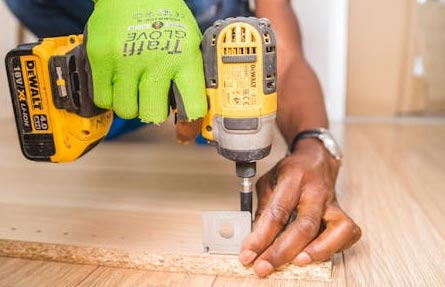
The construction industry in the United States varies in scale by region and project, and regulations differ slightly from state to state, which can make it overwhelming for many to figure out how to get started. Let's take a closer look step by step.
What does a carpenter do?
- Basically, they create, install, and repair houses, buildings, furniture, and structures using wood, plywood, and other materials.
- On construction sites, they may be responsible for formwork, installing doors and windows, and roof framing, while in interior settings, they handle the installation of furniture and decorative woodwork.
- The field is subdivided, allowing for work ranging from residential construction to commercial buildings and bridge projects.
Typical pathways to becoming a carpenter in the U.S.
Apprenticeship Program
- This is the most traditional and representative path in the U.S. You apply to an 'Apprenticeship Program' organized by unions, companies, or local organizations, where you undergo a combination of on-the-job training and theoretical education for a set period (usually 3-4 years).
- Upon completion, you become a 'Journeyman Carpenter' and gain the qualifications to perform independent work.
- Unions (e.g., United Brotherhood of Carpenters) have slightly different programs in each state, and there are admission requirements (high school diploma, driver's license, basic English skills, etc.) that you should check carefully.
Trade School or Community College
- Some individuals complete carpentry or construction-related courses at trade schools or community colleges and gain practical experience after employment.
- They learn basic carpentry skills, how to read blueprints, and safety training, and may either get hired by a company after graduation or transfer into an apprenticeship program.
On-the-Job Training (OJT)
- Another way is to start as a 'Helper' or junior carpenter at a small carpentry shop or interior company.
- While systematic training may be difficult to receive in this case, there is the advantage of quickly gaining practical skills while working at a small company.
- However, many places require qualifications or experience when hiring, so it's advisable to study practical terminology and basic skills in advance if possible.
Are certifications or licenses necessary?
- Generally, there is no federal license specifically for "carpenters," but many states require a Contractor License to exceed certain construction scopes.
- For example, in California, you must obtain a license through the Contractor License Board to undertake projects above a certain amount.
- If you want to run your own business while working as a carpenter or take on larger projects, it may be worth considering a Contractor License in the long term.
Income of carpenters (average wage)
- According to the most recent data from the U.S. Bureau of Labor Statistics (BLS), the median annual wage for carpenters is estimated to be around $48,000 to $55,000.
- There can be significant differences based on location, experience, union membership, and project size. In large cities or areas with active union participation (e.g., New York, San Francisco), hourly wages can be high, often exceeding $60,000 to $70,000 annually.
- When joining a union, wage tables and benefits (insurance, retirement, etc.) are well established, and skilled Journeyman Carpenters or Foremen can earn close to or over $100,000.
Career advancement paths
- Apprentice → Journeyman → Foreman → Superintendent or Contractor
- You can remain simply a carpenter, but as skills and experience accumulate, you can advance to project management, supervision, or even become a Contractor who directly secures projects.
- Many people build experience in larger companies and later become independent, obtaining a 'General Contractor' license to run their own business.
Helpful tips to know
- Safety training: Safety is paramount on construction sites. You must strictly adhere to workplace safety rules and wear PPE (personal protective equipment). Having OSHA-related certifications (OSHA 10, OSHA 30) can also help with employment.
- Language skills: The better your English skills, the smoother communication will be on-site, increasing your chances of promotion. It also makes it easier to read blueprints and understand specifications or safety manuals.
- Ability to use tools and equipment: Familiarity with power tools (drills, saws, etc.), measuring equipment, and leveling tools can significantly improve work efficiency and make you a sought-after employee.
- Networking: Building connections with unions, trade schools, and colleagues on-site can create opportunities for moving to larger projects or better companies.
In summary, to become a carpenter in the U.S., you typically need to either
- complete an apprenticeship program to become a certified Journeyman Carpenter, or
- gain experience through trade schools or on-site work while gradually expanding your scope.
Initially, the salary may not be very high, but as skills and experience grow, it can become a high-income field. Above all, practical skills, safety awareness, and continuous learning are crucial.
Even if it's a bit challenging at first, this profession offers great satisfaction in creating something with your hands and contributing to construction sites, so if you have interest and passion, it is definitely worth the challenge. I wish those building their careers as carpenters in the U.S. a wonderful future!







 My NYC |
 coloradoman |
 Living Economy Information Blog |
 Tomato Health Club blog |
 Banana Style Life |
 xylora |
 wendra |
 Texas Migration Story |
 Aura-Infused WACAM |
 ultron78 |
  Tonky |
  viroma |
  cookie |
  Live and that's it |
  Alright Twain |
  eatontown blog |
  HAWAII Korean Church News |
  Amore |
  linex |
  Balancework |
  laro90 |
  MEDBIO American Doctor Blog |
  SWAT TEAM BLK |
  DREAM BIG |
  frostbite |
  330 Forever My Love |
  El Dorado |
  dralix58 |
  Gorama Round |
  Skydiving |