

Living in DC, with the election season just around the corner, all anyone talks about is Trump, the Democrats, and the Republicans.
And politicians everywhere are busy asking voters for help. They are saying, "Please donate some money."
Emails keep coming in asking for just $5, $25, and claiming that this election will determine the fate of America.
It's the same for both the Republicans and the Democrats. With a two-party political system, both sides are in a frenzy.
They claim they are saving the country, but where exactly do American politicians spend the money they collect?
If you've experienced elections in Korea, you might recall the old election days.
Back then, candidates would gather locals, serve makgeolli, give gifts, and treat people to meals while asking for votes.
However, the money involved in American elections is on a whole different level.
In the 2024 U.S. federal elections, the combined political spending for the presidential election and federal congressional elections reached tens of billions of dollars.
In Korean won, that amounts to several trillion won.
So what exactly are American politicians buying for voters with all that money?
The Largest Portion of Election Costs in the U.S. is Advertising
One of the biggest expenses in American elections is advertising.
When you turn on the TV, you see candidate ads, and when you watch YouTube, you see political ads. Text messages, Facebook, Instagram, and Google ads are all utilized.
Especially in battleground states like Pennsylvania, Georgia, and Arizona, the competition for ads is intense.
If one candidate runs an ad criticizing their opponent, the other candidate can't just sit back. They immediately respond with counter-ads.
This is how advertising costs keep rising.
In addition, there are salaries for campaign staff, polling costs, office rental fees, candidate travel expenses, venue rental fees, and legal and accounting costs.
The U.S. is vast, and the electoral districts are wide. Just getting your name out to voters incurs significant costs.
This differs from Korea, where campaigns are concentrated in a relatively short official election period.
In the U.S., many politicians start preparing for the next election as soon as the current one ends.
So, they constantly need money.
But Are Donations Managed Transparently?
In the U.S., there is an agency called the Federal Election Commission (FEC).
This agency oversees the political funds used in presidential and federal congressional elections.
Candidates and parties must regularly report who donated money and how it was spent.
Generally, if an individual contributes more than $200 in a single election cycle, their name, occupation, and employer information must be disclosed.
Even regular people can check the FEC website to see how much candidates paid advertising companies and how much was spent on staff salaries.
The problem is that not all sources of money are perfectly transparent.
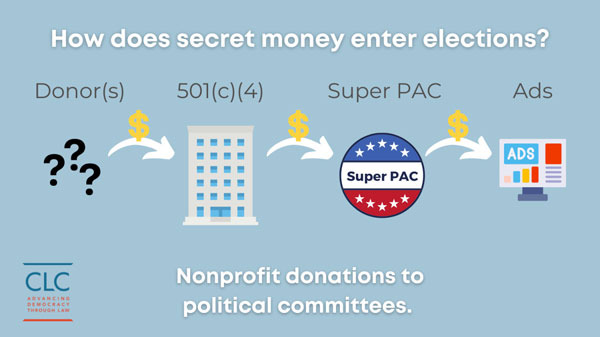
In the U.S., there are political funding organizations called Super PACs. Instead of donating directly to candidates, they independently create election ads and support political activities.
These organizations can receive large donations from individuals or corporations. Legally, they cannot coordinate spending with candidate campaigns.
Moreover, when political funds come through certain non-profit organizations, it can be difficult to determine who the actual donor is. This is known as the dark money issue.
So, while the U.S. has a well-developed system for disclosing political funds, not all sources of funding are transparently revealed.
How Much Do Elections Actually Cost?
According to the political funding watchdog OpenSecrets, the money spent on the 2024 U.S. presidential and congressional elections was about $14.8 billion.
But what's even more surprising is how that money was used.
In the analysis of 2024 election spending, media costs, including advertising, accounted for about 51.7% of the total.
About 11.3% went to fundraising activities, and 7% was used for staff salaries.
This means that money is spent to raise more money.
Costs are incurred for sending fundraising emails, online ads, and running fundraising events.
In essence, elections have become a massive industry.
Is It Like the Old Days in Korea with Makgeolli and Gifts?
When comparing this to the old election days in Korea, there are interesting differences.
In the past, the practice of providing food or gifts to voters was a significant issue in Korea's elections. Now, such actions are strictly prohibited in Korea.
In the U.S., offering cash or gifts to voters in exchange for votes is also illegal.
Of course, it's not that there's no food provided at campaign events or that souvenirs aren't handed out. However, those should not be seen as payment for votes.
The key to spending money in American elections is not to directly buy something for voters but to influence their thoughts and choices.
Money is spent on running thousands of TV ads, attacking the weaknesses of opponents, and repeatedly delivering messages to specific voter groups.
If old Korean elections sought votes with a bowl of makgeolli, today's American elections aim to win voters' hearts with million-dollar ads.
Does the Candidate with the Most Money Always Win?
Not necessarily.
There are plenty of candidates who spend a lot of money and still lose. A candidate's policies, image, party support, and economic conditions also significantly impact election outcomes.
However, without sufficient funds, it's challenging to even get your name recognized in American elections.
Watching political news in Washington DC, I sometimes think about this.
The U.S. is one of the countries that values democracy the most in the world, yet running an election requires astronomical amounts of money.
The Republicans criticize the Democrats while raising funds, and the Democrats raise funds to stop the Republicans.
With the money collected, they run ads attacking each other.
Ultimately, the ones making the most money are probably the broadcasters, advertising companies, and political consulting firms.
In the old Korean elections, at least you could get a drink of makgeolli, but American voters have to fund campaigns with their own money while watching ads attacking each other on TV.
When you think about it, it's a strange kind of democracy.
Politicians promise to work for the people after the election.
Yet, even after the election is over, fundraising emails keep coming in.
In American politics, the never-ending campaign might not be the voting itself but the fundraising.
 ParisBarba
 Biscuit






 Victory 1988 |
 El Dorado |
 lightyear |
 Moscow Kim |
 coloradoman |
 Eldorado 88 |
 American Travel Cruise Information |
 Another Eden Channel BLOG |
  NE Hodori Preik |
  washington mom |
  celtics |
  Balancework |
  round1 |
  Way to easy |
  musicque |
  road98 |
  Churros Train Conductor |
  gleeful |
  Burbank Lee |
  Olivia's Blog |
  Bushing Around Life |
  Active |
  Cherokee Rose |
  Kor. Master |
  Holey Moley |
  Conflite Teacher |
  Hodong Prince Over Flex |
  Mist inn |