
These days, the most common inquiry I receive is this: "The SALT deduction has increased to $40,000; does that mean it's beneficial to pay my November property tax early?"
To put it simply, the answer varies greatly from person to person. If you own a high-value home in Bergen County, it's definitely worth calculating before the end of the year.
SALT stands for State And Local Tax. In simple terms, it refers to the deduction for state income tax and property tax paid to state and local governments from federal income.
Since the tax reform in 2017, this deduction has been capped at $10,000. In places like New Jersey, where both state income tax and property tax are high, this has been a source of frustration.
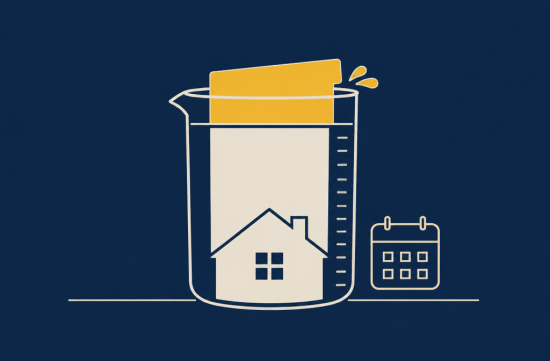
However, with the passage of the One Big Beautiful Bill Act in July 2025, the limit increased to $40,000. In 2026, it will rise by 1% to $40,400.
If a couple files separately, this limit is halved. Additionally, this benefit is temporary; starting in 2030, it will revert back to $10,000.
A crucial aspect that many overlook is the income threshold. If your MAGI exceeds $505,000 in 2026, the limit begins to decrease.
If MAGI sounds unfamiliar, think of it as your adjusted gross income plus certain items. For every dollar over the threshold, the limit is reduced by 30%, but it will not drop below $10,000.
For example, if a couple's combined MAGI is $600,000, they exceed the threshold by $95,000. Therefore, $28,500 (30% of that excess) is deducted, leaving an actual limit of only $11,900.
Calculating shows that at a MAGI of around $606,333, the limit hits the $10,000 floor. This means that high-income households essentially see no difference from before, which was a bit disheartening for me at first.
So how should households within the limit be viewed? Comparing two homes side by side provides clarity.
Home A pays $25,000 in property tax and $20,000 in state income tax. Combined, that's $45,000, which already exceeds the $40,400 limit.
This home will not see any increase in federal deductions, no matter how early they pay their property tax. The limit is already maxed out.
Home B pays $18,000 in property tax and $12,000 in state income tax, totaling $30,000. They still have about $10,000 of room before hitting the limit.
In the case of Home B, moving the tax payment date to the end of the year makes sense. This is the crux of today's article.
In New Jersey, property taxes are paid quarterly on February 1, May 1, August 1, and November 1. Each town may allow a grace period of up to 10 days, but this is determined by the town, so be sure to check with your tax bill or local tax office.
If you pay the November installment before December 31, it will naturally count as a deduction for 2026. The issue arises when paying the February installment early.
The IRS stated in 2017 that property taxes paid in advance are only deductible if they are assessed in that year. In simple terms, if you send money for taxes that have not been officially billed, it won't count as a deduction for that year.
New Jersey tax bills typically include estimates for the first half of the following year. Whether this is recognized as assessed depends on the situation, so it's best not to make assumptions.
Therefore, before making an advance payment for the next year, check whether the town has already confirmed and billed the amount. A quick call to the town's tax office will clarify this.
Another comparison to consider is the standard deduction. The standard deduction for married couples filing jointly in 2026 is $32,200.
The itemized deductions for SALT, including mortgage interest and charitable contributions, must exceed this amount to be meaningful. For homeowners in New Jersey, it's quite common to exceed this with SALT alone.
Don't forget to handle your state tax filings as well. In New Jersey, you can deduct property taxes up to $15,000 or choose one of the $50 credits.
Additionally, households subject to the Alternative Minimum Tax (AMT) may find that early tax payments have no effect, as AMT calculations include SALT deductions again.
In summary, the year-end calculation order is as follows: first, check your expected MAGI for the year, then compare the total of property tax and state income tax against the limit, and finally, compare it to the standard deduction.
Personally, I would only ensure to pay the November installment for a home like Home B that has room under the limit, and I would consult with an accountant before making advance payments for the next year. If income exceeds $600,000, there seems to be no reason to push it.
Tax laws can yield quite different results based on individual circumstances. Therefore, I recommend organizing your numbers and confirming with a tax professional.
The figures in this article are based on the 2026 tax year and reference the IRS's 2026 inflation adjustment announcement and New Jersey Department of Treasury data. It's a reminder that tax calculations, just like home prices, significantly influence the actual cost of owning a home.
 CocoPastaHelp
 SgtKim210








 Choco Choco Star |

 gentle |

 neapolis |

 moo moo |

 ultron78 |

 morninpo |

 dewyo |

 silverleaf |

 Living in New Jersey blog |

 shadow 007 |
 ssome |
 skykong |
 Shining Our Own World |
 gardener 007 |
 golfmaster |
 Nanana Nanana Nanana |
 Who's watching? |
 endone |
 RockStar |
 Casa Mia |
 You Only Live Once |
 Hardworking CPA |
 Joyce 77 |
 Runner Kim |
 My Town My Way Blog |
 My Miami Stories |
 Entip |
 Tony Park |
 Jean Claude Bundang Blog |
 DJ DC BLOG |