

What? Did the Tesla Roadster Reach the Realm of Hovering?
Living in Houston, when talking about cars, the conversation inevitably turns to Tesla.
Is it an electric vehicle company that collects monthly subscription fees with autonomous driving technology, or is it an AI company, or perhaps a company that makes robots that create robots? The roles are diverse.
And perhaps it feels like Elon Musk is running a massive laboratory, akin to a real-life Iron Man Tony Stark.
However, something truly extraordinary, like a scene from a martial arts novel, has occurred this time.
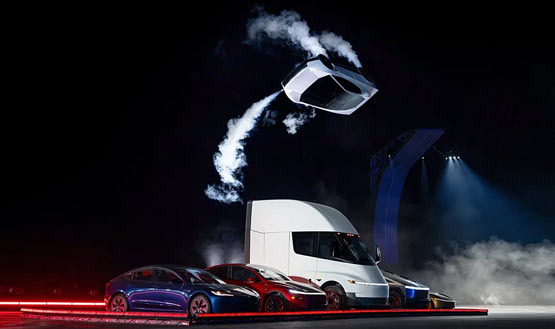
The Tesla Roadster 2 has reportedly taken to the skies.
On October 15, at SpaceX's rocket testing facility in McGregor, Texas, a prototype of the Roadster showcased its ability to leap into the air and spin.
In martial arts terms, Tesla has honed its unique electric vehicle techniques and has now mastered SpaceX's visionary techniques, finally reaching the realm of hovering.
So, what force allows a car to rise into the sky?
The Secret is Not Rocket Fuel, But Compressed Air
At first, I wondered if they had attached a rocket engine to the car. However, upon examining the actual principle, it's a bit different.
The Roadster uses a propulsion device called a Cold Gas Thruster.
Simply put, it's a device that expels gas compressed to an enormous pressure through a nozzle instantaneously.
According to the disclosed explanation, the vehicle contains a high-pressure storage tank wrapped in carbon fiber composite. When the valve is opened, gas is expelled at high speed from the nozzle.
When the gas is expelled downward, the car receives an upward force.
If expelled backward, it accelerates forward, and by adjusting the amount of gas expelled in different directions, the vehicle's posture can be altered in midair.
In other words, the direct power lifting the car is not from an electric motor but from the pressure energy stored in the compressed gas.
Electricity can be used to compress and store air, but the force that instantaneously pushes the body upward comes from the thrust of high-pressure gas.
It's not a method that burns fuel to create hot exhaust gases like a typical rocket.
Not Four, But Ten Propulsion Devices?
Various types of Roadsters are being prepared.
The Performance model for regular roads, the Thrust model with enhanced acceleration, and the Rocket version aimed at aerial maneuvers.
The Thrust model has four propulsion nozzles placed at the rear, while the Rocket model reportedly uses a total of ten cold gas thrusters positioned in various directions on the body.
During the event, a storage capacity of about 600 liters of compressed air was also mentioned.
There's another interesting technology. It's a suction system that draws air from under the vehicle to keep the body pressed against the ground.
Using this device, the Roadster demonstrated the ability to climb a curved ramp and even hang upside down.
Then it leaped into the air, corrected its posture with the propulsion device, and landed.
However, this is not a technology for continuously flying like an airplane. Since compressed gas depletes with use, there is a limit to how long it can stay airborne.
For now, it's more akin to a momentary leap with high control rather than actual flight.
A Lightness of 0.81 Seconds!
It was announced that the acceleration reaches 60 miles per hour, about 97 km, in just 0.81 seconds from a standstill.
Of course, this is a figure released by the manufacturer and should be distinguished from independent certified test results.
Still, just looking at the numbers, it's an astonishing feat.
The problem is, where can you actually drive this car?
If you've ever driven on Houston's I-10 Katy Freeway during rush hour, you know. No matter how skilled you are, if the cars in front are stuck, it doesn't matter.
Moreover, the ability to leap into the air has not been approved for use on public roads.
The Roadster was first announced in 2017, but it has yet to be delivered to customers, with the current production target set for 2028.
Still, I find these experiments fascinating.
While other car companies are improving motor output and battery efficiency, Tesla has brought rocket propulsion technology from SpaceX.
However, a true master should prove their skills not only on the demonstration stage but also in real-world scenarios.
Yet, while the Tesla Roadster has soared into the sky, Tesla's stock is currently trading down about 0.6% around $360 today.
It seems Wall Street operates in a different realm altogether.
Even if it reaches the realm of hovering, what investors ultimately want are sales and profits.
Even if the car can fly, the stock price cannot soar freely.
 StarlitCloud
 WestCoastMood






 Korean Mom |
 novapixel |
 Peter Pan Pet |
 horse |
 Sunset Oregon |
 Things to know |
 U.S. Weather Bureau News |
 Texas Real Estate Blog |
 Premium Gas Camp |
 Texas Migration Story |
  viewtop |
  loverun |
  Kim Do Sun |
  SEVEN SEVEN |
  yentra |
  Make My Day |
  Victory 1988 |
  Tonky |
  viroma |
  cookie |
  Live and that's it |
  Alright Twain |
  eatontown blog |
  HAWAII Korean Church News |
  Amore |
  linex |
  Balancework |
  laro90 |
  MEDBIO American Doctor Blog |
  SWAT TEAM BLK |