
Recently, while having lunch with a colleague, I heard a story. His father had stomach cancer surgery a few years ago, but he had never undergone any stomach-related tests.
So I asked if he had been tested for Helicobacter, and he replied, "What's that?" I was a bit taken aback.
To be honest, I was similar until a few years ago. When I was in Korea, I only saw the name on my health check-up results, but I didn't really understand how it was related to stomach cancer.
So this time, I did some proper research. To cut to the chase, if you have a family member with stomach cancer, this test is definitely worth discussing with your doctor.
Helicobacter pylori (H. pylori) is a bacterium that lives in the stomach lining. Many people are unaware they are infected because it often shows no symptoms.
The problem is that if this bacterium lingers for a long time, it can cause chronic inflammation in the stomach lining, which is considered a risk factor for stomach cancer.
The most cited study was published in the 2020 New England Journal of Medicine by the Korean National Cancer Center. It involved 1,838 first-degree relatives of stomach cancer patients, such as parents, siblings, and children.
The participants were aged between 40 and 65, and they were randomly divided into two groups: one received eradication treatment, while the other received a placebo. They were followed for a median of 9.2 years.
The results were quite impressive. The stomach cancer incidence rate was 1.2% in the treatment group and 2.7% in the placebo group.
In terms of risk ratio, it was 0.45, meaning it was relatively reduced by 55%. Although the difference may seem small in numbers, it's significant for those with a family history.
Of course, there's no such thing as a free lunch. The report of side effects in the treatment group was 53.0%, much higher than the 19.1% in the placebo group.
However, most side effects were mild, with common issues being altered taste or diarrhea. I believe it's important to be aware of these aspects when making a decision.
So what about the U.S.? According to the 2024 Helicobacter treatment guidelines from the American College of Gastroenterology (ACG), first-degree relatives of stomach cancer patients are included in the testing criteria.
Interestingly, this aspect was missing from the 2017 guidelines due to insufficient evidence, but as data from studies like this accumulated, the direction changed.
Why is this more important for Koreans? There's a study analyzing California cancer registry data showing that the stomach cancer incidence rate among Koreans is five times higher than that of non-Hispanic whites.
In the same study, the proportion of Korean patients diagnosed at an early stage was 43%. In Korea, where national screenings are available, it was 57%, indicating that Koreans living in the U.S. tend to be diagnosed later.
Honestly, I was a bit shocked by these numbers. I thought my eating habits would be fine after moving to the U.S., but the infection could have occurred in childhood.
That said, I'm not saying everyone should immediately get an endoscopy. The ACG's other 2024 guidelines state that there's still insufficient evidence to recommend endoscopic screening based solely on race or family history.
So the realistic first step is the Helicobacter test. It's much simpler than an endoscopy, and based on the results, you can decide with your doctor whether an endoscopy is necessary.
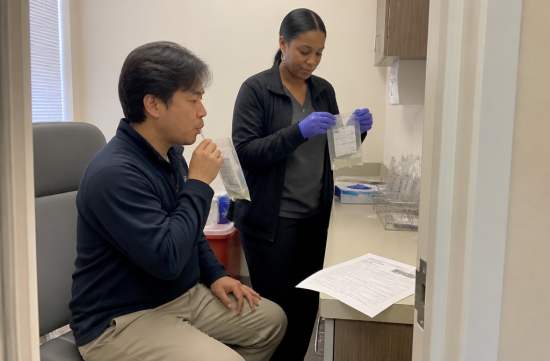
There are several testing methods. The urea breath test and stool antigen test are the main ways to check for current infection.
There is also a blood test, but it's not suitable for confirming current infection as it detects past infections. It's a good idea to ask which test is being ordered.
There are preparations to consider as well. Usually, it's advised to stop proton pump inhibitors (PPIs) two weeks before the test and antibiotics or bismuth-containing medications four weeks prior.
This is because these medications can reduce the accuracy of the test. However, you shouldn't stop prescribed medications on your own; always consult with your doctor or pharmacist.
If you test positive and receive treatment, it's not the end. The ACG recommends a test-of-cure at least four weeks after treatment to confirm that the bacteria are gone.
Nowadays, due to antibiotic resistance, there are cases where the infection isn't cleared in one go, so even though this follow-up test may be a hassle, it's important to ensure that treatment was effective. Otherwise, it's like not having done anything from the start.
My colleague eventually told his primary care doctor about his family history and received an order for the breath test. He said it was simpler than he expected and wondered why he hadn't done it sooner.
Having a family history doesn't mean everyone will get stomach cancer, and one test won't solve everything. Still, I believe it's better to check than to do nothing.
If I were in his shoes, I would mention my family history during my next annual check-up. If you have a parent or sibling with stomach cancer, bring up the Helicobacter test at your next appointment.
 NewMexicoPal


 Tora Tora |
 neroyo |
 nivex85 |
 Old English |
 nixxon |
 saffronroute |

 rosem |
 crumb |

 mygoddess blog |
  Balancework |
  laro90 |
  MEDBIO American Doctor Blog |
  SWAT TEAM BLK |
  DREAM BIG |
  frostbite |
  330 Forever My Love |
  El Dorado |
  dralix58 |
  Gorama Round |
  Skydiving |
  dreamport |
  Yellow Snowman |
  Toaster Pizza Magic Show |
  velvetnom |
  Anytime Journey |
  Mrs. Duluth |
  jaxter |
  Atlanta Mama |
  Baguette Blog |