
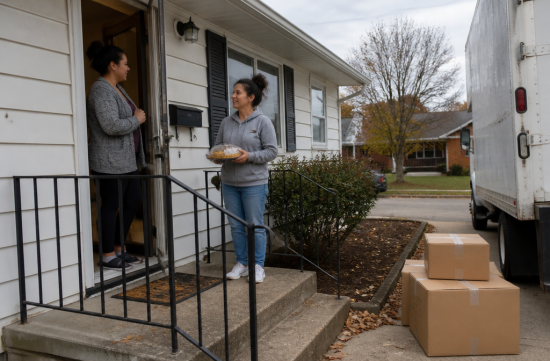
On the afternoon of the third day after moving in, the doorbell rang. When I opened the door, I found my neighbor standing there with a plate of cookies.
She quickly shared a few details about the trash collection days and where the local post office was less crowded before leaving. That brief five minutes strangely lingered in my mind.
So, I looked it up. I wondered where the custom of bringing gifts to new neighbors in America originated. That's when I came across the name Welcome Wagon.
The Welcome Wagon is not just a vague tradition; it's actually the name of a real company. It was founded in 1928 by advertising agent Thomas Briggs in Memphis, Tennessee.
According to the company, the name was inspired by the covered wagons that welcomed travelers during the westward expansion. An advertising professional turned hospitality into a business.
The method was simple. They hired local women as hostesses to visit new homes with gift baskets.
The company states that aside from founder Briggs and a few men, almost all the workers were women. It was likely a rare job opportunity for women at that time, allowing them to work nearby and meet neighbors.
The baskets contained coupons and promotional items contributed by local shops. Small items like bottle openers, pens, and tape measures were included.
So, it was a warm greeting and at the same time, a very clever form of local advertising. At first, it felt a bit forced, but the more I thought about it, the more I appreciated its honesty.
The newcomers learned about local laundries and bakeries, while the shops gained potential regular customers. It was a win-win situation.
Even during the war, these visits continued. Records show that in the early 1940s, hostesses walked, rode bicycles, or even used horses due to gasoline rationing.
By 1944, there were 600 locations, and the government issued gasoline ration coupons to the company. This indicates that welcoming neighbors was seen as a valuable service.
In 1953, they purchased a 17-story building on Fifth Avenue in New York for their headquarters. A basket that started in Memphis made its way to the heart of Manhattan.
The peak was in the 1960s. According to CNN, the number of visits reached 1.5 million in a single year.
I was momentarily stunned by the number. That means someone was standing at the front door with a basket that many times each year.
However, cracks began to show first in the big cities. In 1960s New York, it became difficult to fill the number of hostesses.
A climate of suspicion towards strangers, people being away from home during the day, and a culture that did not welcome evening visits all contributed to this decline. There were even complaints that if someone opened the door, they knew it was to sell something.
After that, the company changed owners several times. In 1971, it was acquired by Gillette, and in 1995, it was taken over by CUC International.
After CUC merged and became Sendent in 1998, the home visits ultimately ended. This method had lasted for over half a century.
Reports from that time indicate that most of the 2,200 visiting representatives were let go, leaving only 500 who handled store advertising.
That year, the number of visits dropped to 500,000. That's one-third of its peak. The company cited the increase in dual-income households as a reason, leading to fewer people being home during the day.
What replaced the baskets were coupon booklets sent by mail and gift books. Instead of people, mailboxes became the ones to welcome guests. While efficiency surely improved, I felt a bit sad throughout the reading.
The name Welcome Wagon still exists today. In 2014, it was sold to the coupon company Money Mailer, and now it sends local store coupons to new residents via mail, online, and through an app.
So, the company didn't go out of business; it just changed its form. However, that moment of ringing the bell is gone.
Personally, I don't think this is solely due to the times. Most of us have become less welcoming to strangers knocking on our doors.
I also check the door cam first when someone rings the bell, not just the delivery person. So, it's not surprising that I was startled to see my neighbor with a plate of cookies.
Interestingly, while the company's baskets have ended, the baskets between neighbors remain. This seems especially true in neighborhoods where people move frequently.
In neighborhoods where military families come and go every few years, new faces are not unfamiliar. When someone leaves, someone else arrives, and each time, a small plate is exchanged. It happens naturally, without anyone instructing it.
I was reminded of the tradition of sharing rice cakes when moving in Korea. Though the forms are different, the sentiment of "I'm here, nice to meet you" is the same.
Coupon booklets are useful, but I still prefer the five minutes in front of the door over the booklets in the mailbox.
So, the next time a moving truck is parked next door, I plan to bake a few muffins and ring the bell. I'll be sure to include the trash collection day information too.
 Walker1976







 Peter Pan Pet |
 horse |
 Sunset Oregon |
 daisypat |
 Anjollinya Blog |
 mintlogic |

 zenvor16 |
 U.S. Weather Bureau News |
 novapixel |
  mortrix |
  ollege Mom |
  Esther 1983 |
  Arizona AZ Cowboy |
  fortbliss |
  Moscow Kim |
  My Two Way |
  toastyfox |
  FLORIDA Acus |
  tracker |
  TONTON COFFEE |
  sunrise |
  ultron78 |
  uplifted |
  Folding Instructions |
  same same life |
  USA Hyundai Kia |
  morvex37 |
  BOL SA RAM |