
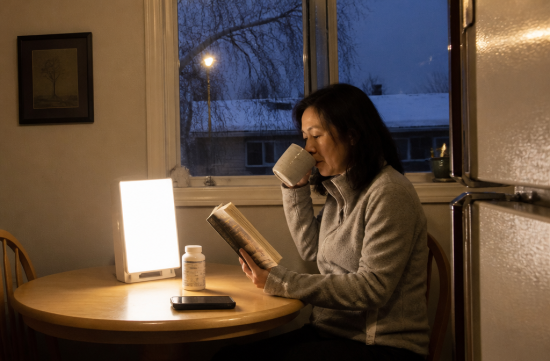
By mid-October, the morning commute is already dark. If you've experienced an Anchorage winter even once, you know how your mood can start to shrink during this time.
According to data from the Alaska Climate Research Center, on the winter solstice, December 21, the sun rises around 10:15 AM and sets at 3:41 PM in Anchorage. The length of daylight is 5 hours and 27 minutes.
Doesn't it feel more real when you see the numbers? It means the sun rises and sets while you're at work, so there are days during the week when you hardly see any sunlight.
So, if you start feeling lethargic, sleeping more, and craving carbohydrates around this time, don't just brush it off as a mood swing. It could be seasonal affective disorder, commonly known as SAD.
The National Institute of Mental Health (NIMH) describes SAD as a form of depression that follows a seasonal pattern. It typically starts in late fall or early winter and subsides in spring and summer.
The symptoms overlap significantly with those of general depression. You may feel persistently low, lose interest in activities you once enjoyed, and experience increased irritability or guilt.
In a 2019 article from the Anchorage Daily News, a psychiatrist from Providence Alaska estimated that the rate of SAD in equatorial regions is around 1%, while in northern areas like Alaska, it approaches 10%. It's important to note that this is more of an expert estimate than official statistics.
So, what should you do? NIMH identifies light therapy as the most evidence-based treatment for SAD.
This involves sitting in front of a lightbox that mimics sunlight. The standard used in research and clinical settings is 10,000 lux of white light, and studies suggest that using it in the morning is more effective than in the evening.
The recommended usage time varies from 20 minutes to 1 hour depending on the source. Therefore, starting with shorter sessions and monitoring your body's response is a practical approach.
When choosing a product, make sure it filters out ultraviolet (UV) light. Some shopping sites promote full-spectrum lights that emit UV, but considering skin and eye health, I personally advise against that.
If you have eye conditions or have been diagnosed with bipolar disorder, you should not start light therapy on your own. It can lead to heightened mood swings, so it's essential to discuss it with your doctor first.
The second recommendation is vitamin D. Research from UAA indicates that in Alaska, the period for producing vitamin D from sunlight is limited to around May to August.
The National Institutes of Health (NIH) recommends a daily intake of 600 IU for adults up to age 70, and 800 IU for those 71 and older. The upper limit for adults is set at 4,000 IU per day.
However, local columns suggest that Alaskans commonly consume around 4,000 IU, which is right at the upper limit, and I must admit, I was a bit surprised.
The causal relationship between vitamin D and SAD has not yet been definitively established. So rather than expecting it to be a mood booster, it's best to check your levels with a blood test and determine the appropriate dosage.
Getting vitamin D through food is also a good option. Including fish like salmon or halibut, as well as vitamin D-fortified milk or cereal in your shopping cart can be beneficial.
The third point is maintaining a regular daily rhythm. If you start sleeping in just because the days are shorter, your rhythm can quickly fall apart.
Try to keep your bedtime and wake-up time similar on weekends. If the sun is out during lunch, I recommend going outside for at least 10 minutes to walk.
Exercise is also essential. A review article published in European Psychiatry in 2023 listed regular exercise, exposure to sunlight during the day, and stress management as fundamental lifestyle guidelines.
If things still don't improve, it may be time to consider counseling or medication. Cognitive behavioral therapy (CBT) and antidepressants are options for treating SAD.
Among the Korean community, there tends to be a reluctance to discuss mental health. However, winter depression is not a sign of weakness; it's more of a physical response to a lack of light.
If symptoms persist for more than two weeks or if daily life becomes overwhelming, be sure to consult your primary care physician or pharmacist. This also applies to those taking vitamin D supplements alongside other medications.
If you're feeling really overwhelmed, you can call or text 988. If you call from the 907 area code, you'll be connected to Alaska's Careline, and if you're using a different area code, you can reach them directly at 1-877-266-4357.
In an emergency, don't hesitate to call 911. This is something that cannot be emphasized enough.
If it were me, I would start preparing now, in October. Ordering a lightbox after symptoms appear in December means you'll already be feeling quite drained.
Turning on the lightbox while enjoying morning coffee, taking a walk at lunch, and maintaining a consistent wake-up time. Just making these three habits can make winter feel much less heavy.
Once the solstice passes, the days will gradually get longer again. Let's work together to not just survive but thrive during the winter until then.
 BlueHarbor74


 Tora Tora |
 neroyo |
 nivex85 |
 Old English |
 nixxon |
 AL ALASKA |
 Information on Area Codes in the Americas |

 Sunny's Travel in America |
 phoenixia |
  viewtop |
  loverun |
  Kim Do Sun |
  SEVEN SEVEN |
  yentra |
  Make My Day |
  Victory 1988 |
  Tonky |
  viroma |
  cookie |
  Live and that's it |
  Alright Twain |
  eatontown blog |
  HAWAII Korean Church News |
  Amore |
  linex |
  Balancework |
  laro90 |
  MEDBIO American Doctor Blog |