
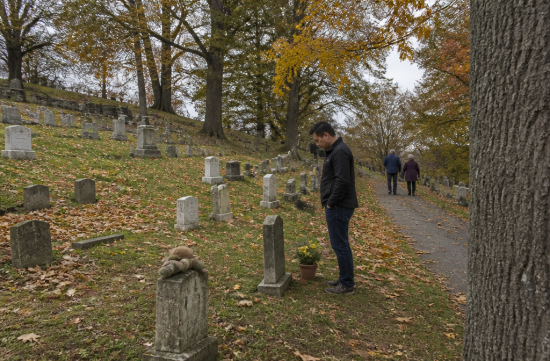
Sometimes, I dream of the dog I lost a long time ago. In the dream, it wags its tail as if nothing happened, but when I wake up, I feel dazed for a while. On those mornings, strangely, the hill of Hartsdale Pet Cemetery comes to mind.
Located on a quiet hill in Westchester, this place is often referred to as the oldest pet cemetery in the United States. When I first passed by, I thought it was just a small park. It wasn't until I realized that all the names on the gravestones belonged to dogs and cats that I stopped in my tracks.
This cemetery wasn't planned. It all started in 1896 with a grieving customer. A client who had lost their dog visited Dr. Samuel Johnson, a veterinarian running an animal hospital in New York City.
The problem was that at that time, burying animals within New York City was not allowed. It must have been overwhelming to figure out where to send their beloved dog. At that moment, Dr. Johnson offered to let them bury it in his apple orchard in Hartsdale.
Imagining this scene strangely warms my heart. A small grave beneath an apple tree. I like that it started from one person's kindness rather than a grand monument.
The story didn't end there. A friend of the doctor, who was a journalist, wrote an article about this event, and the word spread. Soon, requests began pouring in for the doctor to bury their pets there as well.
Eventually, the doctor dedicated part of the orchard entirely as a pet cemetery. It showed that people living in the city shared the same sentiment. It meant that the view of dogs as family rather than mere livestock already existed back then.
The method at that time was quite interesting. When an owner brought their pet to the doctor's office in Manhattan, it would be placed in a coffin and transported to Grand Central, where it would be sent by train to Hartsdale. Imagining an owner boarding a train with a small coffin feels like a scene from a movie, doesn't it?
The cemetery was officially incorporated in 1914 under the name Hartsdale Canine Cemetery. The name included 'canine,' referring to dogs. Later, as various animals were buried there, it changed to its current name.
And indeed, all sorts of animals are buried there. Cats, birds, rabbits, and more. There is even a record of a Russian princess burying a lion cub there in 1912.
When I first heard that story, I thought it was a joke. But most stories about this cemetery are like that. They are real yet somehow dreamlike and surreal.
The place where I stood the longest is the War Dog Memorial. Established in 1923, it was created to honor military dogs that served in World War I. A bronze shepherd stands atop a granite base.
This memorial was funded not by the government but by the cemetery's users. Ordinary owners opened their wallets for the dogs that disappeared in the war. That fact felt heavier than the gravestone itself.
Even now, every June, a memorial service is held in front of this monument. Nowadays, they also honor various service dogs that have worked alongside people.
In 2012, this cemetery was added to the National Register of Historic Places. It was surprising that a pet cemetery, rather than a human cemetery, made it onto that list. The culture of burying animals has been recognized as a page in American history.
The registration materials indicate that the caretaker's cabin, mausoleums, the war dog memorial, and the hilly terrain are all included as preservation targets. It means that the entire landscape, not just a few gravestones, is considered a cultural heritage.
Another interesting fact is that people are also buried here. Many owners have chosen to be buried alongside their pets. I can understand the desire to be together even in death.
As I read the inscriptions on the gravestones, I can see the passage of time. The older gravestones are dignified and short, while the more recent ones often have photos and a more affectionate tone. It made me realize that the way we express grief changes over time.
Growing up in Korea, I honestly found it strange at first. I sometimes felt that putting up a gravestone for a dog was a bit excessive. But knowing the origins of this cemetery changed my perspective.
Ultimately, this place was created for the sorrow that had nowhere to go. The customer from 1896 and the people who visit today feel the same way. It's a space that someone's orchard has provided for feelings that laws or customs could not accommodate.
Nowadays, there are many more diverse ways to handle pet funerals. Cremation is common, and some people bury their pets in their backyards. Still, I'm glad that places like Hartsdale continue to exist.
If anyone plans to visit, I hope you won't wander around noisily like a tourist. It's still a place where actual funerals are held. Just being quiet while taking photos and avoiding stepping on the gravestones is enough.
Visiting in the fall is especially nice. Small gravestones peek through the fallen leaves covering the hill, resembling illustrations from an old fairy tale.
I don't think of this cemetery as a sad place. Rather, it's closer to a place that shows how long love can endure. Even gravestones over a hundred years old still clearly bear someone's name.
I hope that dog comes to me in my dreams again tonight. This time, it would be even better if we dreamt of napping together under the apple tree. So that when I wake up, I feel less empty.
As a side note, the schedule for memorial services and visiting hours may change each year. Be sure to check the cemetery's official website before you go. It's a place that can be explored in a quiet hour on a peaceful afternoon.
 AllOrNothing


 Korean Mom |
 novapixel |
 Peter Pan Pet |
 horse |
 Sunset Oregon |
 liquid asset |
 luido |

 lioness |
 Tennis City |
 Belgray Miscellany |
  Alright Twain |
  eatontown blog |
  HAWAII Korean Church News |
  Amore |
  linex |
  Balancework |
  laro90 |
  MEDBIO American Doctor Blog |
  SWAT TEAM BLK |
  DREAM BIG |
  frostbite |
  330 Forever My Love |
  El Dorado |
  dralix58 |
  Gorama Round |
  Skydiving |
  dreamport |
  Yellow Snowman |
  Toaster Pizza Magic Show |
  velvetnom |