
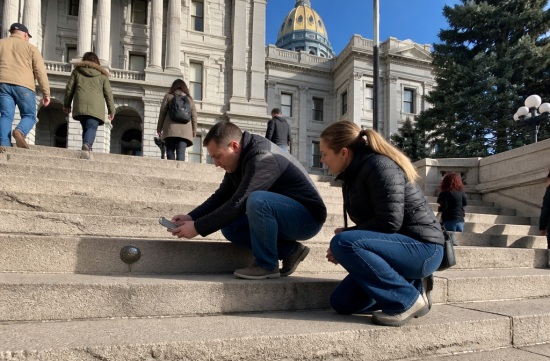
There's a building in downtown Denver with a gold dome, the Colorado State Capitol. As you climb the western stairs, you might notice people stopping oddly on one step to take pictures. At first, I thought there must be some celebrity footprints there.
It turns out that spot marks the "one mile" elevation. 5,280 feet, which is why Denver is called the Mile High City.
But what's interesting is that the marker isn't just on one step. There are separate one-mile markers on the 15th, 18th, and 13th steps. Three one-mile markers? That's quite a plot twist, isn't it?
It all started in 1909. The first official survey determined that the one-mile point was on the 15th step, and a sign was placed there.
The problem was that the sign kept disappearing. Some people took it as a souvenir. Eventually, in 1947, they engraved the phrase "One Mile Above Sea Level" into a stone.
If it can't be stolen, then engrave it. Honestly, I quite like this solution. It feels like they resolved the issue without dragging it into a meeting.
However, in 1969, students from Colorado State University (CSU) conducted another survey, and the results were different. The true one-mile point was actually three steps higher, on the 18th step. So, a brass survey marker was placed there.
If it had ended there, it would have been neat. But in 2003, a more precise measurement revealed that the one-mile point had shifted to the 13th step.
On September 29 of that year, a new brass marker shaped like the Rocky Mountains was placed on the 13th step, attended by then-Governor Bill Owens. It was like the stairs were yo-yoing up and down.
At this point, you might wonder, "So were all those previous people wrong?" I thought so too, but it turns out they weren't.
The key is the datum, or the reference plane for measuring height. Not all sea levels are the same, and depending on which reference model is used, the height value of the same step can vary.
The 1969 marker was based on an older standard called NGVD29, while the 2003 marker used the current NAVD88 standard. The stairs didn't move; the reference changed.
A NOAA representative explained similarly. The previous markers were all correctly placed according to the standards at the time of installation.
So, the 15th, 18th, and 13th steps aren't wrong answers; they're just correct answers for different tests. In this way, a single staircase becomes a timeline of surveying technology.
And this story has been updated again this year. A fourth one-mile point has emerged.
When the National Geodetic Survey (NGS) under NOAA prepared a new national height standard, they re-measured, and this time the 17th step was confirmed as the one-mile point. A private surveying company also participated in the July survey to provide backup data.
The new standard is called NAPGD2022. It is set to replace NAVD88 and defines height based on GPS and gravity data.
According to NOAA, the accuracy of height differences used to be about one foot, but now it has improved to the centimeter level. This isn't just a tourist point issue; it's data used for things like flood maps.
The original plan was to install the new marker on August 1, Colorado Day, coinciding with Colorado's 150th anniversary. However, local reports in July indicated that the official marker installation has been postponed to next year.
In the meantime, a magic pen line drawn by the NOAA team marks the 17th step. It's amusing yet human that the national benchmark is just a Sharpie line.
The official marker is expected to be installed after the new height standard officially takes effect, which is anticipated to be in 2027. Schedules may change, so be sure to check before your visit.
One more interesting fact is that Denver is not the highest state capital in the U.S. Santa Fe, New Mexico, and Cheyenne, Wyoming, are both higher than Denver. Denver may have the name recognition, but not the elevation.
Personally, I appreciate this staircase story because it embodies the idea of "if it's wrong, we fix it" in a very straightforward way. They added new markers without removing the old ones.
These days, whenever a new standard comes out, people tend to want to erase the old one. I believe that, like this staircase, it's much more mature to keep records and update the data.
And this wasn't turned into a large government budget project either. Students surveyed, the geodetic survey office re-evaluated, and private companies contributed backup data, all of which piled up on the stairs. This makes me feel like tax money is well spent.
If you're visiting Denver, be sure to count the 13th, 15th, and 18th steps on the western stairs of the State Capitol. You might even spot the magic mark on the 17th step if you're lucky.
On weekdays, there are free Capitol tours every hour on the hour, so it's a good idea to stop by. The guides say they get asked the question "Where is the one mile?" the most these days.
If it were me, I would step on all four and take four pictures. If you ask which one is the real one, the answer is simple: they're all real; the standards just varied at the time.
 MacaronJoyfl







 Korean Mom |
 novapixel |
 Peter Pan Pet |
 horse |
 Sunset Oregon |
 Your Curiosity Resolved |
 LIZ Legal Information Blog |

 coloradoman |
 Jean Claude Bundang Blog |
  MEDBIO American Doctor Blog |
  SWAT TEAM BLK |
  DREAM BIG |
  frostbite |
  330 Forever My Love |
  El Dorado |
  dralix58 |
  Gorama Round |
  Skydiving |
  dreamport |
  Yellow Snowman |
  Toaster Pizza Magic Show |
  velvetnom |
  Anytime Journey |
  Mrs. Duluth |
  jaxter |
  Atlanta Mama |
  Baguette Blog |
  Tan Sol |
  US Embassy |