
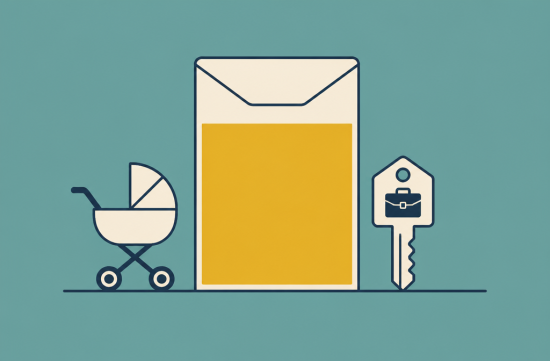
Recently, a coworker asked me how much leave they could take since they are expecting a baby next spring. However, they were unaware that Delaware's Paid Leave has been in effect since January of this year. It seems many people are in the same boat, so I've organized some key numbers for clarity.
First, let's look at the timeline. The deduction for insurance from paychecks started on January 1, 2025. The actual benefits can be applied for and received starting January 1, 2026.
This means if you noticed a new deduction on your paycheck last year, it was likely this. You pay for a year in advance, and the benefits start this year.
The most common question is how much you will receive. You will get 80% of your average weekly pay over the past 12 months. However, for 2026 and 2027, there is a cap of $900 per week.
For example, if your average weekly pay is $1,000, you will receive $800 per week. If your average weekly pay exceeds $1,250, the calculation will be capped at $900.
Thus, those with higher salaries will feel a lower percentage. Conversely, the minimum amount is $100 per week, and if your average weekly pay is less than $100, you will receive the full amount of that weekly pay.
Another advantage is that there is no waiting period. You become eligible for payment starting from the first day of your leave. However, taking less than a day off in a week does not qualify for payment.
The duration of leave varies by reason. Many people get confused about this part.
Parental leave for childbirth or adoption is a maximum of 12 weeks per year. Medical leave for personal illness, caregiving for family, and military family leave can be combined for a maximum of 6 weeks over 24 months.
Additionally, for any reason, you cannot exceed a total of 12 weeks in one application year. This means if you use all 12 weeks for childbirth, you cannot take additional caregiving leave in the same year.
You also need to check the eligibility requirements. You must have worked for the same employer for at least 12 months and have worked over 1,250 hours in the previous 12 months.
1,250 hours is roughly equivalent to working 24 hours a week consistently. Full-time employees will have no issues, but part-time workers or those who have been employed for less than a year may not qualify yet.
The size of the company is also important. If a company in Delaware has 25 or more employees, you can use parental, medical, and caregiving leave.
Companies with between 10 and 24 employees are only eligible for parental leave. Businesses with fewer than 10 employees are not obligated to comply. If you work at a Korean restaurant or a small shop, be sure to check this part.
Now, regarding costs. For businesses with 25 or more employees, the insurance rate for 2025 and 2026 is 0.8% of wages.
Breaking it down, medical is 0.4%, parental is 0.32%, and caregiving is 0.08%. Companies with 10 to 24 employees only pay the parental share of 0.32%.
Employers can only deduct up to half of this from employee wages. For an annual salary of $60,000, the total insurance cost would be $480 per year, with the employee's share being at most $240.
Some companies cover the entire employee share. You can find out exactly how much is deducted from your paycheck by asking HR.
The rate for 2027 has not yet been officially announced. According to the law, the Department of Labor sets it annually, with a cap of 1%.
Equally important as money is job protection. After your leave, you can return to your original position or a comparable one, and your health insurance will remain active during your leave. However, you must continue to pay your share of the insurance premiums.
Opinions on this system are divided. For small businesses, having someone absent for several weeks can be a burden, and the 0.8% is ultimately considered a labor cost.
On the other hand, the federal FMLA is unpaid, and many people have been unable to take time off even when they wanted to. The argument that receiving 80% of income changes the options significantly is certainly compelling.
From the data perspective, I believe the employee burden is not significant. It's like paying a few hundred dollars a year for insurance that provides up to $900 per week. However, I think more support for small businesses needs to be considered.
If you plan to use this, it's best to act early. If it's a scheduled leave like childbirth, inform your company early and check how many hours you have worked.
The application process and required documents are outlined on the Delaware Department of Labor Paid Leave page. If your company has replaced it with a private insurance plan instead of the state program, it's best to first ask HR which one it is.
In areas like Newark, where there are many jobs in universities, hospitals, and logistics, many people will likely be eligible. Since you are already paying into the system, it's important to know what you can receive and make sure to claim it.
If I were you, I would pull out a paycheck right now and check the deduction items. That's the first step in making this system work for you.
 PvtKim







 My NYC |
 coloradoman |
 Living Economy Information Blog |
 Tomato Health Club blog |
 Banana Style Life |
 Doori Ark |


 Min's blog |

 Generation X |
  cookie |
  Live and that's it |
  Alright Twain |
  eatontown blog |
  HAWAII Korean Church News |
  Amore |
  linex |
  Balancework |
  laro90 |
  MEDBIO American Doctor Blog |
  SWAT TEAM BLK |
  DREAM BIG |
  frostbite |
  330 Forever My Love |
  El Dorado |
  dralix58 |
  Gorama Round |
  Skydiving |
  dreamport |
  Yellow Snowman |