
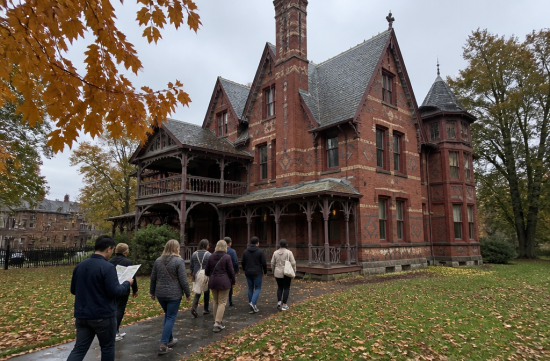
As you pass by Hartford's Farmington Avenue, a house with a pointed roof made of red bricks catches your eye. At first glance, one might think it's a church due to its elaborate decorations. This is the Mark Twain House.
This house is often introduced as the birthplace of Tom Sawyer and Huckleberry Finn. While that's not incorrect, a closer look reveals a more complex story. Today, I will unfold that story step by step.
First, let's see why Twain came to Connecticut. The Missouri-born author settled in New England for surprisingly practical reasons. His publisher, Elisha Bliss, was based in Hartford.
The family began living in a rental house in a neighborhood called Nook Farm in 1871. They then decided to buy land and build a house, hiring New York architect Edward Tuckerman Potter for the design.
Construction started in 1873, but the couple was actually abroad at that time. Most of the design discussions were handled by his wife, Olivia. In September 1874, the family moved in before the house was fully completed.
It's said that they went significantly over budget. Records show that it cost more than $10,000 over the initial plan. It seems that budget overruns in home building were just as common 150 years ago.
The neighbors were impressive as well. Right next door lived Harriet Beecher Stowe, the author of Uncle Tom's Cabin. So, a writer who stirred anti-slavery sentiment and a symbol of American literature lived just a fence apart.
The family lived in this house from 1874 to 1891, a total of 17 years. During that time, Twain wrote The Adventures of Tom Sawyer, The Adventures of Huckleberry Finn, The Prince and the Pauper, Life on the Mississippi, and A Connecticut Yankee in King Arthur's Court.
Looking at the numbers is even more astonishing. Tom Sawyer was published in 1876, and Huckleberry Finn came out in 1885, meaning that two of his major works were released within ten years during his time in this house. It's not common for an author's peak to be concentrated at one address, is it?
The study was a billiard room on the third floor. The billiard table occupied the center of the room, while the desk was tucked into a corner. It's said that he wrote with his back to the billiard table.
I find this part the most interesting. The fact that he didn't set up a separate study and instead wrote in a play area reflects his character. I can picture him inviting guests to play billiards and smoke cigars before returning to his manuscript.
However, the story takes a turn here. Every summer, the family went to Quarry Farm in Elmira, New York, which belonged to Olivia's sister, Susan Crane and her husband.
In 1874, Susan built a small octagonal study on the hill and gifted it to Twain. According to records from Elmira, much of the early drafts of Tom Sawyer and significant portions of Huckleberry Finn and Life on the Mississippi were written in that study.
Twain himself referred to that study as Huckleberry Finn's house in an interview in 1886. He claimed he wrote there ten times faster than anywhere else.
So, to be precise, a significant portion of the manuscripts was written during summers in Elmira, while Hartford was the center of his life for refining and publishing those works throughout the year.
That doesn't diminish Hartford's significance, though. It was where the publishing house was located, where the family grew, and where he achieved both financial success and recognition as a writer. Don't you think both places need to be considered together to complete the picture?
The good times didn't last long. Twain invested heavily in a typesetting machine and nearly went bankrupt. Ultimately, in 1891, the family left for Europe, where living expenses were lower.
They never returned to live in that house again. In 1896, his eldest daughter, Susy, visited Hartford and passed away in that house. Twain sold the house in 1904.
Since then, the house has had various owners, serving as a school, library, and apartments. It's a bit bittersweet to think that a once-grand mansion was divided among tenants.
In 1962, it was designated a national historic site and underwent restoration in the 1960s and 70s. In 2003, a new museum building was constructed right next to it.
From an immigrant's perspective, viewing this house brings a different thought. Twain himself was someone who moved from southern Missouri to the northeast and blended into a new community. Settling down according to work and connections, despite different backgrounds, isn't so different from our experiences today.
Huckleberry Finn still sparks debate in school libraries due to its racial expressions. I believe it's more appropriate to teach the historical context rather than banning it. If we remove books that directly address slavery, we lose the opportunity to discuss that history.
The Stowe house next door is also operated as a museum, so many people visit both places as a day trip. A half-day is usually sufficient.
Operating hours and admission fees change with the seasons, so it's best to check the official website before going. Often, you can only see the interior through guided tours, so make sure to book in advance.
Visiting in the fall is especially nice. The red brick house pairs beautifully with the autumn leaves. If you have a child, I recommend reading Tom Sawyer together before your visit.
In summary, Tom Sawyer and Huck were born between the Hartford mansion and the Elmira hill study. Still, the house that holds the essence of that era is in Hartford.
If it were me, I would visit the Hartford house first, and if time allows, I would also go to the Elmira study in the summer. It would be quite enjoyable to piece together a writer's 17 years across two locations.
 NebraSanta







 SEVEN SEVEN |
 Korean Mom |
 novapixel |
 Peter Pan Pet |
 horse |
 Jin Soo V |
 Buckwheat Muktudari Notebook |

 loverun |
  Kim Do Sun |
  yentra |
  Make My Day |
  Victory 1988 |
  Tonky |
  viroma |
  cookie |
  Live and that's it |
  Alright Twain |
  eatontown blog |
  HAWAII Korean Church News |
  Amore |
  linex |
  Balancework |
  laro90 |
  MEDBIO American Doctor Blog |
  SWAT TEAM BLK |
  DREAM BIG |