

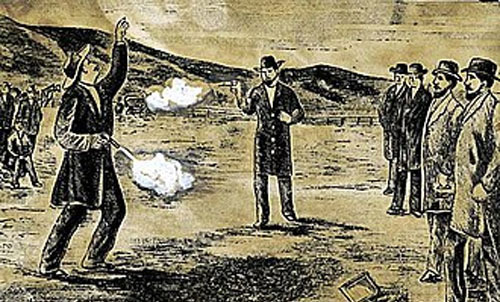
In Western movies, you often see two men fighting in a saloon, and one says, "Tomorrow morning, we duel!"
And then they actually show up the next day with guns. They argue, sleep it off, and then risk their lives to fight?
This piqued my curiosity, so I looked into when dueling actually started. The history of dueling is older than I expected.
Even in ancient times, there were instances of resolving disputes through one-on-one combat, but one of the roots of formal dueling can be found in the medieval European 'trial by combat.'
In cases where evidence was lacking, the parties involved would fight to determine the outcome. There was also a belief that God would grant victory to the righteous.
Later, in Europe, dueling evolved from a judicial practice to a means of preserving 'honor.'
Nobles or officers who were publicly insulted could be seen as cowards if they did not respond.
This led to a culture where demanding an apology from the other party and, if refused, resorting to a duel with swords or guns became common.
However, it wasn't as simple as pulling a gun on the street.
Both sides had a 'second,' a mediator who would discuss the time, place, and weapons to be used.
The second could also negotiate an apology and cancel the duel altogether.
This culture made its way from Europe to America.
However, there was one misconception I had.
I thought dueling was legal in early America, but that wasn't necessarily the case.
In America, during the colonial period and the early years of the nation, dueling was customarily tolerated or actually practiced in certain regions and social classes.
But it was not a legally sanctioned method of murder. In many areas, dueling was already illegal, and if one party was killed, it could lead to murder charges.
Interestingly, the law and reality often diverged.
Because the culture of "dueling for honor" persisted among social elites like politicians, military officers, and lawyers, actual duels occurred even when they were legally prohibited.
Juries or local communities sometimes showed sympathy for duel participants.
A notable incident was the duel between Alexander Hamilton and Aaron Burr in 1804.
Burr, who had served as Vice President, and Hamilton, a key figure in the founding of the nation, fought with pistols, and Hamilton died the day after being shot.
Then in 1859, something even more astonishing happened in California.
Current U.S. Senator David Broderick and former California Chief Justice David Terry engaged in a duel.
In modern terms, it was like two major political figures and a former top judge going to a remote location to settle their differences with guns.
The two were originally friends and political allies in the same Democratic Party. However, they reportedly split over the issue of slavery.
Political conflict eventually turned into a personal feud. They exchanged harsh words, and Terry demanded a retraction of statements he felt damaged his honor. When this was unresolved, a duel was ultimately decided upon.
On September 13, 1859, the two met in a secluded spot near Lake Merced in San Francisco.
Ironically, even though the police had previously prevented attempts at dueling, they changed locations and met again.
The weapon used was a .58 caliber pistol. Terry was familiar with this gun and had practiced with it, while Broderick was not.
Moreover, the pistol Broderick received had a very sensitive trigger.
Ultimately, Broderick's gun fired before he could aim properly, sending the bullet into the ground, while Terry's bullet hit Broderick. Broderick died three days later.
This incident remains one of the last famous duels in America.
And two years later, in 1861, during the Civil War, the culture that viewed dueling as an honorable way to resolve disputes rapidly lost its power.
Even after the war, some duels occurred, but socially they became seen as anachronistic behavior, and legal repercussions became more stringent.
Today in America, the excuse of "we agreed to duel" obviously does not hold up.
If you injure or kill someone with a gun or knife, you are subject to general criminal law for assault or murder.
Ultimately, the interesting thing is this.
Dueling in early America was not the legally sanctioned gunfight we see in movies.
It was closer to a dangerous custom that continued in some parts of society under the name of honor, despite being illegal.
Now, when politicians insult each other, they go on TV to rebut, fight on social media, and sometimes even sue each other.
One amusing fact is that even though dueling has disappeared for nearly 150 years, some state constitutions in America still bear traces of it.
In Kentucky, for instance, public officials still take an oath stating, 'I have not engaged in a duel with a deadly weapon, nor have I requested or accepted a challenge to duel, nor have I assisted anyone in such a duel.' This means that someone taking office in 2026 will be reading an oath that sounds like something out of an 1800s Western movie.
 GoldenRain
 BubbleWarrior







 daisypat |
 Anjollinya Blog |
 Anova US Beauty Information |
 anchor |
 Korea Tiger News |
 Round and Round Children's Song Kingdom |


 Spaghetti Flying Religion |
 Lifestyle Information Search USA |
  Stable Co. |
  Purple Moons, |
  International Court |
  roma |
  horse |
  moodansa 77 |
  zymit |
  maplefox |
  Fun Flex Life |
  hopeful |
  Reeno |
  Coastal city |
  meonetoo |
  Winter bear |
  Peach Jam Eating Laughter |
  Nando Raldo |
  American Man in a Mask |
  wendra |
  silver |
  bada2002 |