
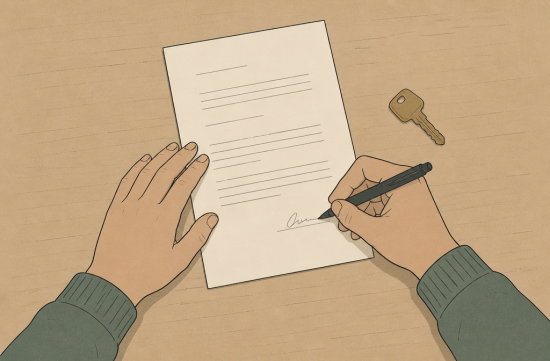
Recently, while catching up with a friend living in the U.S., he casually mentioned that he had just updated his will.
When I asked his age, he said he had just turned thirty, and when I questioned why he was preparing such a document so early, he seemed surprised that I was surprised.
In Korea, a will is often seen as a document written by older adults on their deathbeds or while wrapping up their lives, but the scene I encountered in the U.S. was quite different.
In fact, when looking at various data, this temperature difference is not just a feeling but is clearly reflected in specific numbers.
Among Americans under 30, about one in five has a will, while for those over 65, that ratio jumps to three out of four.
While the older generation still overwhelmingly prepares wills, the noticeable increase in activity among younger people in recent years is the most interesting aspect of this statistic.
One of the key factors driving this change is undoubtedly the COVID-19 pandemic.
During the pandemic, 45 percent of respondents aged 18 to 34 said they began to seriously consider making a will.
During the same period, the rate of will ownership among younger generations increased by 63 percent, indicating that death no longer feels like a distant event.
In fact, in 2021, for the first time, the proportion of those aged 18 to 34 with wills surpassed that of those aged 35 to 54, marking a reversal that hadn't been seen in many years.
It felt a bit strange to encounter statistics showing that young people are taking care of these documents before middle-aged individuals.
Of course, the pandemic is not the only reason for all these changes.
Milestones such as getting married, having children, and buying a first home are often cited as the most common triggers for pulling out a will.
At each stage of life where responsibilities increase, it seems natural to open the file cabinet, and interestingly, these transitions tend to cluster around the age of thirty rather than at the end of one's twenties.
Among these reasons, the one that resonates most with people is, of course, children.
Parents want to designate a guardian for their children in case something happens to both of them, which is why they write a will.
Hearing that people tend to think more carefully and for longer about this aspect than about how to divide their assets is quite touching.
However, despite the clarity of these reasons, the mindset does not always translate directly into action.
Among parents with minor children, the actual rate of those who have prepared a will is only about 36 percent, according to survey results.
When asked why they don't have a will, the most common response was not a grand reason but simply that they haven't found the time, with more than one in three responding this way.
It seems that while the intention is already set, the final step of putting it into writing keeps getting postponed.
The changing composition of assets among today's generation is also a new variable at play.
There is a growing awareness among young people that they need to account for intangible assets like cryptocurrencies, online accounts, and photos stored in the cloud.
They seem to understand that the more intangible the assets, the more likely they are to disappear without a trace if not documented in advance.
The increase in online services that allow for the creation of basic wills at a low cost has also lowered the barrier for younger generations.
What used to require dressing up and knocking on a lawyer's office door can now be done calmly at home in front of a laptop after work.
After hearing all these stories, my perception of the word "will" has gradually changed.
Rather than preparing for death, it feels more like a way to leave a final consideration for loved ones.
Making such a commitment around thirty doesn't seem to stem from a heavy view of life, but rather from valuing the happiness one currently enjoys and the people around them.
Of course, for some, the idea of preparing a will at thirty may still feel unfamiliar and distant, and I think it's natural that there are varying degrees of comfort with this topic.
Still, if it were me, I would lean towards organizing these thoughts on paper sooner rather than later.
The attitude of preparing something for loved ones that no one has asked for feels beautifully kind, regardless of age.
 LottoWishes


 Korea Tiger News |
 Alpha and Omega World |
 Florida King |
 AH LALA |
 Victory 1988 |
 North Dakota Ragdoll Cat Owner |
 My Love Sandra |
 reliable |
 buddydakota |

 Smile Face |
  anchor |
  stalion |
  The Long Shot |
  Investment Beginner Company Information Encyclopedia |
  sweetfox |
  ceporta |
  H Leader |
  My tracks |
  Yes Dorian |
  novent |
  calviro |
  Enjoying Samba at Home |
  Once in a Lifetime |
  novapixel |
  Banana |
  rouge88 |
  toffee |
  King County |