

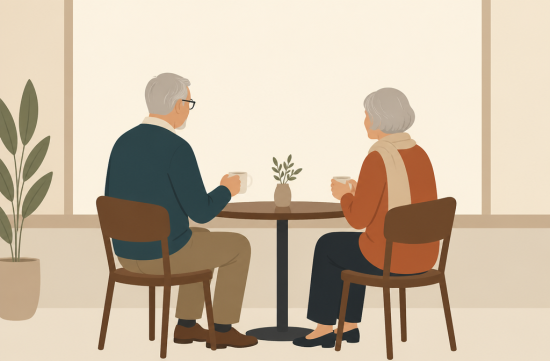
These days in America, it's not uncommon for people in their 60s and 70s to start new romantic relationships. Stories about seniors posting profiles on dating apps are frequently heard.
When people first hear such stories, they often react with surprise. It's understandable to wonder if it's really necessary to meet new people at that age.
However, looking at the statistics reveals that this is not an exceptional phenomenon. The percentage of adults aged 65 and older who are single is as high as 36 percent.
For those aged 50 to 64, this percentage is slightly lower at 29 percent. This indicates that as people age, the likelihood of becoming single due to the loss of a spouse or divorce increases.
Interestingly, attitudes toward being single vary significantly by gender. Among women aged 65 and older, 49 percent are single, while the figure for men is only 21 percent.
The desire for a new relationship after losing a spouse also differs markedly between genders. Among those who lost a spouse a year and a half ago, 15 percent of women expressed a desire to date again, compared to 37 percent of men.
Among women over 50 who have experienced divorce or widowhood, 60 percent reported no interest in remarrying. In contrast, only 35 percent of men in the same situation felt the same way, indicating a significant gap.
The reasons behind this are understandable. Women tend to have stronger social networks with friends and family, which means they often feel less emotionally lonely without a new partner.
At this point, I honestly nodded in agreement. Older women seem to understand that marriage is not the only means of emotional stability.
On the other hand, men tend to find it much harder to live alone after losing a spouse or going through a divorce. As a result, they tend to seek new relationships more quickly, whether through remarriage or new dating.
However, this doesn't mean that older individuals are necessarily dating with the goal of marriage. Nowadays, there is a growing trend of maintaining relationships without marriage or cohabitation.
This is referred to as 'living apart together,' which literally means maintaining a romantic relationship while living separately. Research shows that the percentage of older adults choosing this method is steadily increasing.
When considering why this approach is chosen, practical reasons play a significant role. Many feel no need to combine their lives when they already have their own homes, belongings, and finances.
In fact, studies have shown that older adults who maintain such relationships have better mental health indicators than those who live alone. However, there was not a significant difference when compared to those who are cohabiting or married.
This suggests that having someone emotionally supportive nearby is more important than the form of living together itself. It means that one does not have to be bound by the institution of marriage.
Personally, I find this aspect quite practical. I believe there is no need to be legally or financially entangled even as one ages.
It's also worth looking at marriage-related statistics. As of 2013, 50 percent of adults aged 65 and older had remarried, a significant increase from 34 percent in 1960.
However, in recent years, the percentage of those aged 65 and older who remarry within ten years of divorce has been recorded at 22 percent. This aligns with a trend of preferring flexible relationships like cohabitation or living apart together over remarriage.
Divorce among older adults has also noticeably increased. In 1990, divorces among those aged 50 and older accounted for only 8.7 percent of all divorces, but by 2019, that figure had risen to 36 percent.
Focusing solely on those aged 65 and older, the divorce rate tripled during the same period. Thus, 'gray divorce' has become a common occurrence in America.
As the divorce rate has increased, so has the number of older adults who find themselves single, naturally leading to more people seeking new relationships. The numbers alone explain why this trend continues.
Interestingly, attitudes toward online dating vary. Among singles aged 50 and older, 26 percent have used dating apps in the past year, which is significantly lower than the 53 percent of those aged 18 to 49.
However, when looking at a broader timeframe of the past three years, 49 percent of those aged 50 and older reported having used dating sites. This indicates that while they may not be as active as younger individuals, they are certainly not passive.
That said, the degree of actively seeking relationships does decrease with age. Among singles aged 65 and older, only 16 percent are actively looking for new relationships.
For those aged 50 to 64, the figure is 36 percent, while for those under 50, it is 57 percent, showing an inverse relationship with age. It seems that rather than actively seeking, they are open to new connections if the right person comes along.
There are also emotional reasons at play. In surveys about sexual activity among older adults, 40 percent reported still being sexually active, and a high percentage indicated that this aspect remains important within relationships.
Ultimately, all these statistics point in one direction. The desire for intimacy does not disappear with age.
However, the ways in which that desire is fulfilled differ from when one is younger. Instead of adhering to the single answer of marriage, individuals are now choosing forms that suit their own circumstances.
Personally, I find this trend to be quite rational. Prioritizing the substance of relationships over their form seems to be the wisdom that comes with age.
Whether it's marriage or living apart together, what matters is having someone to care for each other. The ways of finding that answer have diversified, but the desire to connect with others seems to remain the same, regardless of age.
 RagingBunny






 Alpha and Omega World |
 Florida King |
 AH LALA |
 Victory 1988 |
 Panorama Kstar |
 Dingho and USA News |
 Always Atlanta |
 Let's Be Like a Salt-like City Person |
 moonshine 7 |
 SPACE SHIP |
  Enjoying Samba at Home |
  Once in a Lifetime |
  novapixel |
  Korea Tiger News |
  Banana |
  rouge88 |
  toffee |
  King County |
  DREAM BIG |
  Good News Good Thoughts |
  peelynew |
  Helpful Life Stories |
  chicpo |
  monorama tone |
  Kentucky Fried Chicken |
  bloomberg |
  morninpo |
  my town K blog |
  bravik31 |
  Various Knowledge and Information in the USA |