
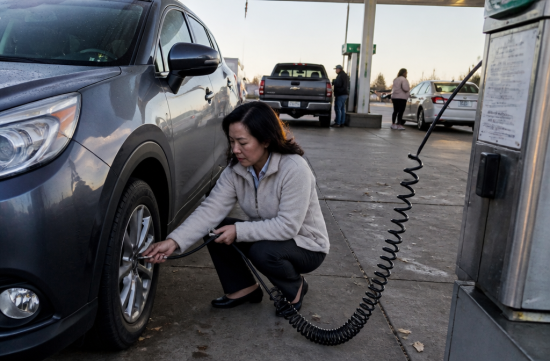
Last week, one morning, I started my car to head to work, and there was a yellow light lit up on the dashboard. It was the tire warning light, shaped like a horseshoe with an exclamation mark inside.
My mind started racing. Did I get a flat? What about the meeting today? But when I got out and checked all four tires, they looked fine.
Later that day, when I got back in the car around lunchtime, the light was off. I thought it might be a malfunction, but it turned out this was a completely normal response.
The key factor is temperature. When the air gets cold, it contracts, and the air inside the tires is no exception.
There's a common guideline mentioned in various sources, including AAA. For every 10 degrees Fahrenheit drop in temperature, tire pressure decreases by about 1 PSI.
Considering the weather in my area lately, this makes perfect sense. During the day, it's warm enough for short sleeves, but in the early morning, I need to pull out a jacket.
On average, the high temperature in October is in the low 70s Fahrenheit, while the average low is around 50 degrees. This means the temperature can swing more than 20 degrees in a single day, which could cause tire pressure to fluctuate by over 2 PSI.
So when does the warning light come on? It actually takes a while to activate. You might be surprised by the numbers.
According to the federal motor vehicle safety standard FMVSS 138, if the pressure in any tire drops more than 25% below the manufacturer's recommended level, the warning light should come on within 20 minutes.
This means that if the light is on, your tire was already significantly under-inflated. A tire that was already a bit low has now dropped below the threshold due to the cold morning air. Tires naturally lose a little air over time.
The reason the light turned off during the day is the same. When driving in the sun, the tires heat up, causing the pressure to rise again. However, this doesn't mean the problem is resolved.
By the way, this feature isn't found in every car. The TREAD Act was passed in 2000, and since September 1, 2007, it has been mandatory for passenger cars and light trucks produced after that date to have a Tire Pressure Monitoring System (TPMS).
The catalyst for this was the Firestone tire recall crisis in the late 1990s. Tire tread separation led to rollover accidents, and low tire pressure was identified as a significant cause.
So, it's not a light to ignore. While we shouldn't expect the government to take care of everything, we can view it as a signal to take care of our own vehicles.
So what should you do when the light comes on? I've organized the steps like this. It's not difficult, so just remember it once.
First, check the recommended tire pressure. When you open the driver's door, there's a sticker on the door frame or B-pillar, known as a placard.
Many people get confused by the numbers on the sidewall of the tire. The numbers printed there indicate the maximum pressure the tire can handle, not the recommended pressure for that specific vehicle.
I used to fill my tires to the sidewall numbers until I got a talking-to from my regular mechanic. Honestly, I thought that was the right way until then.
The second point is the timing of the measurement. The recommended tire pressure is based on a cold tire, so it's best to check it after the car has been parked for a few hours.
If you check it after driving for a while, the heated air will give you a higher reading. So, it's better to check it before you leave for work in the morning or when you're almost at the gas station.
The third point is not to ignore the light if it turns on in the morning and then goes off during the day. As the weather gets colder, that tire will likely be the first to drop below the threshold again.
However, there are times when the light behaves differently. If it blinks for about a minute to a minute and a half when you start the car and then stays on, that's a different situation. Surprisingly, many people don't know this difference.
This indicates a problem with the system itself, not just the tire pressure. The battery in the sensor inside the tire may be weak, or the sensor could be malfunctioning.
Since the sensor battery is built-in and cannot be replaced separately, the entire sensor usually needs to be replaced. In this case, adding air won't help, and it's best to get a diagnosis at a repair shop.
To summarize: if the light stays on, check the tire pressure. If it blinks and then stays on, check the sensor.
And don't just rely on the warning light; check your tire pressure yourself at least once a month. Waiting until it's 25% low is too late.
Since that incident, I bought a few-dollar gauge and keep it in my glove compartment. I take it out to check the pressure every now and then when I'm at the gas station, and it surprisingly gives me peace of mind.
When the tire pressure is right, fuel efficiency improves, and the tires last longer. Most importantly, it reduces the chances of feeling uneasy on the highway. Conversely, driving with low pressure can cause the tires to overheat and increase stopping distances.
So, if you see that yellow light on a chilly morning, don't panic. Just don't ignore it either. If it were me, I'd stop by the gas station on my way home that day.
 JollyBear


 sun walker |
 Let's Be Like a Salt-like City Person |
 Springs Korea |
 US Legal Consultation on Trials |
 Study Abroad Life Know-How Tips |
 pintos |

 Chimhanbang Korea ACU |
 hazelnut |

 Hairy Poppins |
  daisypat |
  Taco Bell Candy Note Blog |
  MintO |
  My Town My Way Blog |
  New Mexico Friends MAX |
  Hajiwon Blog Hair Salon |
  Wicked - Fireyo |
  Seattle - Emerald City |
  new noah |
  xylora |
  Anjollinya Blog |
  total solution |
  Vacation on Hawaii |
  valtri |
  August Snowman |
  Way to easy |
  Pirate Ship Popcorn Maker |
  USA Business News |
  Samsung My My |