
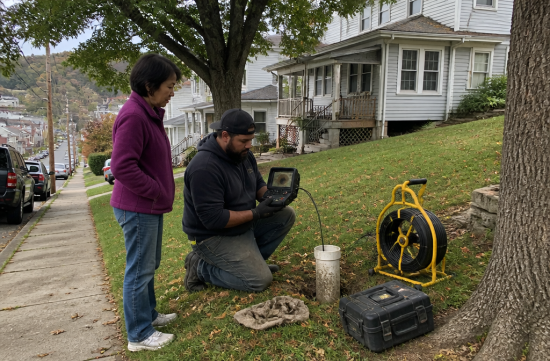
Recently, a family brought an inspection report for an old single-family home they were about to contract. The report detailed the roof, electrical system, and boiler, but there was not a single line about the sewer line under the yard.
They assumed the inspector must have checked the sewer line as a matter of course. However, that is a misunderstanding.
According to the standards of the American Society of Home Inspectors (ASHI) and InterNACHI, a general home inspection involves checking visible areas, and underground sewer lines are not included in that scope.
The inspector will run water inside the house to check if it drains properly. However, the condition of the pipes leading from the house to the main line on the street can only be determined by inserting a camera.
This is why a sewer camera inspection, commonly referred to as a sewer scope, is requested separately. A small camera is pushed through a cleanout access point to visually inspect the inside of the pipe.
There is an additional reason why this inspection is particularly important in this area. The Morgantown Utility Board (MUB) states that the repair responsibility extends to the water meter and the point where the home's sewer line connects to the main line.
In other words, if the pipe from that connection point to the house breaks, the repair is the homeowner's responsibility. MUB also explains that these pipes are often buried deep underground, and repair costs can easily reach thousands of dollars.
MUB's partnership with HomeServe to offer sewer line warranty products is also based on this background. However, warranties come into play after an incident, and it is essential to check the current condition of the home before purchasing.
So, should every home have this inspection? In my opinion, there are certain homes that definitely should.
First, homes that are older. Various cost guides and inspection companies generally recommend inspection for homes over 20 years old.
Second, homes built between 1945 and 1972. During this period, sewer lines made of Orangeburg pipe may have been used.
Orangeburg pipe is made from a mixture of wood pulp and pitch, a material that was used cheaply during the metal shortages of World War II. Over time, it can become crushed and deformed, so if it is still present, its condition must be checked.
Third, homes in older neighborhoods that are likely to have clay pipes buried. These pipes are made of short segments joined together, which means there are many joints where tree roots can easily invade.
Fourth, homes with large trees standing between the house and the road. Roots tend to follow water, so a large tree directly above the sewer line is a reason to check.
Fifth, homes with water stains around the basement floor drain or records of plumbing cleaning by the seller. Long-vacant homes may not have shown issues due to minimal water usage, so they fall into the same category.
What about the costs? The cost information site HomeGuide suggests an additional fee of $100 to $250 for a home inspection.
If called separately, the range is indicated as $125 to $500. Additional costs may apply if access is needed through the home's drains or if a toilet needs to be removed.
Conversely, what about sewer line repairs? According to similar sources, major sewer line work can cost anywhere from $5,000 to over $20,000.
When you compare the numbers side by side, there's not much reason to hesitate. A few hundred dollars for an inspection can help you avoid thousands or tens of thousands of dollars in potential risks.
In the past, suggesting this inspection often drew reactions of being overly cautious. Nowadays, it's increasingly common for buyers to ask about it first, indicating a shift in awareness.
When you do have the inspection, I recommend keeping a few things in mind. Be sure to get the video file. A written report alone may not adequately convey the location and severity of any issues.
Ask how far the camera was able to inspect the line. If the camera got stuck and couldn't reach the main line, there may still be unknown areas beyond that point.
If issues arise, it's wise to obtain estimates from plumbing companies within the inspection contingency period. This way, you can substantiate any price adjustments or repair requests.
The difference between a few visible roots and a completely broken or collapsed pipe is significant. Rather than hastily backing out of a contract based on a single video, it's better to seek a second opinion from a professional.
Contract terms and warranty coverage vary by home and contract, so be sure to confirm with your agent or plumbing expert before making a final decision.
The family I mentioned earlier ultimately added the camera inspection. Fortunately, there was no major damage, and they received results indicating that only root removal was necessary.
If it were me, I would not hesitate to include this inspection for older homes, homes with large trees, or homes built before the 1970s. I've seen too many cases where hidden issues end up being the most expensive to fix.
 EyeBoogerFae









 urbanmint |
 |
| 
 Premium Gas Camp |
 CA Real Estate |
 Gomex Korea |

 castle |
 |
| 
 silver |
  wendra |
  bada2002 |
  horizon |
  Nanana Nanana Nanana |
  victoria jung |
  Kkikki Ppappa Shout Out Loud |
  Lululala |
  Toaster Pizza Magic Show |
  nortrix |
  Mau Nui |
  novapixel |
  fixed |
  AL ALASKA |
  amola |
  History Repeats Itself |
  Doori Ark |
  Rainbow Bridge to the Sky |