

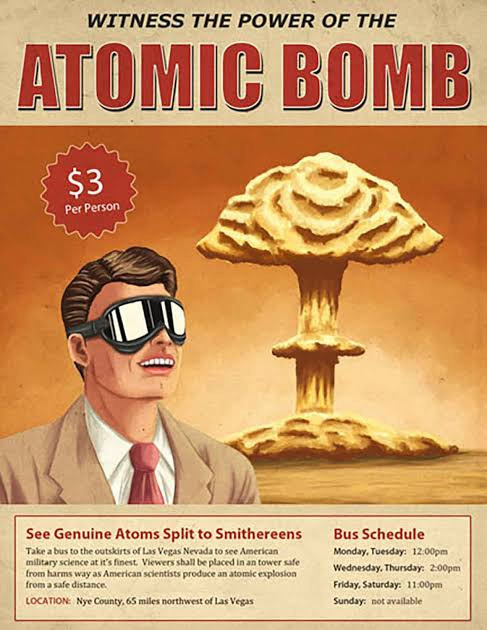
On the morning of January 27, 1951, a flash split the sky over the desert northwest of Las Vegas.
It was Able, a 1-kiloton device, the first experiment of Operation Ranger.
The location was the Nevada Test Site, 65 miles from downtown.
From that day on, the city began to gain fame in an entirely unexpected way.
Looking back, it seems crazy, but at the time, people gathered on hotel rooftops to watch the nuclear bomb explode.
From 1951 to July 1962, there were 100 atmospheric nuclear tests conducted at this site.
When combined with 828 underground tests until 1992, the total reached 928. Just looking at the numbers, the Nevada desert was at the forefront of the Cold War.
Perhaps collectively losing their minds, the Las Vegas Chamber of Commerce created a calendar listing the times and best viewing spots for the explosions and distributed it to tourists.
In other words, it was a guide for watching nuclear tests. As the schedule was announced months in advance, some people planned their trips around it.
Hotels and casinos held what they called Dawn Bomb Parties.
They would start drinking and singing at midnight, and when the morning flash lit up the sky, they would cheer.
The most popular spot was the Sky Room at the Desert Inn.
The lounge on the third floor faced the test site, providing a great view, and they even served a menu item called the Atomic Cocktail.
The atmosphere downtown was similar. Atomic Liquors, which opened in 1952, got its name from customers who would climb onto the roof to watch the mushroom clouds.
This establishment is still in business today and is known as the oldest independent building in Las Vegas.
On April 22, 1952, scenes of the nuclear tests were broadcast nationwide on TV. After that, the so-called atomic fever intensified.
If I had to pick a symbolic image, it would be the Miss Atomic Bomb photo. Taken on May 24, 1957, by photographer Don English of the Las Vegas News Bureau.
This photo, released during Operation Plumbbob, features a dancer from the Sands Hotel Copa showroom wearing a mushroom cloud-shaped costume.
The model was long known only by the stage name Lee Merlin.
However, in 2025, after 25 years of research, her real name was confirmed to be Anna Lee Mahoney.
Ultimately, many people were exposed and suffered from aftereffects, leading the federal government to create the Radiation Exposure Compensation Act (RECA) in 1990.
Then, on July 4, 2025, this law was revived, expanding the eligible areas and increasing the compensation amount to $100,000.
However, not all of Nevada is included; only designated counties and areas are eligible.
The deadline for claims is December 31, 2027, so if you qualify... it is recommended to check the Department of Justice's guidance directly.
Atmospheric nuclear testing officially ended with the signing of the Limited Test Ban Treaty on August 5, 1963. After that, when you see the bright lights of the Strip, take a moment to look up at the sky to the northwest. In that direction lies another face of this city.
 MacaronSoul




 anchor |
 Korea Tiger News |
 Alpha and Omega World |
 Florida King |
 AH LALA |
 Home Run King Byeon Seung-yeop Blog |
 US Legal Consultation on Trials |
 vegas mom |
 korvix |
 See South Carolina |
  dorex |
  Taek Jun |
  Choi Cho |
  Anova US Beauty Information |
  whiskerbread |
  Yo Lock Me Up |
  pecantop |
  self-evaluation |
  |
|  stalion |
  Smile Face |
  The Long Shot |
  Anjollinya Blog |
  Investment Beginner Company Information Encyclopedia |
  sweetfox |
  ceporta |
  H Leader |
  My tracks |