
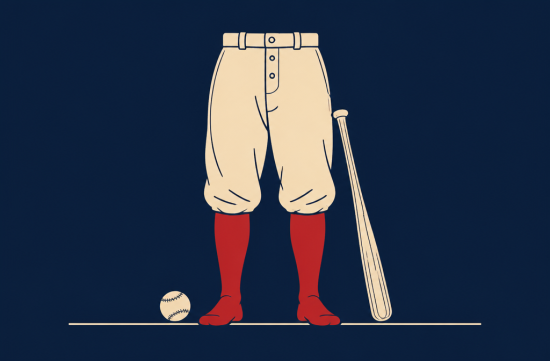
When I see people wearing red hats at the baseball park, I sometimes wonder if they know where this red color comes from and why they cheer for it.
The answer goes back to 1869. This is where the first baseball team in America to publicly pay all its players was formed.
The team was called the Cincinnati Red Stockings. Their uniform, which revealed red socks under knee-length pants, gave them their name.
Before this, baseball was primarily a sport for amateur clubs. While there were players who secretly received money, this team was the first to openly sign contracts and form a professional team.
The person who created the team was a manager named Harry Wright. He took care of everything from recruiting players to training while playing as a center fielder, eventually earning the nickname "the father of professional baseball."
The club president was Aaron Champion. He was responsible for the players' salaries, essentially acting as the team owner and CFO.
Interestingly, the player composition was unique. Only one player, first baseman Charlie Gould, was from Cincinnati; the rest were scouted from the East based on their skills.
This part touched me. They prioritized talent over local pride. The way Major League Baseball now recruits players from around the world actually started here.
The highest-paid player was Harry's brother, shortstop George Wright, who earned $1,400. Charlie Gould, the local player, was paid $800.
So, how did they perform? The official record for the 1869 season was 57 wins and 0 losses. Including exhibition games, the number of victories increased, but they never lost a game.
In fact, the record isn't perfectly clean. On August 26, during a game against the Troy Haymakers, the score was tied at 17-17 when the opposing team left the field in protest of a call.
Whether this game is considered a draw or a forfeit varies slightly across different records. However, the fact that they never lost remains unchanged.
Even more astonishing is the distance they traveled. During their Eastern road trip in June, they traveled 1,821 miles and won all 20 games.
In the fall, they took the newly opened transcontinental railroad to San Francisco. The round trip distance was 4,764 miles, which is impressive considering there were no charter flights back then.
According to the Baseball Hall of Fame, 200,000 spectators saw the team during these two road trips. In one game in Brooklyn that year, over 10,000 people attended.
It must have felt like an idol group on a nationwide tour today. People flocked to see them everywhere, indicating their popularity.
In Washington, they even met President Ulysses Grant. A local baseball team became a national star.
But nothing lasts forever. On June 14, 1870, they lost to the Brooklyn Atlantics 8-7 after 11 innings, ending their long winning streak.
They were tied 5-5 going into the ninth inning, and the Atlantics wanted to end it as a draw. However, the Red Stockings wanted to play for a win, and the umpire allowed the game to continue, leading to their first loss.
I find this moment very human. A team used to winning couldn't stand the thought of a tie.
After that, attendance dropped, and salary burdens increased. Ultimately, the club board decided in November 1870 not to have a professional team for the next season.
Harry Wright moved to Boston to form a new team, taking four Cincinnati teammates with him. They even brought the name Red Stockings along.
So, the current Cincinnati Reds are not legally connected to the 1869 team. The Reds were established in 1882 and are more closely related to the legacy of the red color and name.
Still, I believe this city can take pride in being the starting point of professional baseball in America. Both George Wright and Harry Wright have been inducted into the Hall of Fame.
What I love most about this story is that this team was the first to prove that paying for the best talent yields results.
At the same time, it showed that without continued financial support, even the strongest team cannot last long. They demonstrated both success and limitations in just two years.
If you live in this area, think of the red socks the next time you pass by Great American Ball Park. It's not just a color of support; it carries a 157-year-old story.
Since learning this story, my perspective on watching Reds games has changed. Regardless of their performance, the fact that this city was the first to start it all is reason enough to cheer for them.
 EricUnisex


 daisypat |
 Anjollinya Blog |
 Anova US Beauty Information |
 anchor |
 Korea Tiger News |
 happy 9 |

 Bliss O |
 Mr Cleveland |
 peace |
 maplefox |
  Fun Flex Life |
  hopeful |
  Reeno |
  Coastal city |
  meonetoo |
  Winter bear |
  Peach Jam Eating Laughter |
  Nando Raldo |
  American Man in a Mask |
  wendra |
  silver |
  bada2002 |
  horizon |
  Nanana Nanana Nanana |
  victoria jung |
  Kkikki Ppappa Shout Out Loud |
  Lululala |
  Toaster Pizza Magic Show |
  Utah, the Most Livable State |