
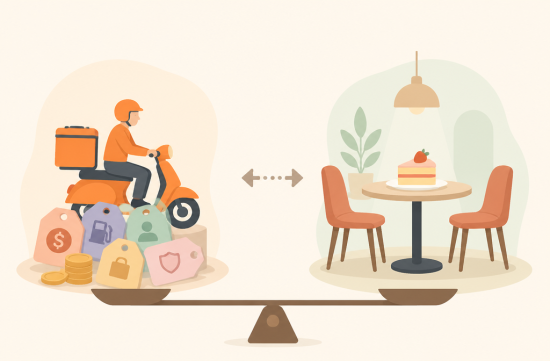
Last weekend, I opened a delivery app to have a cozy dinner at home with my girlfriend.
We added two slices of cake and two cups of Americano from a local dessert cafe, but when I got to the payment screen, the total was surprisingly high.
With a few dollars for delivery, a few dollars for service fees, and an additional small order fee, I was confused about what the original prices were.
Normally, I would have just hit the pay button, but that day I felt oddly curious and decided to close the app and pull out my calculator.
According to industry data, DoorDash charges a service fee of 10 to 11 percent of the order amount, and delivery fees range from $1.99 to $5.99.
I also learned for the first time that if the order amount is below a certain threshold, a small order fee of $2.50 is added.
Uber Eats wasn't much different. The service fee is around 15 percent, and delivery fees can vary from $0.49 to $7.99 depending on distance and time of day.
But that wasn't all.
I discovered that the prices listed on delivery apps are often higher than in-store prices.
One study found that menu prices on delivery apps are typically about 15 percent more expensive than in-store prices, with some places showing a difference of up to 20 percent.
In a comparison study using McDonald's menu items, it was found that when ordered through DoorDash, the prices were 71.1 percent higher than in-store, and Uber Eats was 69.4 percent higher.
By 2023, this gap had widened to an average of 93.8 percent, so the fact that it's slightly reduced nowadays is still significant.
With menu prices already inflated, plus delivery fees, service charges, and tips, it's no surprise that the total is much higher than in-store prices.
Other apps like Grubhub have similar issues, with fee structures ranging from 5 percent to 20 percent, and additional costs paid by restaurants for advertising, which ultimately get passed on to consumers.
When I calculated the cost of the cake and coffee we wanted to order, it was nearly a third more than the in-store price.
So, I closed the app and suggested to my girlfriend that we just drive out to eat instead.
After about fifteen minutes, we arrived at the cafe and ordered the cake and coffee, which were definitely cheaper than ordering for delivery, and the cake looked much nicer too.
It turns out that the convenience of pressing a delivery button can really lighten your wallet.
Of course, on rainy days or when you're not feeling well, there are times when delivery is the only option.
I'm not suggesting that you should always go out to eat on those days.
However, on days when you have the time, especially for a date, I definitely felt that going out to eat is much sweeter for both your wallet and your heart.
I'm sure many in the Korean community have had similar experiences.
I've seen quite a few people who, feeling that delivery fees are a waste, place takeout orders through the app and then go pick them up themselves.
Doing so can save you almost all the delivery fees and service charges, making it a much more economical choice.
As a result of this experience, I've developed a habit of checking the total amount every time I open the app.
Seeing the numbers side by side made me realize how carelessly I had been paying for convenience.
In the end, using delivery apps is about buying convenience, and that convenience comes with hidden costs.
Life is meant to be sweet, so sometimes putting in a little effort to enjoy that sweetness at a lower cost seems like a pretty good idea.


 Anna Life |
 JESIKYEOALBA BLOG |
 Dad's Tribute TC |
 Glow Yo |
 U.S. Retirement Pension Information |
 strawberry |




 ness 6 |
  Montgomery Mom |
  SteelOrbit |
  Puddle Puddle |
  Arizona Cowboy |
  macaronpop |
  marydock |
  peachpanda |
  U.S. College Admission Information |
  Fruitop |
  Exploring American Life Information |
  sing sing |
  ORAVEZIN Oppa |
  Lego My Ego |
  logger |
  Conflite Teacher |
  summita |
  Ari Songhan American Immigration Life |
  marketbox |