

Last week, I visited a local salad chain and stared at the "We are cashless" sticker posted at the checkout for a while. I heard that starting October 1, cash refusal is banned in Maryland, so I wondered if that sticker was illegal.
To cut to the chase, it's not exactly illegal. While the law has been enacted, its scope is narrower than expected and has quite a few conditions.
This law is House Bill 191, which passed the state legislature in 2026 and was confirmed as Chapter 714 after the governor's signature. The effective date is October 1, 2026.
The House vote was 103 to 33, and the Senate vote was 35 to 11. It was noticeable that there were more opposing votes than expected.
The key point is that cash cannot be refused when purchasing "essential goods." The law defines essential consumer goods as five categories.
The first category includes food for people and pets. The second includes water and beverages, including ice.
The third category consists of personal hygiene products like toiletries and cleaning supplies. The fourth includes health products, including medications, medical supplies, and personal protective equipment like masks.
The last category is fuel, specifically gas at gas stations. So, grocery stores, pharmacies, and gas stations are the most directly affected.
There are also time conditions. This applies only between 6 AM and 10 PM.
During these hours, stores cannot refuse cash payments and cannot force card payments. It is also prohibited to charge more for cash payments than for card payments, regardless of whether it's labeled as a fee.
Amount conditions are also important. This applies only to transactions totaling less than $300 conducted in-store.
Online, phone, or mail orders are excluded. Vending machine or kiosk transactions are also not included.
And the salad shop I initially saw is a key point. Places that primarily sell food or beverages for consumption on-site are exempt.
Stores that mainly sell limited premium foods or specialty foods, like cheese, nuts, candy, and spices, are also excluded. Gas stations that require a paid membership to fuel up are exempt as well.
If you think of Costco gas stations, it will be easy to understand. Since they operate on a membership-only basis, this law does not apply.
Stores have two mechanisms they can use. The first is that they can refuse bills larger than $20.
So, if you present a $50 or $100 bill and it gets refused, that's not a violation of the law. If you plan to use cash, it's best to carry bills of $20 or less.
The second mechanism is to have a machine in the store that converts cash to prepaid cards. It must operate without fees or deposits, and if the machine malfunctions, cash must be accepted during that time.
There's also a provision regarding coins. When rounding prices, stores can charge up to an additional 4 cents. This seems to reflect the current situation where pennies are scarce.
Violations do not result in immediate fines. The state Attorney General's Consumer Protection Division must first provide at least two opportunities for correction.
If the issue is not corrected, the maximum fine is $500 per violation, and if it continues to be violated, it can go up to $1,000 per violation. The original proposal was for fines of $5,000 and $10,000, but they were significantly reduced during the review process.
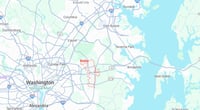
So, what changes for shoppers in Bowie? When purchasing essential goods at grocery stores, pharmacies, and gas stations during the day, if cash is refused, they will now have grounds to argue.
Conversely, cafes and restaurants can still operate cashless. Even if a convenience store refuses cash after 10 PM, it's difficult to contest under this law.
Whether an exception applies depends on what the store "primarily" sells. Therefore, it's reasonable to think that just because there's a small coffee corner inside a pharmacy or grocery store, the entire store does not become exempt. If in doubt, it's best to ask an employee first for clarity.
Stores with only self-checkout kiosks are also worth noting. While kiosk transactions are excluded from the law, if a staffed checkout is open, it seems that cash must be accepted there.
Both sides of the argument have merit. For residents without bank accounts or cards, or for seniors who find card usage inconvenient, this is a necessary protective measure.
On the other hand, small business owners worry about cash management costs and theft risks. The state legislature's financial analysis also notes that the impact on small businesses is "meaningful."
Personally, I think this compromise is reasonable. By narrowing the scope to essential goods, daytime hours, transactions under $300, and $20 bills, the burden on stores has been significantly reduced.
If you are refused cash, first check if the item is an essential good and if the time and amount are correct. If all conditions are met and you are still refused, the next step is to contact the Maryland Attorney General's Consumer Protection Division.
I plan to always carry a few $20 bills in my wallet from now on. The day when card readers malfunction happens more often than you might think.
 PuddingJungle
 OceanValley94


 Anjollinya Blog |

 Kitchen Ideas |
 Spaghetti Flying Religion |
 Giant Squid and Sweet Potato Soup |
 choi family |
 maryland park |

 Annapolis NSA |
 strawberry |


 ssome |
 skykong |
 Shining Our Own World |
 gardener 007 |
 golfmaster |
 Nanana Nanana Nanana |
 Who's watching? |
 endone |
 RockStar |
 Casa Mia |
 You Only Live Once |
 Hardworking CPA |
 Joyce 77 |
 Runner Kim |
 My Town My Way Blog |
 My Miami Stories |
 Entip |
 Tony Park |
 Jean Claude Bundang Blog |
 DJ DC BLOG |