
It's the first week of November, and gift sets are already piled up at the entrance of the store. It reminds me of last year when I received my credit card statement and sighed.
This year, I decided to change the order. Before opening a shopping app, I write down the list of recipients first. Deciding who to give to before figuring out how much to spend makes the flow of money much clearer.
First, let's look at the mood for this year. The National Retail Federation (NRF) projected on October 15 that retail sales in November and December will increase by 4.2% compared to last year, reaching $1.13 trillion.
Last year's year-end sales increased by 3.1% to $972 billion. The NRF explains that part of this year's increase is due to inflation. Just because sales are up doesn't mean everyone is financially comfortable.
Deloitte's 2026 year-end consumer survey found that the average spending per household was $1,654, which is 4% more than last year. Of this, $988 was for purchases, and $666 was for activities like travel or dining out.
Spending on goods increased by 10%, while spending on activities decreased by 4%, suggesting that people are cutting back on outings and focusing more on gift boxes. This survey was conducted among 4,000 American consumers from late August to early September.
The problem comes afterward. A survey released by LendingTree in January found that 37% of Americans went into debt last year, with an average debt of $1,223.
This is an increase from $1,181 the previous year, and 41% of people still hadn't paid off their debt from the previous season. That means four out of ten people are still paying off last Christmas's expenses, which was a bit surprising.
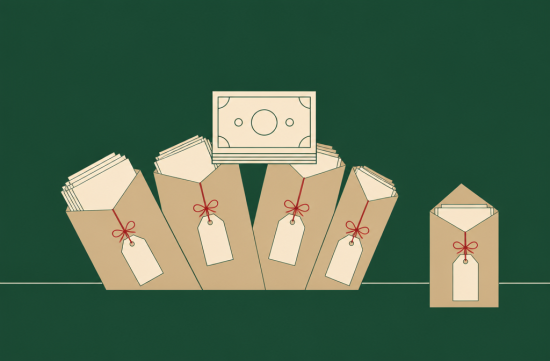
Now, let's talk about the envelope budgeting method. The key is to set a total amount first and then divide that total into envelopes for each person.
The first step is the list. Write down names grouped by relationships: family, close friends, coworkers, teachers, church or club acquaintances.
As you write, the list tends to get longer than expected. I thought it would be about ten people at first, but it ended up exceeding twenty. If you have people to whom you will only send cards, mark them separately to account for postage costs in advance.
The second step is the total amount. Determine how much money you can spend without debt after deducting this month's living expenses. The basis is your bank balance, not your credit limit.
For reference, Deloitte's average of $1,654 includes not just gifts but also expenses for travel and dining. There's no need to match others' averages; our household balance is the correct figure.
The third step is dividing the envelopes. Assign amounts to each group on your list and then specify amounts for each individual within those groups.
For example, if the total amount is $800, you might allocate $450 for family, $150 for friends, $100 for coworkers and teachers, and $100 for a contingency envelope. Adjust the numbers according to your situation.
Make sure to keep a separate contingency envelope. Unexpected expenses like forgotten people, last-minute invitations, or shipping costs often arise.
If physical envelopes are cumbersome, you can use a sub-savings account in your banking app or a spreadsheet instead. The important thing is to see how much money is left in each category at a glance. I put a piece of paper on the refrigerator for my family to see together.
Record your spending daily. Taking pictures of receipts makes returns easier.
It's also good to create a separate envelope for small items like wrapping paper, cards, and tape. These can add up to a significant amount.
The principle is not to borrow from another envelope when one runs out. Sticking to this rule is the hardest part but also the most effective. If you're really short, decide to only take from the contingency envelope.
As you write the list, you'll see areas where you can cut back. Instead of giving individual gifts to coworkers or neighbors, sharing a box of cookies can be just as warm.
If you have a large family, you can also consider a draw-a-name method where each person only buys for one other person. In the U.S., this is called Secret Santa. Setting a spending limit in advance ensures no one feels burdened.
I also enjoy making things myself. Choosing a few photos to create a small album or including a handwritten card makes the recipient remember it for a long time.
Sales periods should also be managed within the envelope budget. Even if Black Friday discounts seem appealing, it's best to pass on items not on your list. For gifts on the list, it's good to note their prices in advance and compare them during sales.
Considering the NRF's projection that inflation is a factor, the same gift may be more expensive than last year. It's wise to take this into account when setting your envelope amounts.
For children's gifts, I believe it's better to choose one quality item rather than several. Having many boxes doesn't necessarily make kids happier. Experience gifts like going to a show together or enrolling them in an art class are also great options.
Check in around mid-December. Look at the remaining money in each envelope and transfer any excess to the contingency envelope.
If there's leftover money, send it to your January living expenses or emergency fund. Starting the new year lightly is a surprisingly big gift.
Honestly, the year-end spending atmosphere can make people anxious. Advertisements always encourage more purchases.
However, I believe that expressing your feelings doesn't necessarily require spending a lot of money. If it were me, I would prioritize making the list first, then the envelopes, and shopping last this year.
Take out a piece of paper tonight and start writing names. That one sheet could change your January credit card statement.
 joyfulmomentmaker1979




 Carolina border |
 juicylol |

 Mr Song Song |
 Way to easy |
 holy cow |

 zonter88 |

 American Hardcore Band |

 Next Year, Let's Become Rich |


 lomira98 |
 fonix |
 MacMorningBlog |
 Encyclopedia of New York and Surrounding Areas |
 romeo JU |
 Folding Instructions |
 See It |
 memorabilia |
 H Leader |
 xylora |
 linex |
 Victory 1988 |
 washington mom |
 Deep South Mississippi |
 moomoon |
 premium |
 hexora |
 jammybear |
 chiobase |
 jondol |