

In American Western films, you see cowboys riding across the Texas plains, guns at their hips, pushing open the doors of saloons.
This is the typical image of America that we think of.
However, if we look back a bit, an interesting story emerges.
If it weren't for France, the American Wild West as we know it might have been quite different.
You might wonder what this means, but connecting the dots in history reveals some fascinating insights.
First, we need to look at the American Revolutionary War.
In 1776, the United States declared independence from Britain, but at that time, America was not the powerful nation it is today.
Britain was a country with one of the strongest navies and armies in the world. The nation that truly helped America was France.
France provided weapons and funding and even engaged in direct conflict with Britain.
The support of the French navy was particularly crucial in the Battle of Yorktown in 1781, where the British surrendered, effectively deciding the outcome of the American Revolutionary War.
So, to exaggerate a bit, we could say that France played a midwife role in the birth of America.
But the story doesn't end there.
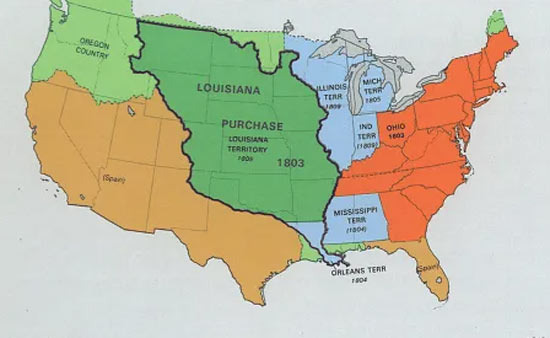
In 1803, a monumental real estate transaction took place in American history: the Louisiana Purchase.
At that time, Napoleon of France held vast territories in North America.
This isn't just about the state of Louisiana; it referred to a vast area stretching from the Mississippi River to the Rocky Mountains.
The United States purchased this land from France for $15 million.
The area covered about 828,000 square miles. This single transaction nearly doubled the size of the United States at the time.
Present-day Missouri, Arkansas, Iowa, Nebraska, Kansas, Oklahoma, and parts of several other states were included in this land.
From this point on, a vast space opened up for Americans to look westward.
The direct ancestors of American cowboys are considered to be the vaqueros from Spain and Mexico.They rode horses, herded cattle, used ropes, and managed livestock on large ranches, and these skills were passed down through the Spanish colonies and into the American Southwest.
Many of the techniques we associate with cowboys originated here.
However, as the United States gained independence and secured vast western territories from France, the stage was set for this ranching culture to spread.
After the Civil War, large-scale cattle drives began, moving cattle hundreds of miles from Texas to Kansas railheads.
This is when the typical cowboy era we see in films emerged.
So, when you connect the dots, it becomes interesting. France helps America gain independence. America becomes independent. A few decades later, France sells Louisiana to the United States.
The territory of the United States nearly doubles. The westward expansion begins in earnest.
And in that vast West, American cowboy culture, inheriting the traditions of the Spanish and Mexican vaqueros, grows.
This is how history works.
We often think of cowboys as an entirely American cultural phenomenon when watching Western films.
Of course, it is true that this culture developed uniquely in America.
But if you trace back, you find Spain and Mexico, and if you follow the expansion of American territory, you find France, and even if you go back to the birth of the nation, France appears again.
So, if someone brings up Western films at a gathering, you can show off your knowledge.
"The original cowboys are the Mexican vaqueros, you know. But if it weren't for France, the American Wild West as we know it might not have been created at all."
 MintCreator
 TacoBellCandy
 RedSteed






 novapixel |
 Peter Pan Pet |
 horse |
 Sunset Oregon |
 daisypat |

 White bunny |
 melon90 |
 butter 90 |
 Jazz Queen |
  Finding Superfoods |
  lightyear |
  song bang |
  vexomo |
  Indiana Jones |
  meloncat |
  mortrix |
  Esther 1983 |
  fortbliss |
  Moscow Kim |
  My Two Way |
  toastyfox |
  FLORIDA Acus |
  tracker |
  TONTON COFFEE |
  sunrise |
  ultron78 |
  uplifted |
  Folding Instructions |