

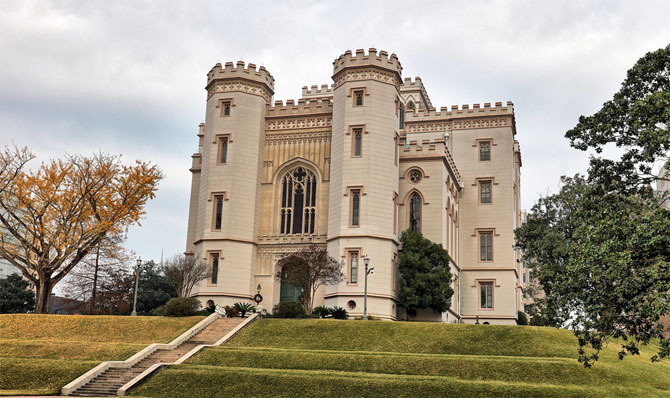
After planning to write a review about the famous tourist attraction Louisiana's Old State Capitol located in Baton Rouge, Louisiana, I am finally leaving a review on Webpromo after half a year.
The Louisiana Old State Capitol may look like a European castle at first glance, but in fact, it is a symbolic place where the political history and artistic sensibility of the American South are intricately intertwined.
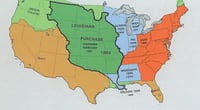
The name Louisiana was given in honor of King Louis XIV of France. At the time of naming, this area was referred to as 'Nouvelle-France' and encompassed vast lands that included French Canada and the American Midwest. However, not much of the area was actually developed. As French Canadians migrated to the Midwest during that time, French culture naturally took root in Louisiana. To this day, it is considered one of the regions in the United States where French culture is best preserved.
The name of the capital, Baton Rouge, also means 'red stick' in French, and New Orleans is derived from 'la Nouvelle-Orléans.' It is named after the city of Orléans in France, carrying the meaning of 'new city' like New York. The traces of the French language and culture are embedded throughout Louisiana, particularly evident in music, food, and architectural styles.
This building, located on a hill right next to the Mississippi River, is a masterpiece of Gothic Revival style completed in the mid-19th century, and anyone seeing it for the first time would be surprised, asking, "Was this really a capitol?"
The white stone exterior, pointed towers, and castle-like windows give the impression that a medieval European castle has been transported here. Upon entering the building, the first thing that catches the eye is the stained glass ceiling adorning the central staircase.
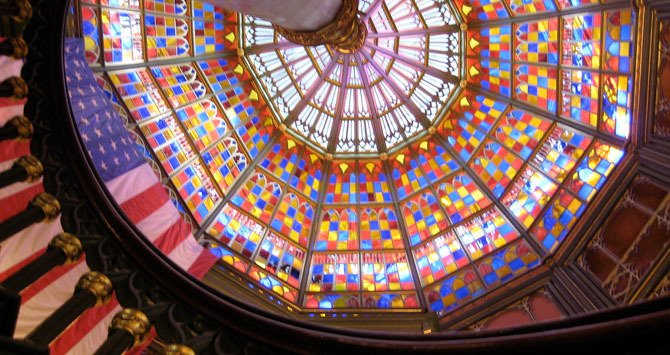
Every time sunlight streams in, the red, blue, and yellow light shatters against the walls and stairs, transforming the entire space into a work of light art, which is truly breathtaking.
The interior decor is beyond simply beautiful. Each room holds traces of Louisiana's political decisions and historical moments.
During the Civil War, this place was not used as the state capitol for a time and was instead used as a prison and hospital. It was later completely destroyed by fire and restored in the 1880s, and now it serves as a 'museum' rather than a state capitol.
Inside the exhibition hall, there are various displays covering not only Louisiana's political history but also the women's suffrage movement, the civil rights movement, and the changes in Southern society. The interactive exhibits, where visitors can participate directly, are particularly interesting. Through screens, one can listen to speeches from past governors or flip through newspaper articles from that era to experience the atmosphere of the time.
Personally, what impressed me the most were the blueprints and letters left by architect James Harrison.
He wrote, "I hope this building becomes a symbol that embodies the spirit of Louisiana, not just a political space." After reading that sentence, I felt that each ornate decoration was not merely an aesthetic element but an expression of the region's identity.
Standing on the balcony at the back of the building, the Mississippi River can be seen at a glance. The cargo ships passing along the river and the silhouette of the modern New State Capitol in the distance create a striking contrast, giving the feeling of simultaneously looking at both the past and present of Louisiana.
In the souvenir shop near the exit, stained glass bookmarks and capitol-shaped magnets were popular. I purchased a small bookmark among them.
It felt like more than just a simple souvenir; it was a way to carry the history, culture, and passage of time of this city in my heart.
Louisiana's Old State Capitol is a source of pride for Louisiana and a place imbued with artistic spirit.
If you visit Baton Rouge, I highly recommend stopping by.



 cherrydino |
 ORAVEZIN Oppa |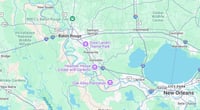

 berrypup |
  Tonky |
  viroma |
  cookie |
  Live and that's it |
  Alright Twain |
  eatontown blog |
  HAWAII Korean Church News |
  Amore |
  linex |
  Balancework |
  laro90 |
  MEDBIO American Doctor Blog |
  SWAT TEAM BLK |
  DREAM BIG |
  frostbite |
  330 Forever My Love |
  El Dorado |
  dralix58 |
  Gorama Round |
  Skydiving |