
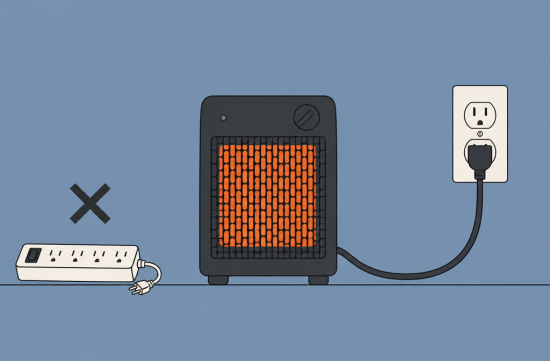
It's mid-October, and the morning air is already biting at my nose. It's a bit early to turn on the boiler, and just toughing it out makes my hands cold—it's that awkward time of year.
So, I pulled out the electric heater I bought last year from storage. As I was about to plug it in under my desk, my hand naturally reached for the power strip.
The wall outlet is hidden behind the sofa, and the power strip is right at my feet. When faced with inconvenience, humans always choose the closer option.
However, there was a small warning written on the side of the heater's box. It said to plug it directly into a wall outlet, not into an extension cord or power strip.
Honestly, at first, I thought it was just a disclaimer to avoid liability from the manufacturer. But when I looked into it, I found out there was a much more serious reason.
The U.S. Consumer Product Safety Commission (CPSC) also stated the same thing in their winter safety guidelines earlier this year. They advise that electric heaters should be plugged directly into a wall outlet and never into an extension cord or power strip.
The key point is that heaters consume a lot of electricity. Most commonly sold household heaters are rated for up to 1500 watts.
Since the standard household voltage in the U.S. is 120 volts, that means about 12.5 amps are flowing. This is a completely different scale compared to a phone charger.
As a general rule in electrical safety, devices that are used for long periods should operate within 80 percent of the circuit's capacity. Many heaters on the market do not exceed 1500 watts for this reason.
Typically, power strips are rated for a total capacity of about 15 amps. Just plugging in one heater would exceed 80 percent of that capacity.
And if you also have a laptop, monitor, and electric blanket plugged in? Just thinking about it made me feel like I could hear the power strip sweating.
More importantly, it's about time. A hairdryer is used for a few minutes and then turned off, but a heater runs for hours, continuously drawing the same amount of electricity.
The wires inside a power strip or extension cord are often thinner than the wiring in the walls. When a large current flows through a thin wire for a long time, heat builds up due to resistance.
Especially, the area where the plug meets the outlet is a weak point. If heat concentrates at a slightly loose contact point, the plastic can start to melt and char.
So, the fire doesn't necessarily start at the heater itself. Ironically, it's the power strip underneath that gets hot first, not the heater that was turned on to keep warm.
Looking at the numbers makes it even more alarming. The CPSC estimates that from 2020 to 2022, there were an average of 1,600 fires related to portable heaters each year.
During the same period, there were an average of 70 deaths and 150 injuries. Considering these incidents occur over just a few winter months, that's not a small number.
But I can't just throw away the heater, so I've decided to change a few habits. First, I moved the sofa a bit to free up the wall outlet for the heater.
I've decided not to plug anything else into that outlet. Even if it's a two-slot outlet, plugging in something like a microwave into the other slot would overload the same circuit.
I've also decided not to keep anything within 3 feet of the heater, which is just under 1 meter. The CPSC recommends keeping curtains, furniture, and bedding at least this distance away.
Before going to bed, I always turn it off. This is also a CPSC recommendation, and once I imagined my blanket shifting toward the heater while I was asleep, I immediately agreed.
It's easy to think that having surge protection or a cutoff switch on a power strip makes it safe. However, surge protection only prevents momentary voltage spikes, and the cutoff switch only activates when the rated capacity is exceeded.
A heater can run for hours just below that rated capacity. The switch may hold up fine, but heat continues to build up at the contact points, creating a very ambiguous situation.
I also recommend occasionally touching the plug to check its temperature. If it feels hot or gives off a burnt smell, or if it has changed color, you should unplug it immediately.
In that case, there may be an issue with the outlet itself, so it's best to have an electrician check it. If you're renting, be sure to inform your landlord or property management right away.
If you buy a new heater, check if it has an automatic shut-off feature if it tips over and an overheat protection feature. It's also good to look for certification marks like UL.
And if the heater has a low-power mode, make sure to use it. Even under a desk, it can keep you warm on a lower setting, and it will save on electricity costs.
In fact, I doubt many people feel it's dangerous to plug a heater into a power strip. It's a familiar item that we use every day.
I've used it that way for years without a second thought, and I was just lucky that nothing happened. Realizing that made me feel a bit uneasy.
Ultimately, my conclusion is simple. The heater goes in the wall outlet, and the power strip gets reserved for the laptop.
It's a bit annoying to crawl behind the sofa to plug it in for 30 seconds. But if that 30 seconds is the best way to stay warm this winter, I'll gladly crawl back there, even if it gets dusty.
 HodlWins







 Khan Film Blog Production |
 dermoon |
 hoosierdaddy |
 sun walker |
 Let's Be Like a Salt-like City Person |
 Lim Ario |
 zeltrio |


 novapixel |
  mortrix |
  ollege Mom |
  Esther 1983 |
  Arizona AZ Cowboy |
  fortbliss |
  Moscow Kim |
  My Two Way |
  toastyfox |
  FLORIDA Acus |
  tracker |
  TONTON COFFEE |
  sunrise |
  ultron78 |
  uplifted |
  Folding Instructions |
  same same life |
  USA Hyundai Kia |
  morvex37 |
  BOL SA RAM |