

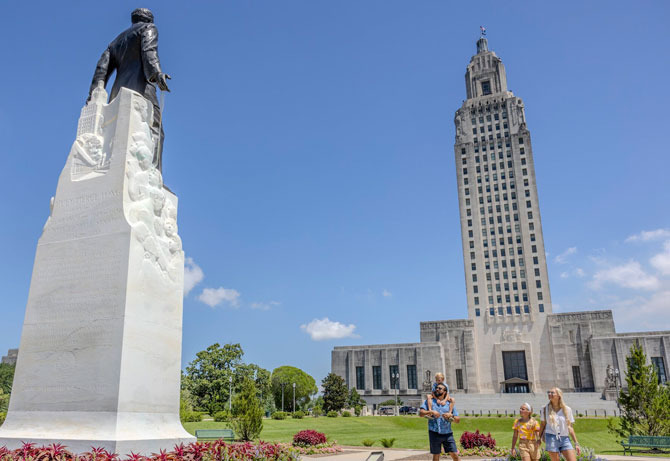
The Louisiana State Capitol building in Baton Rouge, the capital of Louisiana, is one of the iconic landmarks of the American South. When people actually see this building, many feel, "Oh, this looks similar to LA City Hall!"
This is not just a coincidence. The two buildings share a common aesthetic philosophy due to the historical context, architectural style, and the concept of 'modern government buildings' that was spreading in America at the time.
First, the Louisiana State Capitol is a high-rise capitol building completed in 1932 in a ultra-modern style. It stands about 137 meters tall and consists of 34 floors, known as the tallest state capitol in the United States.
On the other hand, LA City Hall was completed in 1928 and also adopted the Art Deco style that was popular across the United States at the time. Both buildings were constructed with the aim of symbolizing the 'modernized urban image' of America in the 1920s and 30s.
The Art Deco style is an architectural style that emerged in the optimistic atmosphere of the industrial age, characterized by linear and symmetrical designs, decorative vertical lines, and geometric patterns. Both the Louisiana State Capitol and LA City Hall were designed with this aesthetic at their core.
They are not only similar in being high-rise buildings but also emphasize vertical forms to symbolize 'power and progress.' At that time, America was experiencing the Great Depression and needed a symbol of national reconstruction, and these high-rise government buildings became a visual expression of 'America moving towards the future.'
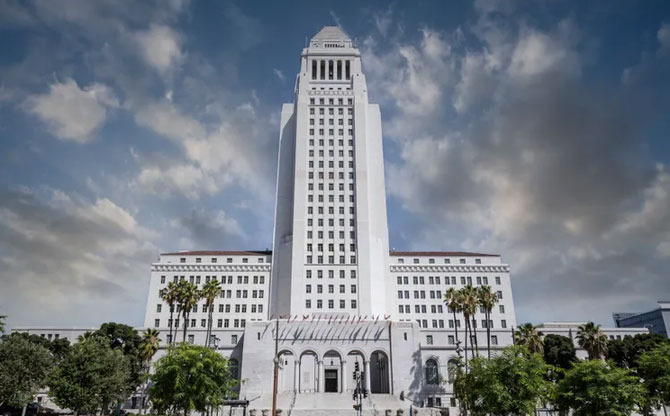
The designer of the Louisiana State Capitol was architect Leon Weiss from New York, and the project was promoted under the strong political support of Louisiana Governor Huey Long. Huey Long had ambitions to develop Louisiana into the "New York of the South" and wanted a high-rise capitol as a symbol of that. In contrast, the design of LA City Hall was undertaken by John C. Austin and John Parkinson, who also believed that a symbol was needed to showcase the 'grandeur of a metropolis' in the growing city of Los Angeles. Ultimately, both buildings served as 'political structures visually expressing the status of the region.'
Another interesting commonality is that both buildings possess 'functional symbolism.' The Louisiana State Capitol is not just a capitol but also serves as a government office and a memorial. The top floor features an observation deck that overlooks the Baton Rouge skyline, and the interior is decorated with marble and brass. LA City Hall is also not just an administrative building but features an innovative design that combines earthquake-resistant reinforced concrete structure with decorative elements. Both buildings can be seen as works reflecting the experimental spirit and technical confidence of American architecture at the time.
There are also similarities in the building materials. Both buildings combine marble, limestone, and concrete to give a solid feel, with vertical patterns emphasized in the columns and window lines on the exterior. In the case of the Louisiana State Capitol, the marble steps and the statues placed on either side of the entrance add to its grandeur, which gives a very similar impression to the column structure at the front of LA City Hall. Even at night, both buildings are illuminated, creating an atmosphere where the tower seems to rise into the sky, which can also be seen as a shared intention of being designed as 'symbolic towers of the city.'
Historically, both buildings have become symbols of politics and urban development. LA City Hall became the center of city government with the growth of Southern California, while the Louisiana State Capitol became a new center of Southern politics and a symbol of Huey Long's reform politics. Huey Long wanted to leave this capitol as his political legacy, and indeed, after he was assassinated in 1935, he was buried in the garden in front of this building. In the lawn in front of the building, there is his grave and statue, making the Louisiana State Capitol not just an architectural structure but 'history itself.'
Ultimately, the reason why the Louisiana State Capitol and LA City Hall resemble each other is not just due to their external forms or heights, but because they are buildings that equally reflect the ideals and spirit of the 1930s America. At that time, America was searching for a 'symbol of a new era' amidst the waves of urbanization and technological innovation, and even government buildings sought to embody a futuristic image in line with that trend.
When I encountered the Louisiana State Capitol while traveling in Baton Rouge, it was not just a mere illusion that the city hall building of LA downtown came to mind. Though they are in different cities and cultures, the two buildings stand like 'twin symbols' holding the dreams of the same era.






 cherrydino |
 ORAVEZIN Oppa |


 berrypup |
  Tonky |
  viroma |
  cookie |
  Live and that's it |
  Alright Twain |
  eatontown blog |
  HAWAII Korean Church News |
  Amore |
  linex |
  Balancework |
  laro90 |
  MEDBIO American Doctor Blog |
  SWAT TEAM BLK |
  DREAM BIG |
  frostbite |
  330 Forever My Love |
  El Dorado |
  dralix58 |
  Gorama Round |
  Skydiving |