
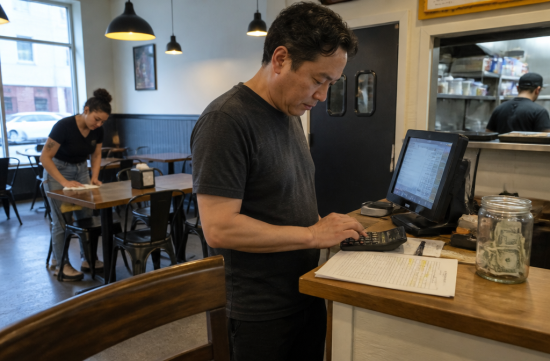
Last week, I had a brief conversation with the owner at my favorite taco place. They mentioned they are already recalculating labor costs for January next year.
They are considering adjusting the menu prices again, and as I listened, I became curious too. So, I started looking into the numbers one by one.
The key point is that the Michigan tip credit rate will decrease again starting January 1, 2027. The tip credit is a system that allows a portion of the tips given by customers to be counted as part of the hourly wage.
As of 2026, the general minimum wage in Michigan is $13.73 per hour. The cash wage for tipped employees is 40% of that, which is $5.49.
The remaining 60%, or $8.24, is recognized as being covered by tips. This is the current maximum tip credit.
On January 1, 2027, the general minimum wage will increase to $15.00. The cash wage for tipped employees will also rise to 42%, making it $6.30.
This means the tip credit rate will drop from 60% to 58%. Interestingly, in dollar terms, the maximum credit will actually increase by 46 cents to $8.70.
The percentage decreases while the amount increases, which initially confused me. Ultimately, what matters for the owner is that the cash wage they pay directly will increase by 81 cents.
From $5.49 to $6.30, that's nearly a 15% increase. Compared to the general minimum wage rising just over 9% from $13.73 to $15.00, it's a steeper increase.
For reference, the federal cash wage for tipped employees is still $2.13. Compared to that, Michigan's rate is already quite high, which can be a significant burden for restaurant owners.
This schedule comes from Public Act 1 of 2025, commonly referred to as SB 8, signed on February 21, 2025. It starts at 38% in 2025 and increases by 2 percentage points each year.
It will reach 44% in 2028, 46% in 2029, 48% in 2030, and stop at 50% in 2031. The tip credit will not disappear entirely but will be reduced to half.
Originally, according to a 2024 Michigan Supreme Court ruling, the tip credit was supposed to be phased out completely. The legislature modified that to the current schedule.
There was also a petition for a referendum to overturn this law. The campaign led by One Fair Wage failed to gather the required 223,099 signatures by the March 23, 2026 deadline.
As a result, this issue will not be on the ballot this November. The organization has stated they will try again in 2028, so it's not completely over.
So, how much will restaurant labor costs actually change? I calculated based on a server working 30 hours a week.
An 81-cent difference per hour amounts to $24.30 a week. Over 52 weeks, that totals an increase of $1,263.60 a year.
If there are five servers, that's $6,318. That's not a small amount for a small-town restaurant.
We also need to consider the kitchen staff. If a minimum wage employee works 40 hours a week, their pay will increase by $1.27 per hour, totaling $2,641.60 a year. When combining front and back of house staff, it's understandable why owners are crunching numbers ahead of January.
With employer payroll taxes added, the impact feels even greater. I can see why the owner is sighing.
However, that doesn't mean tipped employees will necessarily lose out. If the combined cash wage and tips do not meet the general minimum wage, the employer must make up the difference.
Additionally, to use the tip credit, employers must inform employees of this regulation in advance. Employees also need to report their tips accurately.
So, Korean restaurant owners should check their payroll systems now. If the old wage is still paid in the first paycheck of January, it could lead to problems.
Don't forget to post the new labor standards poster in the restaurant. It can be obtained from the state's Labor and Economic Opportunity (LEO) website.
If you're working, make sure to check if your hourly wage has changed to $6.30 on your January pay stub. If something seems off, you can report your wages online or by phone to LEO.
This is not just a concern for restaurant owners. Customers may see menu prices rise slightly or service charges added at more establishments.
In fact, if you look at receipts from restaurants in the Detroit area, you'll often see service charges listed these days. It's becoming more common to pause and consider whether to add a tip on top of that.
Personally, I don't think this schedule is a bad thing. Wages for workers are steadily increasing, and businesses have time to plan ahead.
However, after 2027, the minimum wage will be adjusted annually based on inflation. From then on, the numbers will need to be checked every year. The new amounts are usually announced in the fall, so it's helpful to remember that timing.
If I were a restaurant owner or employee, I would mark January 1 on my calendar and review the payroll numbers before December. That way, I can ensure I have the budget for another taco plate.
 OpenMind






 coloradoman |
 Living Economy Information Blog |
 Tomato Health Club blog |
 Banana Style Life |
 crystalo |
 Granola |
 juniper |
  tracker |
 aaoaa |
 Michigan Enthusiast |
  FLORIDA Acus |
  TONTON COFFEE |
  sunrise |
  ultron78 |
  uplifted |
  Folding Instructions |
  same same life |
  USA Hyundai Kia |
  morvex37 |
  BOL SA RAM |
  TOUCHE NEWS |
  Small Business Information USA |
  draxen |
  gallery |
  milkyotter |
  Zoom Zoom Zoom |
  Minnesota Lakes and Clouds |
  noraro |
  tervox95 |