

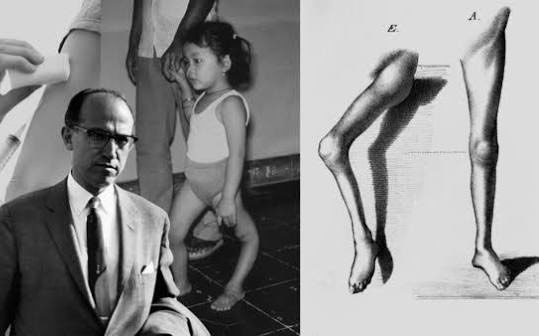
These days, for people in their 20s and 30s, polio might feel like a disease they've only heard about in textbooks.
However, in South Korea, until the 1970s, it was one of the childhood infectious diseases that parents feared so much they lost sleep over it.
The official name for polio is poliomyelitis, and it often appears in the news in the U.S. This disease is an infection caused specifically by the poliovirus.
Because of its name, it's easy to think of it as a disease that only affects children, but adults can also become infected. However, it became widely known as polio in South Korea because it primarily affected children in the past.
The poliovirus mainly enters the body through the mouth.
In unsanitary conditions, the virus can be transmitted to others through the feces of an infected person via hands, food, or water.
The reason polio is so frightening is somewhat unique. Most infected individuals show no symptoms or only experience mild cold-like symptoms.
The problem lies with a minority of patients. If the virus invades the nervous system, it can damage the motor neurons in the spinal cord.
This can lead to sudden weakness in the legs and paralysis.
In some cases, one leg may become thinner or a person may be unable to walk properly, and in severe cases, they may need to use crutches or assistive devices for life.
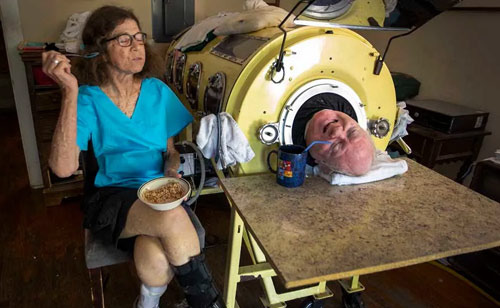
In more serious cases, the muscles needed for breathing can also become paralyzed.
You may have seen images in the past of a person lying inside a large cylindrical machine.
This was a device known as the 'Iron Lung.' It was a machine that helped polio patients who could not breathe on their own.
It was such a terrifying disease, yet these days, you hardly see polio patients around. The reason is the vaccine.
Since the 1950s, the polio vaccine has been developed, and large-scale vaccinations began, which were later included in childhood immunization programs in various countries.
The poliovirus must continue to spread through people to survive.
However, when most children gain immunity through vaccination, the virus loses its pathway to find new hosts.
It needs to move from one person to the next, but since most people around them are immune, the chain of transmission is broken.
As a result, as vaccination rates increased, the number of cases dropped sharply. The change accelerated particularly after the global polio eradication initiative began in 1988.
At that time, it was estimated that about 350,000 cases of paralytic polio occurred worldwide each year, but the number of cases has since decreased by over 99%.
In the United States, the last naturally occurring wild poliovirus infection was reported in 1979.
The World Health Organization officially certified the Americas as a region free of wild polio in 1994.
That's why it feels like polio suddenly disappeared in the 1990s.
However, to be precise, it has not completely disappeared from the world.
Smallpox is a representative infectious disease that humanity has completely eradicated through vaccination, but polio still has a final stage to complete.
In some countries, the transmission of wild poliovirus continues, and occasionally outbreaks caused by vaccine-derived viruses occur.
That's why the polio vaccine is still included in childhood immunizations. Interestingly, the more the disease seems to disappear, the easier it is for people to forget the need for vaccination.
Nowadays, it's rare to see a child limping due to polio in the neighborhood.
The very fact that polio seems to have disappeared paradoxically demonstrates the significant impact of vaccinations.
 SaladBase
 foxroadtraveler1972
 FridgeTap
 HenryCho






 Jimbeam 88 |
 Taco Bell Candy Note Blog |
 Splendid Mission |
 Florida Gario |
 DelphiaMo |
 Learn English Accurately |
 Happy Together 213 |
 Duck Duck Go |
 Tainami American Travel Story |
 Shintongbangtong Shin Naerin James Park |
  Tamfa Fan |
  Jenny's Mom blog |
  Karina's Blog |
  Best Frozen Yogurt |
  Victory 1988 |
  Coding Elf |
  Infinite Style |
  Mr Cleveland |
  Sugar Cream Door Bulletproof Noodles |
  novapixel |
  lavender |
  macan 08 |
  Goroke Geureoke News |
  colo colo |
  U.S. Weather Bureau News |
  Dragon Lee |
  American Food Information & Calories |
  zephyrs |
  ness 6 |
  Montgomery Mom |