

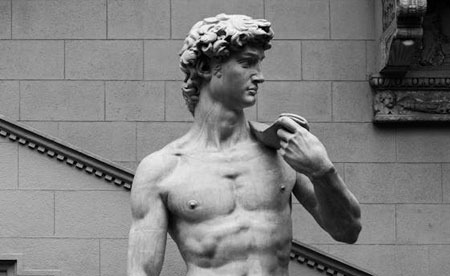
In 1501, at just over 20 years old, Michelangelo, already renowned for his Pietà, received a commission from the Florence Cathedral Committee (Opera del Duomo) to carve David, a character from the Bible. Through the symbol of David defeating Goliath with a sling, he aimed to express the spirit of Florence, which protected the freedom of its citizens from foreign oppression.
However, the marble Michelangelo inherited had already been worked on and abandoned by several sculptors before him. As a result, there was not enough marble to carve the traditional pose (David stepping on Goliath's head). Therefore, Michelangelo chose a pose of David preparing to throw a stone at Goliath. After relentless effort, in 1504, the towering statue of David, over 5 meters tall, was completed.
The next challenge was how to raise this massive statue onto the high cathedral buttress, but when the work was unveiled, the public reaction was overwhelmingly enthusiastic. The opinion that "this cannot just be placed on a buttress" gained traction, leading to the convening of a committee of 30 citizens from Florence. This committee included prominent artists such as Leonardo da Vinci, Sandro Botticelli, and Giuliano da Sangallo. After much discussion, it was decided that the statue of David would be erected in Piazza della Signoria in front of the Palazzo Vecchio.
As a result of this decision, David replaced the bronze statue of Judith and Holofernes created by Donatello in the square. This David stood guard over the square for nearly 400 years, but due to concerns about damage from pollution, it was moved to the Accademia Gallery in 1873. A replica was then installed in the square. Given that the gallery even built a special room for David, you can imagine how highly regarded this work was.
As mentioned above, the statue of David is famous for depicting David (Da-vid), a figure from the Old Testament. He is the hero who fought and triumphed over the giant Goliath. Uniquely, the David expressed by Michelangelo captures the tense moment just before battle. Unlike other sculptors who traditionally depicted the victorious pose or the scene of Goliath's head at David's feet, Michelangelo captured the emotions and tension of the moment just before the fight. If you look closely at the sculpture, you can vividly feel David's situation through the stone he holds and his slightly furrowed brow.
Another noteworthy aspect is the human proportions and details. The statue of David is based on the ideal human proportions developed in ancient Greece (the golden ratio), but it was intentionally sculpted with a larger head and hands to appear more balanced from a distance. Moreover, upon closer inspection, even the veins are delicately represented, and the naturally tilted pelvis and leg positions (contrapposto technique) give it a sense of liveliness as if it could move at any moment.
Thus, Michelangelo's David is considered the pinnacle of Renaissance art. It captures not only the beauty of the human form but also the mental and emotional tension that David embodies.
If you are planning a trip to Italy, I highly recommend visiting the Accademia Gallery to see the statue of David in person. The impact of the work's scale and detail is truly extraordinary when viewed up close.






 U.S. Supreme Court Judge Kim |
 Egg Steamed Pot |
 Learn English Accurately |
 Magic Cabbage School of Martial Arts |
 Peach Jam Eating Laughter |
  Atlanta Mama |
  Baguette Blog |
  US Embassy |
  Korean Mom |
  My NYC |
  moo moo |
  Mr Oh |
  forevergee |
  festival |
  manchester |
  constant |
  Leapfrog Move |
  vibranto |
  Tora Tora |
  yellowbutter |
  Dolly |
  NYC saladbar |
  Finding Superfoods |
  lightyear |
  song bang |