
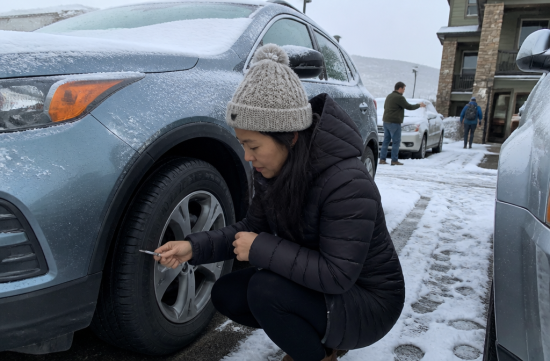
On the morning of the first snowfall, I saw a car at the exit of the company parking lot struggling to gain traction and slowly sliding backward. A quick glance at the side of its tires revealed a clear M+S mark.
That moment made me think about my own tires. I also have all-season tires, and I wondered if that was a good choice, so I spent the weekend digging into the data.
To cut to the chase, you can "get by" with all-season tires in winter. However, performing "well" is a different story.
First, let's talk about the often-confusing M+S mark. It stands for Mud and Snow, but it does not indicate that the tire has passed any performance tests.
According to Tire Rack, this mark is based on the tread pattern's design, meaning it does not guarantee how well the tire will perform on snow.
As a result, many all-season tires come with the M+S label. While it sounds like they are great for snow, in reality, it's more like "please don't hate us too much if it snows."
On the other hand, the three mountains with a snowflake mark, commonly referred to as 3PMSF, are different. This mark is only given to tires that exceed minimum standards in snow traction tests.
However, that doesn't mean they are perfect. According to Discount Tire, this test only evaluates snow acceleration traction and does not assess braking, cornering, or ice performance.
So where does the real difference lie? The key is in the rubber. All-season rubber hardens when temperatures drop, while winter tire rubber is designed to remain flexible even in cold conditions.
A report from the University of Michigan Transportation Research Institute (UMTRI) states that winter tires provide better grip on roads below 7 degrees Celsius (45 degrees Fahrenheit), even without snow.
It surprised me to learn that there's a difference even when it's not snowing. I had always thought winter tires were only for snowy days.
The same report indicates that the stopping distance on packed snow is 35% shorter with winter tires compared to all-season tires. For researchers, a 35% difference is significant enough that it cannot be dismissed as an "error."
When Tire Rack conducted a snow braking test at 30 mph, they found that all-season vehicles slid two car lengths further than those with winter tires.
Two car lengths is just the right distance to say hello to the bumper of the car in front of you while waiting at a traffic light. It's a joke, but not a very funny one.
There's also a middle option: all-weather tires, which can be used year-round like all-season tires but have received the 3PMSF mark.
Consumer Reports found that all-weather tires perform better in snow traction than tires without the mark. However, they caution not to confuse them with dedicated winter tires.
If you live in Colorado, you can't ignore the legal aspect. In November 2025, CDOT will announce new Traction Law standards.
When the traction law is in effect, tire tread must be at least 3/16 inches deep. This is an increase from the previous 1/8 inch requirement, and it applies to 4WD and AWD vehicles as well.
The types of tires that qualify include M+S, 3PMSF winter tires, or any all-weather rated by the manufacturer. So, if you have an AWD vehicle with M+S all-season tires, you can legally pass as long as the tread is sufficient.
For 2WD vehicles, the situation is different. According to the Colorado State Patrol (CSP), since SB25-069, simply changing tires is not enough for 2WD vehicles to meet the standards; chains or approved alternative equipment are required.
Specifically, the I-70 Dotsero to Morrison section requires 2WD vehicles to carry chains from September 1 to May 31. The specifics can vary slightly by source, so it's best to check the CDOT website before heading out.
The fines are not light either. According to CDOT guidelines, being caught without proper equipment can result in a $130 fine, and if it causes lane blockages, it can go up to $650.
It's also good to remember that passing the law and being truly safe are two different things. The law sets a minimum standard, and if my car slides down a hill, I'm ultimately responsible as the driver.
You can check your tread depth at home. A tread gauge from an auto parts store will do, and CDOT also distributes tread measurement cards every winter.
So what will I do? If I'm mainly driving in the city for commuting, I think an all-weather tire with the 3PMSF mark is sufficient. It saves on replacement costs and avoids taking up space in the garage during spring and fall.
However, if I'm going skiing in the mountains every weekend or live in a hilly area, I would vote for dedicated winter tires. A 35% difference in stopping distance is not a number worth ignoring.
If you're currently using M+S all-season tires, check your tread depth first. If it's less than 3/16 inches, there's no question that you should replace them before winter.
The car that was sliding backward in the parking lot the other day had different tires the next day. It seems like everyone realizes this after experiencing the first snowfall.
 FunUSALife





 Questions about firearms while living in America |


 coloradoman |

 Skydiving |









 Mr. Midwest America |
 orvella |

 donggul donggul |

 Mr. Largo |

 Silent Sea |
 Cool Beach Freeway |
 biscuitz |
 John Denver |
 Iri Jori Missouri |
 road98 |
 American Airlines Mileage |
 Whoever It Is, I Don't Know |
 meloncat |
 kimchi warrior |
 Angeles Choi |
 nutnew |
 ringwinds |
 happy 9 |
 United States National Administrative Organization Stories |
 upbeat |
 silents |
 Korean American National Foundation Promotion Blog |
 PETRO Vatican Shrine |
 American Food Information & Calories |
 Sammy Beach |