
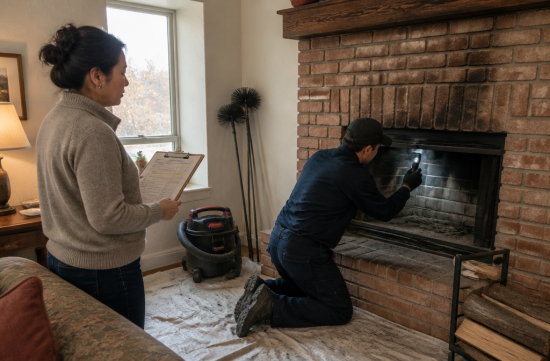
During the Thanksgiving holiday, when families gather, someone usually suggests lighting a fire in the fireplace. However, if you haven't checked your chimney since last spring, it's a good idea to pause before striking a match.
Today, we'll outline why chimney cleaning and inspection are necessary and how they relate to homeowners' fire insurance.
First, according to the National Fire Protection Association (NFPA) standard NFPA 211, it is recommended to inspect and clean chimneys, fireplaces, and vents at least once a year if needed.
One thing to note is that NFPA 211 is not a law but an industry standard, and local regulations take precedence if they differ from this standard.
In simple terms, "it's not legally mandated, but when an accident occurs, everyone refers to this standard to determine fault."
So why annually? The key is a substance called creosote.
If the term is unfamiliar, think of it as the black tar residue that sticks to the chimney walls when smoke from burning wood cools. This substance ignites easily, and the more you burn less-dry wood or keep a weak fire going for a long time, the more it accumulates.
If the temperature inside the chimney rises sufficiently and this layer builds up thickly, the creosote itself can catch fire, leading to a chimney fire.
According to fire department guidance citing NFPA data, from 2014 to 2018, the leading cause of residential heating fires was "lack of cleaning," accounting for 25%. This primarily involved solid fuel appliances like wood stoves, especially chimneys.
I was surprised when I first saw this statistic. It means that one in four heating fires ultimately relates to cleaning issues.
There are also stages of inspection. NFPA 211 divides inspections into Level 1 through Level 3, with Level 1 being a basic inspection of visible areas.
Level 2 involves a more in-depth inspection using cameras and is recommended when buying or selling a home or transferring ownership. If you've recently purchased a home, remember this point. No one can guarantee how the previous owner maintained it.
When choosing an inspection company, it's wise to ask if they have certification from organizations like CSIA. After the inspection, make sure to request a report that includes photos.
When it comes time for insurance claims or selling your home, presenting a dated report is far more substantial than just saying, "I had it inspected."
Now, let's move on to the insurance aspect, which many people are curious about. This is often the question I hear from others.
Typical homeowners' insurance covers sudden and accidental fire damage. Chimney fires generally fall under this category.
The Chimney Safety Institute of America (CSIA) also states that chimney fire damage is usually covered by homeowners' insurance. However, keep in mind that this is based on industry organization explanations.
The issue lies on the opposite side. Standard homeowners' insurance policies often include clauses that exclude damage caused by wear and tear, deterioration, or lack of maintenance.
So, when comparing the two scenarios, the difference becomes clear. A fire in a home that has been inspected annually can easily be described as an "unexpected incident."
On the other hand, if a chimney that hasn't been touched for years has thick creosote buildup, an adjuster may question the lack of maintenance.
Whether or not compensation is granted depends on the specific wording of your policy and the investigation results. The best way to find out if your insurance requires inspection records is to ask your insurance company directly.
For my part, I would definitely keep the inspection receipts and reports. CSIA also recommends taking photos of the damaged areas and creosote condition before cleaning after a fire.
If you live in an area where people burn wood, there's one more thing to keep in mind. The Albuquerque and Bernalillo County air quality regulations allow for a "No Burn" order from October 1 to February 28.
If such an order is issued, EPA-certified wood-burning devices cannot be used. There is a grace period of up to three hours to extinguish any fire that has already been lit.
EPA-certified stoves or fireplaces are recognized as exceptions, and there are specific exemptions for cases where wood is the only heating source or if the primary heating system is broken.
According to city guidance, such orders are rarely issued. Still, it's a good habit to call 505-768-2876 or check the city's air quality page for the day's status before lighting a fire.
In summary, the steps are simple. Get an inspection before the season and clean if necessary.
Keep the receipts and reports. Check the burn ban status on the day you plan to light a fire.
While the cost of a chimney inspection may seem steep, it pales in comparison to the time, expense, and stress involved if an insurance dispute arises. I see no reason to hesitate.
This holiday season, I hope you enjoy your fireplace with peace of mind, armed with your inspection report.
 NerdAlert





 Mrs New Mex |
 Golden |

 Pointy |

 Seatea |


 Raccoon Ramen Night |
 ovelion |

 Something is popping in the situation |

 lumix88 |
 quiet river |
 silents |
 Korean American National Foundation Promotion Blog |
 PETRO Vatican Shrine |
 American Food Information & Calories |
 Sammy Beach |
 monalisa blog |
 Pronunciation Yo |
 Softy |
 rigid |
 Website Design Artisan |
 Folding Instructions |
 hulu 1978 |
 musicque |
 average life |
 Casa Mia |
 aaoaa |
 Mr. Midwest America |
 Taek Jun |
 molten |