
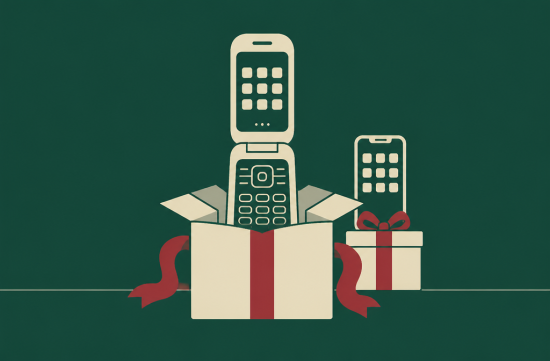
Once Thanksgiving is over, there's something that begins right away: the Christmas wishlist season for kids. And these days, the item that consistently tops that list is a smartphone.
You may have heard the phrase, "I'm the only one in class without a phone." The impact of that statement is truly explosive, and it's understandable why parents feel pressured.
So today, let's look at the data instead of just feelings. At what age are kids actually receiving smartphones, and what does research say?
First, let's check the reality. The Pew Research Center surveyed 3,054 parents with children under 12 last May. Among children under 12, the percentage who own a smartphone is 23%.
Breaking it down by age, the numbers change significantly. For ages 8-10, it's 29%, and for ages 11-12, about 6 out of 10 already have their own phones.
Even among 5-7 year-olds, 12% reportedly have smartphones, which honestly surprised me. This generation is learning to unlock screens before they learn to tie their shoelaces.
So, the statement "I'm the only one in class without a phone" isn't entirely false for 11-12 year-olds. It's true that a majority already have one.
However, here's the twist. A study published last December in the journal Pediatrics gained quite a bit of attention. It analyzed data from over 10,000 participants in the Adolescent Brain Cognitive Development (ABCD) study.
Children who had smartphones at age 12 were 1.31 times more likely to experience depression, 1.40 times more likely to be obese, and 1.62 times more likely to suffer from sleep deprivation compared to those who did not have smartphones.
What's even more striking is the relationship with age. The earlier a child receives a phone, the higher the risk of obesity and sleep deprivation tends to be.
They also compared children who did not have a phone at age 12 but received one within the following year. Those who continued to be without a phone showed better mental health symptoms and sleep quality a year later.
Of course, there are points to consider fairly. Dr. Ran Barzilay from the Children's Hospital of Philadelphia, who led the study, clearly stated that this shows correlation, not causation.
We can't definitively say whether phones are the cause or if families that tend to give phones early have pre-existing tendencies. However, the consistent direction of the findings is hard to ignore.
What do parents think? In the same Pew survey, a majority of parents responded that children should be at least 12 years old to have a smartphone.
Interestingly, there's a gap between this belief and actual behavior. While they think 12 years is the right age, more than half of 11-12 year-olds already have phones. Everyone seems to think, "My child is the exception."
For those living in Texas, it's important to be aware of changes in schools. Due to HB 1481, signed by the governor last June, Texas public schools prohibit the use of personal devices during school hours for all grades K-12.
This includes not just smartphones but also smartwatches, tablets, and flip phones. Exceptions are made for students with medical needs or special education support, as well as devices provided by the school.
Devices can be used before and after school, and specific regulations may vary by district, so it's a good idea to check your school's policy. Ultimately, since phones can't be used at school, the real stage for them is after school and at home.
Personally, I think this law is a reasonable regulation. While I oppose the government intruding into homes, it's reasonable for schools to set boundaries to maintain focus during class.
So, what should you give for Christmas? A popular approach these days is a phased approach. The Wait Until 8th pledge, which started in Austin, Texas, encourages delaying smartphone ownership until at least 8th grade, allowing basic phones that only make calls and texts.
So, if the purpose is communication, a basic phone or a calling kids' watch is sufficient. You don't need TikTok just to contact someone at pickup time.
If it were up to me, I would do this: for elementary school kids, a watch or basic phone, and if they show responsibility in managing their time when they enter middle school, then upgrade to a smartphone.
If you're going to give a smartphone, it's crucial to set rules before unboxing it. No phones in the bedroom, charging in the living room at night, that sort of thing.
Even just enabling basic features like iPhone Screen Time or Google Family Link can help manage app installations and usage time effectively. These are free features, and not using them would be a missed opportunity.
Also, I recommend discussing this with other parents. If only our family holds out, there may be concerns about bullying, but if several families in the class delay, the phrase "I'm the only one without a phone" loses its power.
In conclusion, there is no definitive answer for the right age, but the data suggests "a little later." Personally, I would advise against giving a fully-featured smartphone before age 12.
A phone is a gift, but it also comes with significant responsibility. Whatever you place under the tree, wrapping it with rules for use is the real gift of Christmas, isn't it?
 RapidPeak83








 rissa |

 Gomo Nim |

 lattepop |

 Well Done Sir |

 butter 90 |

 Giant Squid and Sweet Potato Soup |


 Texas Migration Story |

 American Blog Forge |

 ultron78 |
 donggul donggul |
 korvix |
 Noodle Zin |
 Forever Tiger Teacher |
 strongman |
 U.S. Military Recruitment Information |
 |
 cherry cherry |
 Star Way |
 Pleasant K |
 Spaghetti Flying Religion |
 Texas Migration Story |
 Forever Coco is Bangga |
 nougat |
 coloradoman |
 Village Man |
 endone |
 Live and that's it |
 what gives |
 willow woo |