
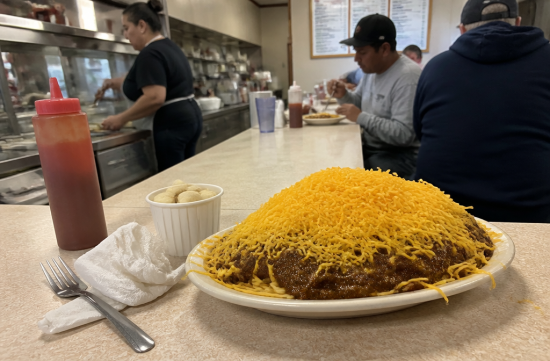
When I first walked into the chili parlor and saw the menu, I was honestly a bit taken aback. They pour chili over spaghetti and pile on cheddar cheese like a mountain.
When we think of chili in Korea, we imagine a thick stew with beans and meat. I remember taking a spoonful, expecting Texas-style chili, and being puzzled by the cinnamon aroma that filled my mouth.
However, this unfamiliar dish has now become a representative flavor of this city. Today, I want to carefully outline its origins.
The story goes back to October 24, 1922. Immigrant brothers Tom and John Kiradjieff, who came from the Macedonia region, opened a small shop on Vine Street in downtown.
The shop was named Empress. It was said to be named after the Empress Burlesque Theater located in the same building.
The brothers didn't initially intend to sell spaghetti dishes. They started by selling chili hot dogs, known as coneys, topped with their hometown-style meat sauce.
The sauce is the key. It wasn't just chili powder; it included spices like cinnamon, cloves, and allspice, giving it a flavor close to a Mediterranean meat stew.
Food researchers often compare this sauce to tomato meat sauces from Greece or the Balkans. Although it has an American name, chili, its roots lie in the immigrant kitchen.
There's an interesting point here. Even today, the nationality and hometown of the brothers are described differently in various records.
Some records refer to them as Bulgarian, while others introduce them as coming from a village in northwestern Greece. This confusion arises from a region where borders have changed multiple times, and such cases are quite common when studying immigration history.
So when did spaghetti come into the picture? As the practice of pouring hot dog sauce over noodles became established among customers, it solidified into a complete ordering system.
That's the way system. Let me break it down for newcomers.
If you just add chili to spaghetti, that's a two-way. If you add finely grated cheddar cheese, it becomes a three-way, which is the most popular basic menu item.
If you add either onions or beans to the three-way, it becomes a four-way. If you add both, it's a five-way.
Each shop has slightly different naming conventions. Still, as long as you understand that the larger the number, the more toppings there are, you can order anywhere.
For a while, Empress was the largest chili chain in this city. However, in 1949, Nicholas Lambrinides, a Greek immigrant who worked at Empress, broke away to open his own shop.
That shop is now the most famous Skyline Chili. It was named after the skyline of the city viewed from the hills.
In 1965, the Daoud brothers from Jordan established Gold Star Chili. They originally took over a hamburger shop but shifted their focus to chili.
Perhaps that's why it's not uncommon to see the signs for Skyline and Gold Star close together in this area. Asking which one is better is a topic that should be approached with as much caution as discussing politics here.
In summary, an interesting picture emerges. The Macedonian brothers planted the seeds, and Greek and Jordanian immigrants nurtured those seeds into chains.
When we talk about regional food in America, we often think of long-standing native traditions. However, this chili is a dish that has been thoroughly created and refined by immigrants competing with each other.
The Kiradjieff family, who led Empress, passed the shop on to someone else in 2009. And in 2022, this chili celebrated its 100th anniversary.
Of course, opinions on it are quite divided. Some friends from other regions firmly say that this is not chili but rather cinnamon-flavored meat sauce.
I don't think that's entirely wrong. If you use Texas-style chili as the standard, it certainly is a strange dish.
However, if you change the standard, the story changes. This is less a variation of chili and more a new dish born from the meeting of Balkan meat sauce and American hot dog culture.
I find this aspect quite appealing. They preserved the taste of their hometown in a foreign land while adapting it into a name and form that local people could accept.
This process is remarkably similar to how Korean immigrants have introduced Korean barbecue or kimchi tacos to American tastes. The brothers from 100 years ago probably faced similar dilemmas.
If you're trying it for the first time, I recommend starting with the three-way. It's good to know that cutting it sideways with a knife, rather than rolling it up with a fork, is the local way to eat it.
And try it with small oyster-shaped crackers and hot sauce. If you think of it as a bowl containing 100 years of immigration history, the cinnamon aroma will feel quite different.
 GreatTown



 Mr Cleveland |

 content |

 peace |










 aloeverame |

 some fame |

 Yo Lock Me Up |

 moodansa 77 |
 Conflite Teacher |
 kimchi warrior |
 Angeles Choi |
 nutnew |
 ringwinds |
 happy 9 |
 United States National Administrative Organization Stories |
 upbeat |
 silents |
 Korean American National Foundation Promotion Blog |
 PETRO Vatican Shrine |
 American Food Information & Calories |
 Sammy Beach |
 monalisa blog |
 Pronunciation Yo |
 Softy |
 rigid |
 Website Design Artisan |
 Raccoon Ramen Night |
 Folding Instructions |
 hulu 1978 |