
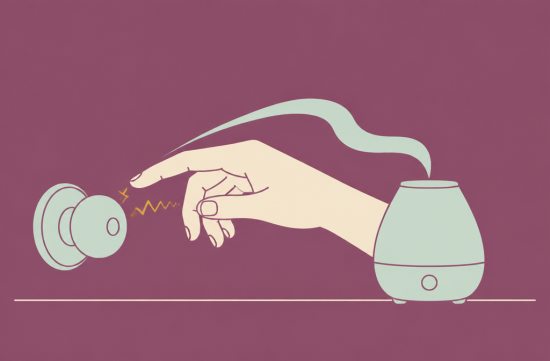
These days, I hesitate before grabbing the doorknob every morning. Just yesterday, while taking off my sweater, my hair stood on end, and I laughed at myself in the mirror.
When I close the car door, I feel a jolt; petting my cat gives me a shock. At this point, it's a clear sign that winter has arrived.
This week, I decided to figure out why I experience static electricity so often and what I can change at home to reduce it. The principle turned out to be simpler than I expected.
The key is the moisture in the air. Humid air allows the electric charge built up in our bodies to dissipate gradually, but when the air is dry, that charge remains on our skin. In other words, our bodies act like small batteries as we go about our day.
When our hands get close to a metal object like a doorknob, the charge discharges all at once. That's the jolt we feel, and since our fingertips are the first to touch, they tend to hurt the most.
This is especially severe in winter because cold air holds less moisture than warm air.
Plus, when you turn on the heater, the indoor air becomes even drier. With the outside being dry and the inside even drier, it creates the perfect environment for static electricity.
Friction adds to the problem. Walking on carpet with thick socks or layering sweaters and coats causes static to build up. Essentially, your winter wardrobe becomes a static electricity factory, which is a bit unfair for those who love fashion.
So, there are two main solutions: make the air more humid or reduce the buildup of static.
The first solution is, of course, a humidifier. The U.S. Environmental Protection Agency (EPA) recommends indoor humidity levels between 30-50%, so I used that range as my guideline.
When I placed a small hygrometer from the store in my living room, I was surprised to find that the humidity was much lower than I expected. I realized I couldn't just rely on my instincts.
However, simply cranking up the humidity isn't the answer either. If humidity exceeds 60%, issues like mold or condensation can arise.
If you use a humidifier, you also need to manage the water tank. Don't let water sit for too long, change it frequently, and clean it regularly to avoid buildup.
If you don't have a humidifier, you can dry laundry indoors or simmer a pot of water on low heat. Bringing in a few houseplants can also help. I started by leaving the bathroom door open after showering.
The second solution is laundry. In fact, a significant amount of static electricity generated from sweaters occurs in the dryer.
Using two or three wool dryer balls helps reduce tangling and friction between clothes. I switched to this method because I find dryer sheet scents a bit overwhelming, and I'm satisfied with the results. Plus, they can be reused multiple times, which I appreciate.
If you don't have dryer balls, you can toss in a slightly damp towel about 5-10 minutes before the drying cycle ends. Just make sure it's not dripping wet.
And don't over-dry your clothes. Taking them out when they're just dry or slightly damp can significantly reduce static. This also helps preserve the fabric, extending the life of your sweaters.
Separating fabrics by material can also be quite effective. The more different types of fabrics are mixed together, the more static electricity builds up.
The third solution is your body. Applying body lotion before getting dressed can help reduce the buildup of charge on your skin.
This is something you should do as part of your beauty routine anyway, so there's no downside. In winter, I apply a slightly richer cream generously on my hands and arms instead of a lightweight formula.
If you keep getting shocked from your sofa or chair, you can rub the surface with a dryer sheet. It can also be used on car door handles.
Lastly, my favorite tip is to use a key. Instead of grabbing the doorknob with bare hands, touch the metal first with a key or the edge of a coin.
This way, the charge built up in your body discharges through the metal, reducing the shock significantly. At first, it seemed a bit silly, but I noticed a real difference when I tried it.
Touching metal frequently to discharge a little at a time is also a good strategy. It's better to have several small discharges than one big shock. I've made it a habit to tap the metal shelf next to the entrance with my key when I come home.
To summarize: keep humidity between 30-50%, use dryer balls in the dryer, apply lotion before dressing, and touch the doorknob with a key first.
The static shock from petting my cat is the same principle. After raising the humidity in our home, my cat seems to flinch less when my hand approaches, which makes me feel a bit proud.
Static electricity is more annoying than dangerous. However, that little annoyance can accumulate and really dampen the winter mood.
If I had to choose just one thing, I would buy a hygrometer first. Seeing the numbers visually made it clear what I needed to do. It's much easier than guessing when to turn the humidifier on and off.
This winter, I hope to feel only the soft texture of my sweaters instead of those shocks. Stay cozy and warm, everyone.
 WildHorse



 creamcat |

 kiwifox |

 mochibear |



 honeypot |








 Mr. Midwest America |

 orvella |

 donggul donggul |

 Mr. Largo |

 Silent Sea |
 Iri Jori Missouri |
 road98 |
 American Airlines Mileage |
 Whoever It Is, I Don't Know |
 meloncat |
 kimchi warrior |
 Angeles Choi |
 nutnew |
 ringwinds |
 happy 9 |
 United States National Administrative Organization Stories |
 upbeat |
 silents |
 Korean American National Foundation Promotion Blog |
 PETRO Vatican Shrine |
 American Food Information & Calories |
 Sammy Beach |
 monalisa blog |
 Pronunciation Yo |
 Softy |