
Last week, while having lunch with a coworker, we started talking about endoscopies. I mentioned that I get one every two years, and my American colleague was surprised by how often I do that.
For Koreans, getting an endoscopy is almost an annual event. This indicates how close stomach cancer is to us.
So today, I want to start by looking at the numbers, and then realistically discuss kimchi and fermented fish.
There is a study analyzing California cancer registry data from 1988 to 2012. It found that the stomach cancer incidence rate among Koreans was five times higher than that of non-Hispanic whites and twice that of Japanese Americans.
Honestly, I was a bit shocked when I first saw these numbers. We live in the same neighborhood and shop at the same grocery store, yet there is such a difference.
Interestingly, the incidence rate for Korean men living in the U.S. was about one-third lower than that of men living in Korea. This suggests that factors other than genetics, such as environment and diet, play a role.
First, let's clarify something. The American Cancer Society (ACS) identifies Helicobacter pylori infection as a major cause of stomach cancer.
Smoking is also significant. According to ACS data, smokers have nearly double the risk of developing stomach cancer.
So, we can't just blame salt. However, salt is one of the few factors we can directly control at our dining table.
The World Cancer Research Fund (WCRF) has summarized strong evidence that salted fish, meat, and vegetables are causes of stomach cancer. They also noted that salty foods could contribute to Helicobacter infection.
However, much of this evidence comes from studies in Korea and Japan. This is not just someone else's problem.
When looking specifically at kimchi, the results are not straightforward. Some Korean studies have identified kimchi as a risk factor, but a 2021 Korean study found inconsistent results regarding kimchi and concluded that sodium intake from noodles and dumplings should be reduced instead.
In my opinion, rather than cutting out kimchi, we should focus on managing our total daily salt intake.
Let's look at the guidelines. The FDA recommends a daily sodium intake of less than 2,300mg, while the average American consumes about 3,400mg.
In Korea, the average for 2023 was 3,136mg, and for men, it was 3,696mg. When eating soup, stews, and kimchi together, exceeding the guideline is not difficult.
A Korean consumer organization tested 15 packaged napa cabbage kimchi products and found that the average sodium content was 569.58mg per 100g. The sodium content varied from 467mg to 692mg, showing a 1.5-fold difference.
This means that even with the same kimchi, changing brands can lead to significant differences. This is useful information.
According to a review paper from Korea, kimchi accounts for about 20% of sodium intake among Koreans. Conversely, this means that most sodium comes from other foods, so there's no reason to solely focus on kimchi.
So, what can we realistically do? Let me share what I actually do at home.
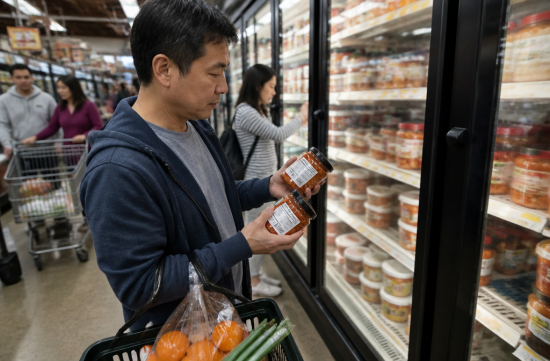
First, when buying kimchi, I check the Nutrition Facts label on the back. Serving sizes vary by product, so it's important to compare them based on the same amount.
Second, I serve kimchi on a side dish plate. If I take it out whole, I tend to grab much more than I need.
Third, I don't drink the kimchi juice or the broth from ramen or noodle soup. The previous study pointed out noodles specifically, likely due to the broth.
Fourth, if I make kimchi at home, I try to gradually reduce the amount of fermented fish and salt instead of cutting them out all at once. The sodium in kimchi mainly comes from salt and fermented fish, while napa cabbage and vegetables provide potassium.
Fifth, I found that reducing the frequency of eating fermented fish as a side dish has been the most effective. Even a small amount of fermented fish can make a dish taste very salty.
Sixth, when dining out, I focus on the solid ingredients in stews or soups and only refill side dishes once. At first, it felt a bit disappointing, but after a few weeks, I adjusted my taste quite well.
Additionally, ACS suggests that consuming fresh fruits, especially citrus fruits, may lower the risk of stomach cancer. So, we can try replacing one salty side dish with a piece of fruit at the table.
The frequency of Helicobacter testing or endoscopies varies based on family history, age, and symptoms. Please consult your doctor or pharmacist about this.
Not everyone with risk factors will develop the disease, and conversely, it can occur even without risk factors, according to the National Cancer Institute (NCI). Therefore, managing dietary habits and regular check-ups should go hand in hand.
In summary, rather than blaming just kimchi, we should look at our overall sodium intake and broth habits.
If it were me, I would start by reducing the size of my kimchi serving tonight. A small habit can last longer than a grand resolution.
 reator1977







 U.S. Weather Bureau News |

 MEDBIO American Doctor Blog |

 Forever Tiger Teacher |

 humpday sonata |

 Piano Teacher Blog |















 Sammy Beach |

 molten |

 Joyce 77 |

 zestorbit |

 hihihi |
 Iri Jori Missouri |
 road98 |
 American Airlines Mileage |
 Whoever It Is, I Don't Know |
 meloncat |
 kimchi warrior |
 Angeles Choi |
 nutnew |
 ringwinds |
 happy 9 |
 United States National Administrative Organization Stories |
 upbeat |
 silents |
 Korean American National Foundation Promotion Blog |
 PETRO Vatican Shrine |
 American Food Information & Calories |
 monalisa blog |
 Pronunciation Yo |
 Softy |