
The morning after Thanksgiving, while brewing coffee with a leftover slice of pie, I opened the gas bill I retrieved from the mailbox. As soon as I saw the numbers, the apple crumble flavor felt a bit less sweet.
It turns out there was a reason for that. The Michigan Public Service Commission (MPSC) approved a gas rate increase for Consumers Energy on October 15.
The approved amount is $139.2 million annually. The company initially requested $240 million, so the commission made quite a significant cut.
So how much will it add to my bill? According to MPSC, a typical household using 75 ccf per month will see an increase of $3.92, which is a 4.33% rise.
The new rates took effect on November 1. This means the impact will start to be felt from the current bill. Since this is the month when heating is used more heavily, the increase will likely feel even more pronounced.
At $3.92, it's not even the cost of a latte, I thought, but then I remembered last year. In September, a gas rate increase was approved, resulting in a $6.44 rise for the same 75 ccf usage.
That increase also took effect on November 1. So, for two consecutive years, rates have gone up right at the start of winter. Individually, these amounts seem small, but they add up, making them hard to ignore.
But what really surprised me was what came next. Just a few days after the approval news, Consumers Energy announced another upcoming gas rate increase.
In Michigan, utility companies must give at least 60 days' notice before formally applying for a rate increase. This was that notice.
The state Attorney General's office expects a formal application to come in December. The amount they will request has not yet been disclosed. Once the figures are available, I plan to review them again.
The company explains that the costs are due to investments in pipeline replacements and safety. I believe it's necessary to upgrade aging pipes, as losing gas in winter would be a serious issue.
However, the pace of annual increases is honestly a bit overwhelming. The Attorney General's office likely intervenes each time to negotiate lower amounts for that reason.
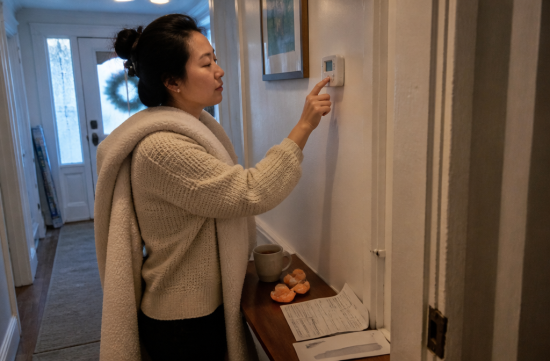
Anyway, since I can't control the rates, I decided to focus on what I can manage. The first thing I tackled was the thermostat.
According to the U.S. Department of Energy (DOE), lowering the temperature by 7 to 10 degrees Fahrenheit for 8 hours a day can save up to 10% on heating and cooling costs annually.
It's easiest to lower the temperature when sleeping or when leaving the house. If you have a programmable thermostat, you just need to set it once. If not, manually adjusting it before bed is a good start.
However, homes using heat pumps are a different story. The DOE warns that drastically lowering and raising the temperature can make heat pumps operate inefficiently.
I often work from home during the day, so instead, I wear a thick sweater and wrap myself in a blanket. Sipping warm tea and peeling a few tangerines makes it surprisingly bearable.
The second tip is to check for assistance programs. Consumers Energy has a Winter Protection Plan that prevents shutoffs from November 1 to March 31.
Customers aged 65 and older can apply, as well as households that meet income criteria. Low-income households are those earning below 150% of the federal poverty line and receiving assistance like SNAP or Medicaid.
Low-income households must provide proof of income and show they have applied for state or federal heating assistance. Specific conditions may change each year, so be sure to check the company's website or MPSC guidance.
If your parents are elderly, it might be worth looking into this for them. Many people overlook the English notices. A quick phone call can clarify eligibility, so it's not as difficult as it seems.
The third tip is to seal small gaps. Weatherstripping for windows or door sweeps can be purchased at local hardware stores for just a few dollars.
If cold air seeps in under the front door, no amount of heating will keep your feet warm. Sealing those gaps can significantly improve the perceived temperature. Closing thick curtains at night also helps more than you might think.
Lastly, make it a habit to open your bill. If you only set up automatic payments, you might not notice how much your usage has increased.
I started keeping track of the ccf numbers from last month and this month. Seeing the numbers makes me less likely to adjust the thermostat unnecessarily.
I'll also be watching for the new rate increase application coming in December. The MPSC holds public hearings and allows for comments, so those interested can share their thoughts once the case number is released.
If it were me, I'd start by setting the thermostat and checking my parents' eligibility for the Winter Protection Plan. Starting with no-cost options is the best way to save money.
Outside, it's already gray, but thanks to the scent of tangerine peels, the inside of my home feels a bit fresher. I hope everyone has a warm winter with less frightening bills.
 bluecitydreamer2024


 zestorbit |


 oneonly |

 icingflare |

 mygoddess blog |








 Scade Studio |

 Nevada Vegas UNLV |

 Things to know |
 West Kong |

 havero70 |
 Cool Beach Freeway |
 biscuitz |
 John Denver |
 Iri Jori Missouri |
 road98 |
 American Airlines Mileage |
 Whoever It Is, I Don't Know |
 meloncat |
 kimchi warrior |
 Angeles Choi |
 nutnew |
 ringwinds |
 happy 9 |
 United States National Administrative Organization Stories |
 upbeat |
 silents |
 Korean American National Foundation Promotion Blog |
 PETRO Vatican Shrine |
 American Food Information & Calories |
 Sammy Beach |