
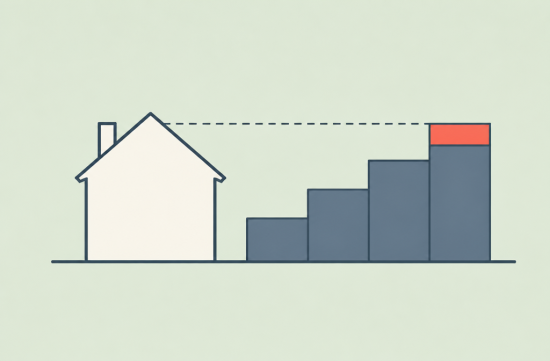
When talking to people looking to sell their homes in Bellevue, there's a common question that comes up. They ask if the 3% tax applies to the entire home price when it exceeds $3 million.
To put it simply, no. The Real Estate Excise Tax (REET) in Washington State is calculated on a progressive scale, so the 3% only applies to the amount that exceeds the highest bracket.
REET stands for Real Estate Excise Tax, which is essentially a transaction tax applied to the sale price when selling a home. According to King County, this tax is typically paid by the seller.
It's also important to remember that this tax is completely different from the income tax on capital gains. It is calculated based on the sale price, regardless of whether there was a profit or a loss.
According to the Washington State Department of Revenue (DOR), the state tax rates applicable from January 1, 2023, to December 31, 2026, are divided into four brackets.
Up to $525,000, the rate is 1.1%. From $525,000 to $1,525,000, the rate is 1.28%.
From $1,525,000 to $3,025,000, the rate is 2.75%. And only the portion exceeding $3,025,000 is taxed at 3%.
If the terminology is unfamiliar, think of it like stairs. The first step is taxed at 1.1%, the next step at 1.28%, and so on, calculating each segment separately and adding them together.
Additionally, there is a local REET that applies. According to the DOR's 2026 local tax rate table, Bellevue has a rate of 0.5%, which applies to the entire sale price without brackets.
Now, let's run some actual numbers. Let's assume you sell a home in Bellevue for $2 million in 2026.
For the first bracket of $525,000, multiplying by 1.1% gives you $5,775. For the next $1 million, multiplying by 1.28% results in $12,800.
The remaining $475,000 falls into the 2.75% bracket, which amounts to $13,062.50. The total state portion comes to $31,637.50.
The local portion is 0.5% of $2 million, which is $10,000. Combined, that totals $41,637.50, resulting in an effective tax rate of about 2.08% based on the sale price.
When calculating the seller's net profit, if you overlook this amount of around $40,000, your expectations can be quite off. That's why I always extract this number separately when running a selling simulation.
This time, let's consider a $3.5 million home. The amounts for the 1.1% and 1.28% brackets remain the same at $5,775 and $12,800, respectively.
The 2.75% bracket includes the entire $1.5 million, resulting in $41,250. For the $475,000 exceeding $3,025,000, multiplying by 3% gives you $14,250.
The total state portion is $74,075, and adding the local portion of $17,500 brings the total to $91,575. I was a bit surprised when I first calculated it, as it exceeded $90,000.
However, compared to the $122,500 calculated by multiplying the entire sale price by 3.5%, there's a difference of over $30,000. This means there's no need to panic just because you hear about the 3% bracket.
One more thing to note is that, according to the DOR, the threshold for these brackets is adjusted every four years, with the new thresholds applying to sales from January 1, 2027.
According to the DOR page, the first bracket will rise to $551,000 in 2027. By law, the other brackets will also increase by the same amount as the first bracket.
Following that rule, the 2027 thresholds will be $1,551,000 and $3,051,000. The tax rates themselves will remain at 1.1%, 1.28%, 2.75%, and 3%.
If we recalculate for a $2 million listing, the state portion in 2027 will be $31,208.50, which is $429 less than in 2026.
In simple terms, waiting until the new year won't save you much. I believe the risk of missing the market timing by delaying the closing date for a few hundred dollars is greater.
Now, let's go through the things to check before selling in order. First, see which bracket your expected sale price falls into.
Next, check whether the closing is in 2026 or 2027 to determine which rate table to use.
Then, ensure that the local Bellevue rate of 0.5% has been added separately. Finally, compare the REET amount on the escrow company's settlement statement draft with your calculations.
If the transaction involves exemptions or special cases like inheritance, divorce, or corporate share transfers, the conditions can become complex. In such cases, be sure to check with the DOR REET page or consult escrow and tax professionals.
The tax rates and thresholds in this article are based on information from the Washington State DOR and King County as of November 2026.
If I were the seller, I would likely calculate the REET by bracket in advance when setting the listing price to include it in my net profit calculations. Knowing the numbers before entering negotiations makes me feel much more comfortable.
 ChaChaCha404





 summita |

 Always Dreaming of Big Success |

 element |

 French Macarons |

 kimchi warrior |










 Raccoon Ramen Night |

 ovelion |

 Something is popping in the situation |

 lumix88 |

 quiet river |
 Angeles Choi |
 nutnew |
 ringwinds |
 happy 9 |
 United States National Administrative Organization Stories |
 upbeat |
 silents |
 Korean American National Foundation Promotion Blog |
 PETRO Vatican Shrine |
 American Food Information & Calories |
 Sammy Beach |
 monalisa blog |
 Pronunciation Yo |
 Softy |
 rigid |
 Website Design Artisan |
 Folding Instructions |
 hulu 1978 |