

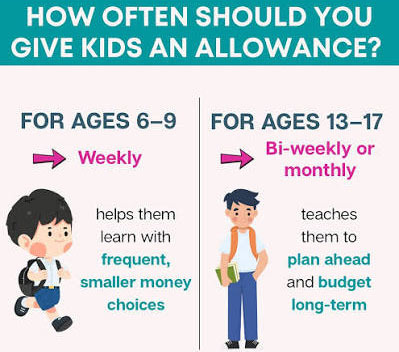
My child suddenly asked, "My friend gets an allowance every week, so why don't I?" I was momentarily taken aback.
Honestly, I've been pondering this issue for months.
Should I just give a set amount every week, or should it depend on completing chores like washing dishes or folding laundry?
First, let's see how much parents in the U.S. are giving these days.
A survey released by Wells Fargo in July 2025 is frequently cited.
Ipsos conducted an online survey of 1,587 parents with children aged 5 to 17, and 71% of them reported giving their kids an allowance.
The average weekly allowance was $37.
Honestly, I was a bit surprised by this number; it's nothing compared to what I received as a child.
Of course, since it's an average, families that give more could be skewing the number higher.
I don't think we need to match our allowance to this figure.
In the same survey, 85% of parents said that giving an allowance helps kids learn how to manage money.
However, 65% found it difficult to let their kids make financial mistakes on their own.
The methods of giving were also interesting. Among parents who give weekly allowances, 73% still use cash.
As of 2017, 83% of parents who give allowances believed that kids should earn their allowance through chores.
Most definitely lean towards the idea of "you get what you earn."
The reason is simple. They want to teach kids early that money is earned through effort. That's how it is in the real world.
I understand the desire to teach them that there's no such thing as free money.
However, there are also strong opposing views. Some argue that allowances and chores should be separated.
Chores are something family members do as a matter of course, while allowances are an educational tool for learning money management.
If you tie the two together, one day a child might say, "I don't need money, so I won't clean up."
I think my kids would do the same, haha, since their basic needs are met.
Lieber suggests adjusting privileges like TV time instead of money when chores aren't done.
Parents don't cook dinner just to get paid, right?
It's something we do as a family. I want to instill this sense in my child as well.
When I go to the store, I let my child choose snacks with their own money.
Seeing them compare prices and think it through makes me realize this is real-life education.
Ultimately, the answer varies from family to family.
However, if it were up to me, I would go for a hybrid approach: a basic allowance without conditions, and additional rewards for extra chores.
 ChiliDesert






 UNI Lover |


 What can make money? |

 Runner Kim |














 korando9 |

 Augusta 90 |

 Pointy |

 rissa |

 Gomo Nim |
 American Food Information & Calories |
 Sammy Beach |
 monalisa blog |
 Pronunciation Yo |
 Softy |
 rigid |
 Website Design Artisan |
 Raccoon Ramen Night |
 Folding Instructions |
 hulu 1978 |
 average life |
 Casa Mia |
 aaoaa |
 Mr. Midwest America |
 Taek Jun |
 molten |
 Kondae Garusong Blog |
 micos |
 Living Economy Information Blog |
 vintage |