

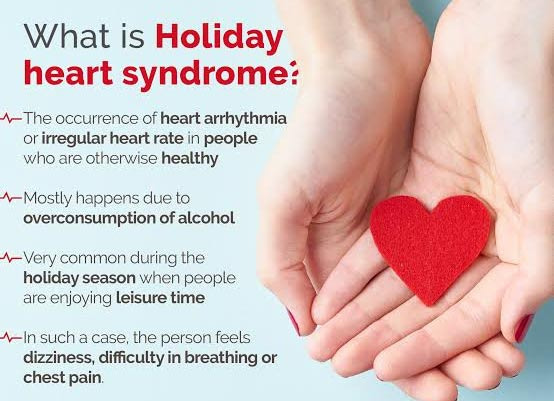
A friend of mine was surprised when his heart started racing after mixing wine and whiskey late at night.
Fortunately, it calmed down by morning, but there's a specific name for this situation.
It's called Holiday Heart Syndrome.
This describes the phenomenon where someone without a history of heart disease suddenly experiences an irregular heart rhythm after drinking heavily.
Why is it called Holiday?
It's a nickname that arose because the number of cases tends to increase during festive seasons when people gather to drink.
The most common occurrence during this time is atrial fibrillation (AFib).
This refers to the upper chambers of the heart not beating regularly and fluttering instead.
Symptoms include a pounding or fluttering sensation in the chest, tightness, dizziness, shortness of breath even at rest, and unexplained fatigue.
Interestingly, some people may experience no symptoms at all.
So, how much is considered excessive drinking?
According to the CDC, binge drinking is defined as consuming 5 or more drinks for men and 4 or more drinks for women in one sitting.
The NIAAA explains that this pattern typically leads to a blood alcohol concentration of 0.08% within about 2 hours.
Honestly, at a party, it's easy to exceed 5 ounces in a wine glass quickly.
If you're not paying attention, you can easily drink 5 glasses in no time.
The cause is attributed to alcohol increasing urine output, which depletes electrolytes in the body.
When combined with salty foods, lack of sleep, and holiday stress, it can be a pretty exhausting season for the heart.
The good news is that most cases of atrial fibrillation that arise in this way resolve on their own within 24 hours.
However, that doesn't mean you should just wait it out.
Many hospitals warn that if atrial fibrillation persists without treatment, the risk of stroke or heart failure increases.
If it lasts more than an hour or is very uncomfortable, you should go to the emergency room or urgent care.
If you experience severe chest pain, significant shortness of breath, or feel faint, don't wait—call 911 immediately.
The American Heart Association (AHA) also issued a warning about this syndrome last December, emphasizing the link between alcohol and atrial fibrillation and advising those who don't drink to avoid starting.
So, what should you do for the remaining holiday gatherings?
The solution is simple.
Make sure to drink a glass of water for every alcoholic drink.
Avoid drinking on an empty stomach, and try to steer clear of mixing wine with hard liquor.
Opt for vegetables or fruits instead of salty snacks.
Setting a limit on the number of drinks beforehand can also be surprisingly effective.
And make sure to get plenty of sleep the next day.
This year, I plan to resist staying up all night for Black Friday shopping.
This year's parties will be enjoyed slowly, with plenty of water in between.
 SbuxPaik


 Korean Blog |

 Fong Mr |


 Coastal city |








 molten |
 Joyce 77 |
 zestorbit |

 hihihi |
 fruitflash |
 American Food Information & Calories |
 Sammy Beach |
 monalisa blog |
 Pronunciation Yo |
 Softy |
 rigid |
 Website Design Artisan |
 Raccoon Ramen Night |
 Folding Instructions |
 hulu 1978 |
 average life |
 Casa Mia |
 aaoaa |
 Mr. Midwest America |
 Taek Jun |
 Kondae Garusong Blog |
 micos |
 Living Economy Information Blog |
 vintage |