

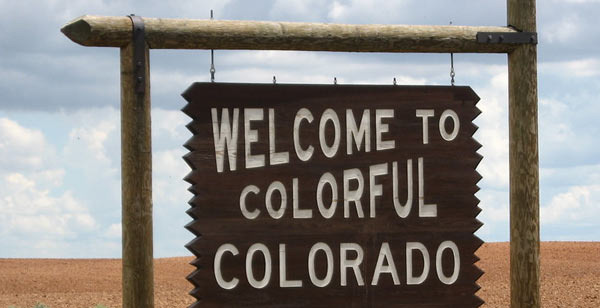
There is a road sign that everyone sees at least once when entering the state of Colorado.
"Welcome to Colorado." Why is Colorado called 'Colorful'?
This phrase is not just a promotional tagline for tourism, but it accurately expresses the essence of the region's nature and culture.
Colorado is related to color from its very name. The word "Colorado" means 'reddish' in Spanish. It was named by Spanish explorers in the late 1500s when they first saw the rivers and canyons of this area, as they observed the red mud flowing in the river. Today, the Colorado River is named for the same reason.
Thus, the true meaning of Colorado is 'land of the red river.' However, as time passed, people realized that the scenery of this region could not be described by red alone. It is a place where the blue of the mountains, the yellow of the desert, the green of the plains, and the orange of the sunset coexist. Therefore, the phrase that symbolizes this state naturally became 'Colorful Colorado.'
The first color representing Colorado is red.
The red canyons and rocks often seen in Western movies are symbols of this region. The 'Red Rocks Amphitheatre' south of Denver is a performance venue created between natural red sandstone cliffs, which amazes during the day with its natural beauty and at night creates a spectacle where the red rocks seem to come alive under the lights. Also, the 'Garden of the Gods' in southwestern Colorado is a feast of red rocks. The red sandstone pillars rise into the sky, and behind them, the snow-capped peak of Pikes Peak stands white; is there a more contrasting color combination?
The second color is white.
Colorado is located in the heart of the Rocky Mountains, and in winter, the entire range is covered in snow. When looking west from Denver, those white peaks are the 'Colorado Rockies.' There are nearly 50 peaks over 14,000 feet (4,000 meters), and snow remains on the summits even in summer. Because of this snow, Colorado is known as the birthplace of skiing in the U.S. Resorts like Aspen, Breckenridge, and Vail are bustling with skiers from around the world every winter. The color white of the snow is not just a part of the landscape; it is also a color that drives the lifestyle, culture, and economy of this state.
The third color is blue.
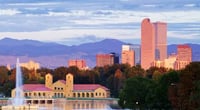
People say that Colorado's sky is particularly blue. Due to the high altitude and clear air, there are many days with almost no clouds. In fact, Denver has over 300 clear days on average per year. Therefore, in Denver, known as the 'Mile High City,' the sky feels closer, and even on sunny days, the air is refreshing. The color of the lakes viewed from the mountains is also astonishing. Bear Lake in Rocky Mountain National Park or Blue Mesa Lake in Mesa Verde National Park has a deep turquoise hue. On windless days, the sky reflects perfectly on the lake, making it look as if clouds are floating on the water.
The fourth color is green.
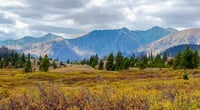
Many people think of Colorado as a barren mountainous area, but surprisingly, its summers are quite green. By June, the alpine meadows are covered in greenery, and wildflowers bloom explosively. In the highlands, wild lavender, Indian paintbrush, and lupines sway in the wind, creating a colorful spectacle. In areas like the outskirts of Denver or Fort Collins, vast cornfields and ranches stretch out, blending the green of the plains with the gray of the mountains. When taking a summer road trip, you can immediately feel that the name 'Colorful Colorado' is not just a coincidence, as the roadsides are covered in grass and flowers.
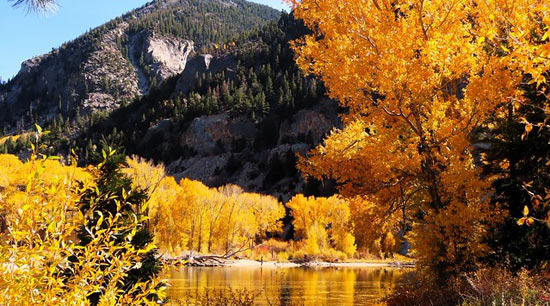
The fifth color is gold.
Autumn in Colorado is breathtakingly beautiful. It is the time when the aspen forests at the foot of the Rocky Mountains turn golden, and when the wind blows, the leaves reflect sunlight and sparkle. This is how the city named 'Aspen' came to be. Known for its gold mines in history, it is now better known for its 'autumn colors.' From late September to early October, all of Colorado turns golden, attracting photographers from around the world to witness this season.
Not only the colors of nature but also geological diversity is an important reason for this nickname. Colorado is one of the states with the most diverse terrain in the U.S. The north has high peaks of the Rocky Mountains, the central part has canyons and valleys, the south has deserts, and the east leads to plains. The Front Range in the east is a boundary where the mountains suddenly rise, soaring from the plains to over 4,000 meters in elevation. Therefore, just a 30-minute drive can take you to a completely different colored world. This extreme color transition is the essence of 'Colorful.'
Another interesting fact is when the expression 'Colorful Colorado' officially took hold. In the 1950s, the state government began a tourism campaign and included this phrase on road signs, which then spread nationwide. At that time, the U.S. was experiencing a boom in automobile travel, and with the opening of highways heading west, Colorado became 'the gateway to the West.'
Over time, this expression has come to symbolize the identity of the state. Colorado's license plates feature a white silhouette of the mountains, and the state flag is adorned with blue, white, red, and golden circles. Each represents the sky, snow, red earth, and the sun. Just by looking at the state flag, one can see how well the word 'Colorful' fits.
The colors of Colorado are not just the colors of nature. They are also the colors of the people, the way of life, and the spirit of this place. In downtown Denver, the latest tech companies are innovating, while in mountain towns, handcrafted and community-centered living continues. The blend of urban and nature, tradition and modernity, Eastern and Western cultures creates a harmony. It is this 'balance within diversity' that truly makes this state 'Colorful.'
And finally, the reason Colorado is 'Colorful' is not just because of the visible landscapes. When you look at the sky here, you can feel the spectrum of light. At dawn, the sky turns a soft pink, in the afternoon it is cobalt blue, in the evening it is a red sunset, and at night, the stars pour down. There are not many places where the colors of the day change so distinctly.




 Your Curiosity Resolved |
 LIZ Legal Information Blog |
 coloradoman |
 Jean Claude Bundang Blog |
  Tonky |
  viroma |
  cookie |
  Live and that's it |
  Alright Twain |
  eatontown blog |
  HAWAII Korean Church News |
  Amore |
  linex |
  Balancework |
  laro90 |
  MEDBIO American Doctor Blog |
  SWAT TEAM BLK |
  DREAM BIG |
  frostbite |
  330 Forever My Love |
  El Dorado |
  dralix58 |
  Gorama Round |
  Skydiving |