
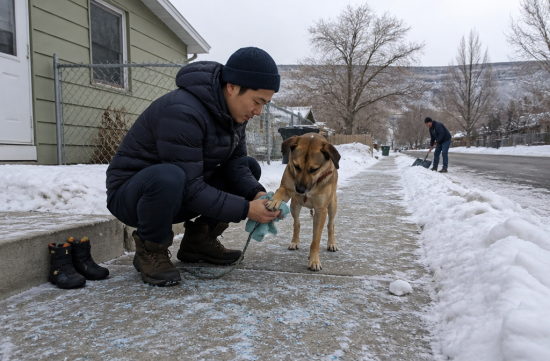
Yesterday morning, I took my dog for a walk, and after just ten steps, he stopped right in his tracks. He lifted one paw and looked at me with a face that clearly said, "Dude, are you serious?"
I realized that Montana's winter is really starting now. So this week, I looked into when I should start reducing our walks based on the temperature.
There are common guidelines cited by various veterinarians and pet media. They reference a scale developed by Tufts University that categorizes dogs' weather responses based on their body types, divided into three main temperature ranges.
The first threshold is 45°F (about 7°C). Above this temperature, most dogs are fine, but below it, small dogs, puppies, and senior dogs with thin fur start to feel the cold.
The second threshold is 32°F, which is the freezing point of water. At this point, many dogs begin to face risks of hypothermia and frostbite, so the common advice is not to keep them outside for too long.
The third threshold is 20°F. Below this temperature, hypothermia and frostbite can set in quickly, so regardless of size, it's advised to keep walks very short.
One pet insurance company provided specific time recommendations. They suggest that small dogs or those with thin fur should not be outside for more than 15 minutes when it's below 20°F, and for medium to large dogs, walks should be kept under 30 minutes when it's between 20°F and 32°F.
However, it's important not to take these numbers as absolute rules. Different sources may have varying thresholds, so I decided to use them as a general guideline for caution.
Additionally, there's another reason not to rely solely on the thermometer. It's the wind.
Anyone living in this area knows that while the temperature might seem manageable, a gust of wind can change the feel entirely.
The National Weather Service often notes that during cold snaps, the wind chill can drop the temperature to between -20°F and -30°F. So, I always check the wind chill before heading out for a walk.
Breed differences also play a significant role. Dogs with double coats, like Huskies or Malamutes, tend to handle the cold better, while short-haired and lean breeds like Chihuahuas or Greyhounds tire much quicker in the same weather.
Being wet is another variable. If a dog rolls around in the snow and gets their belly and leg fur wet, they can cool down much faster, even at the same temperature.
Older dogs, those with joint issues, or sick dogs are also more vulnerable to the cold. It's best to reduce their walks sooner than those of other dogs in the same household.
So when should you head back home? I consider it an early sign of hypothermia when a dog starts to shiver.
If they keep lifting their paws or suddenly try to stick close to a building, that's also a sign that it's time to stop. My dog did just that yesterday when he lifted his paw.
The ASPCA has a much simpler guideline: if it's too cold for you to be outside, it's too cold for your dog. Honestly, that seems like the most accurate thermometer.
Now, let's get into the winter checklist. First is paw care.
Salt and chemicals used for de-icing can irritate or crack their paw pads. After walks, wipe their paws with a damp towel and check to make sure the skin between their toes isn't red. It's also good to wipe off any snow and salt that may have stuck to their belly and legs.
You can put booties on them, but when they first wear them, they often walk like robots, stretching their legs out. It can be fun to watch, so buying a pair just for that is not a bad idea.
Second, choose de-icing products for your driveway that have pet-safe labels. This is also included in the winter safety guidelines from the American Veterinary Medical Association (AVMA).
Third is antifreeze. Common ethylene glycol antifreeze has a sweet taste that dogs may lick, but it's a highly toxic substance.
Make sure to clean up any spills in the garage immediately and store containers out of reach. Some advice suggests that products with propylene glycol are safer alternatives.
If you suspect your dog has ingested something harmful, contact your veterinarian right away. The ASPCA Animal Poison Control number is 888-426-4435.
Fourth, avoid frozen ponds or rivers. If you enjoy walking along river trails, be especially mindful of your leash length. You can never tell how thick the ice is just by looking at it.
Fifth, since the days are shorter, it's a good idea to have a reflective leash or a small light. By the time you get off work, it's already dark.
However, if you completely stop walking, your dog will have pent-up energy at home. On cold days, I take them out for short walks two or three times and fill the rest of the time with indoor nose work games.
Hiding a few treats in a towel can keep them quiet for ten minutes. That ten minutes can be a lifesaver for someone working from home.
In summary, here's my plan: if the wind chill is below 32°F, I'll keep walks short, and if it's below 20°F, I'll just take care of business and head back inside.
Ultimately, the most important factor is my dog's paws. The moment those paws lift, it's the owner's duty to turn around and head home without hesitation, right?
 SaladBase
 OkCafeCat





 donggul donggul |

 Mr. Largo |

 Silent Sea |

 Noodle Noodle |

 figtop |

 tarvion |

 orvella |

 Childbirth Drabble Blog |

 gravity |
 714 Success Era Real Estate |
 Investment Beginner Company Information Encyclopedia |
 musicque |
 The Gelaton |
 ovelion |
 Chicagonian |
 Freedom Yea |
 AZ Road Master |
 glenix39 |
 Something is popping in the situation |
 vella |
 comets |
 Banana |
 Yes Dorian |
 Minnesota Sonata N |
 zentar |
 mykiwi blog |
 shinramen wang |