
These days, it's not even five o'clock yet, and it's already dark outside. When I finish work and look up, it feels like the day is already over, which leaves me a bit empty.
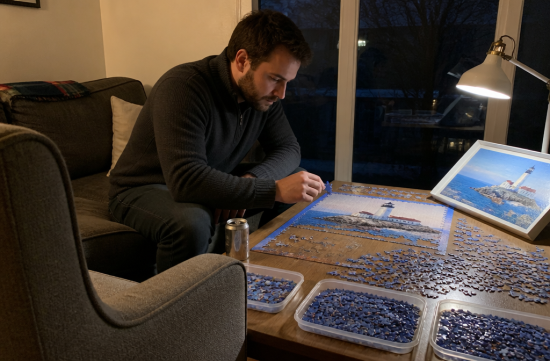
So last week, I bought a 1000-piece puzzle. It's a picture of a lighthouse standing on a calm sea, but as soon as I opened the box, I felt a little regret.
The sky and the sea are almost the same shade of blue. That means more than half of the thousand pieces are just blue.
But strangely, I didn't mind that. I poured all the pieces out on the living room table, opened a can of Coca-Cola Zero, and sat down, and it oddly calmed my mind.
Looking around, I see I'm not the only one doing this. At the local library or café, I often see unfinished puzzles spread out on tables.
Other nearby libraries also hold puzzle swap events quite often. You bring a completed puzzle and exchange it for one someone else has brought, but there's a condition that you can only take one that has no missing pieces.
So why are all these grown-ups getting back into puzzles? After spending a few days working on it, I've come up with a few thoughts.
First, it allows you to step away from the screen for a bit. I work in front of a monitor all day, and if I'm looking at my phone until evening, my head keeps buzzing.
Puzzles don't send notifications. The pieces just sit there quietly, waiting for me to find them.
Second, you can see your progress. Work can take weeks without a clear end in sight, but with a puzzle, just fitting together the edges gives you a definite sense of accomplishment for the day.
Third, it quiets your thoughts. When you're picking out dozens of blue pieces based only on their shapes, there's little room for other worries to creep in.
Fourth, no one knows if you fail. If you try to fit a wrong piece and take it out, that's it, and no one is judging you. That lightness is surprisingly comforting.
Before you know it, an hour has just slipped away. It doesn't feel like time wasted; it feels like it flowed quietly, which isn't a bad feeling.
You often hear that puzzles are good for the brain. Out of curiosity, I looked it up, and I found there are some cautious aspects to consider.
A 2018 study published in the journal Frontiers in Aging Neuroscience featured an experiment by a German research team. They divided 100 cognitively normal adults over 50 into two groups, with one group solving puzzles for over an hour every day for 30 days.
The results showed that their puzzle skills definitely improved. However, there was no significant difference in overall spatial cognitive abilities compared to the group that didn't do puzzles.
Instead, how much they had done puzzles throughout their lives was related to their spatial cognitive abilities. The researchers cautiously concluded that doing puzzles consistently over a long time might be more beneficial than doing them for a short period.
Since it's a correlation, we can't definitively say it's a causation. Honestly, I liked this result even more.
It felt more like a suggestion to keep it as a long-term enjoyable hobby rather than a promise that your brain will get better after a month of intense puzzle-solving. The moment you try to gain something, puzzles become homework.
There are many forecasts that the puzzle market is growing, but the numbers vary too much between research agencies, so I just take it as a reference. However, it caught my attention that the German puzzle company Ravensburger announced that their puzzle, game, and book business has grown in the 2025 fiscal year.
If you're just starting, it's much easier if you prepare a few things. I went through quite a few trial and error in my first round.
Start by sorting out the edge pieces. Just gathering the pieces with flat edges will quickly give you the overall shape.
It's good to separate them into small plates by color. I used the lids of empty food containers, and surprisingly, they worked perfectly.
Lighting is more important than you might think. Under a yellow lamp, it's nearly impossible to distinguish similar shades of blue, so I eventually switched to bright white lights. When I work on it under natural light by the window during the day, it's much easier to differentiate colors, so on weekend afternoons, I intentionally move the table closer to the window.
Also, designate a separate spot for it instead of using the dining table. I almost lost two pieces while putting it away and taking it out every time we ate.
If starting with 1000 pieces feels overwhelming, starting with 500 pieces is also sufficient. You need to have the experience of completing a puzzle to feel motivated to open the next one. If you pack it back into the box halfway through, you won't want to take that puzzle out again.
If doing it alone feels boring, it's nice to do it together. When a friend came over, we quietly took on different sections, and it was fascinating how it didn't feel awkward even without conversation.
Last night, I finally completed the top of the lighthouse. There are still hundreds of blue pieces left for the sea, but strangely, I don't feel rushed at all.
In the past, long winter nights felt just depressing, but this year, it feels a bit different. Long nights allow for these quiet moments to exist.
Tonight, I plan to open another can and look for a few blue pieces. If the evening feels long, I think opening a box of puzzles is a pretty good choice.
 CroquetteYa




 Noodle Noodle |

 figtop |

 Toaster Pizza Magic Show |

 DO Main TODAY |

 Caribbean |

 Glow Yo |
 Silent Sea |

 Amber H |

 oster |

 bearcup |
 MBTI Detective Agency |
 ShyShy dating |
 hihihi |
 kiwifox |
 Masa Masa |
 dewyo |
 summita |
 coconutpath |
 moonlight |
 Dolly |
 Curry Dragon |
 secure |
 tredon |
 Eldorado 88 |
 donggul donggul |
 korvix |
 Noodle Zin |
 Forever Tiger Teacher |
 strongman |